
The Flattery Gambit: How NATO's Survival Hangs on Appeasing a President's Ego
Published
- 3 min read
The Facts: A Summit on Shifting Sands
The upcoming NATO summit in Turkey is not a routine gathering of allies; it is a high-stakes crisis management session. As reported, the core challenge for Secretary-General Mark Rutte remains starkly unchanged from his tenure’s beginning: keeping the United States, the alliance’s keystone, firmly within the fold. This task, once focused on fostering consensus among 32 nations, has been narrowed to a single, Herculean effort—managing the impulses of President Donald Trump.
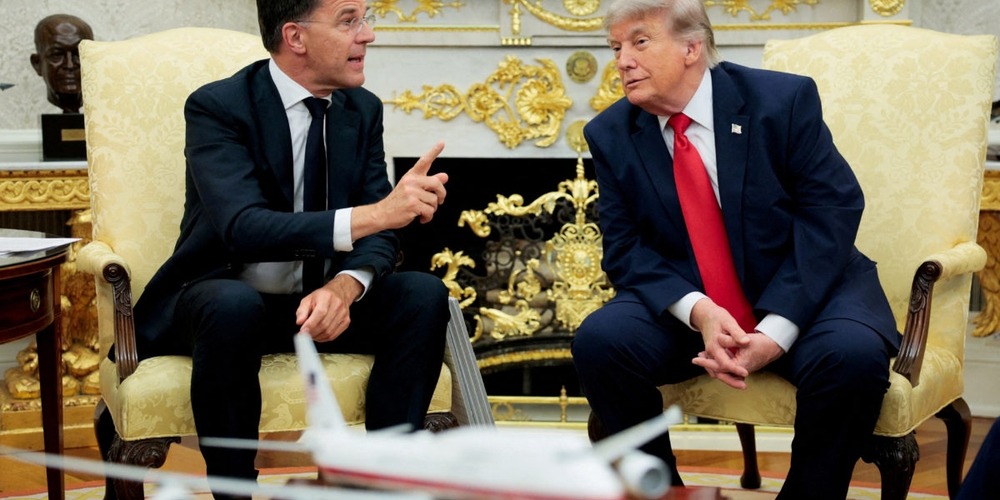
The article details a timeline of moving goalposts. Initially, the pressure point was financial, with President Trump’s long-standing critique that allies were not spending enough on defense. At the 2023 summit, allies made significant pledges to increase spending, seemingly addressing this concern. Yet, the problem persists. Rutte’s recent Oval Office presentation, featuring a chart emblazoned with “The Trump Trillion,” was a theatrical attempt to quantify European and Canadian defense investments since 2017, totaling $1.2 trillion. The goal was to demonstrate tangible results from allied commitments.
President Trump’s response, however, revealed a deeper, more intractable issue. Dismissing the financial argument, he stated, “We don’t need their money — we don’t need anything… I just want loyalty.” This demand shifts the foundation of the alliance from a treaty-based, mutual defense pact to a personal fealty test. The article notes his threat to skip the summit were it not hosted by Turkish President Recep Tayyip Erdogan, another leader he purportedly respects, underscoring the personalization of international commitments.
The Context: An Erosion of Trust and Capability
The historical role of the NATO Secretary-General is to be a consensus-builder and a voice for the collective. Under President Trump, Rutte and his predecessor, Jens Stoltenberg, have been forced into the role of retention specialists. The article catalogues actions that have systematically eroded alliance trust: threats to leave NATO, dalliances with withdrawing U.S. troops from Europe, the bizarre episode over Greenland, and, most dangerously, casting public doubt on the U.S. commitment to defend allies who do not meet spending targets—a direct challenge to Article 5’s sacred guarantee.
This erosion coincides with a period of acute threat. Russia, the alliance’s foundational adversary, is actively probing European defenses. Meanwhile, the Pentagon’s surprise announcement of scaling back promised troop and equipment support for allied defense, coupled with Trump’s conflicting messages on troop levels, has created what the article describes as a “moment of peril.” NATO cannot function without its most powerful member, yet that member’s president is simultaneously questioning its value and reducing its tangible commitments.
The flattery strategy had a previous success. The 2023 summit in The Hague, Rutte’s hometown, concluded with a major spending pledge and a reportedly “happy” President Trump. Rutte’s current argument seeks to build on this, attempting to convince Trump that increased European spending allows America to pivot to China while Europe handles Ukraine. But as Stoltenberg’s memoir recalls, Trump nearly upended a 2018 summit, a stark reminder that the alliance’s credibility hinges on an American president’s mood. Stoltenberg’s warning is chilling: “If an American president says he no longer wishes to defend the other allies and leaves a NATO summit in protest, then the NATO treaty and its security guarantee aren’t worth very much.”
Opinion: A Betrayal of Principle and a Perilous Path
What we are witnessing is not a tough negotiation; it is the slow-motion unraveling of the most successful collective security arrangement in modern history, driven not by strategic necessity but by narcissistic impulse. The spectacle of the NATO Secretary-General, a representative of democratic nations, resorting to props and flattery that would be excessive in a corporate sales meeting is a profound humiliation for the West. It reduces the solemn duty of mutual defense—forged in the ashes of World War II and cemented during the Cold War—to a transactional loyalty test for a single leader.
This dynamic is antithetical to every principle of durable alliance management and democratic accountability. Alliances are built on treaties, law, and shared strategic interest—not on the personal whims of a president. President Trump’s demand for “loyalty” over demonstrated commitment is a authoritarian reflex, utterly foreign to the republican principles upon which America was founded. It treats sovereign nations as vassals and confidants, not equal partners bound by a common covenant. This approach doesn’t strengthen America’s hand; it reveals a fundamental misunderstanding of power. Trust is the currency of alliances, and Trump is bankrupting it. The message sent to allies in Warsaw, Tallinn, and Berlin is clear: your security is contingent on the President’s personal feelings, not on America’s word. This is how deterrence fails.
The practical consequences are dire. As the article notes, the uncertainty sowed by Trump’s rhetoric and the Pentagon’s mixed signals directly “undermined unity at the alliance” precisely when Russia is most aggressive. It forces European nations to plan for a future where American guarantees may be absent, potentially triggering a destabilizing arms race or fatalistic accommodations with Moscow. It also empowers adversaries like China, who see the West divided and America’s commitments as fickle.
From a standpoint of democratic values and strategic foresight, this situation is a calamity. The bipartisan consensus that sustained NATO for over seven decades was a recognition that American security is inextricably linked to a stable, free Europe. Dismantling that trust for short-term political theater or personal gratification is an act of profound strategic malpractice. Rutte’s flattery is a stopgap, a desperate attempt to preserve an institution he knows is vital. But no amount of gold-lettered charts can fix a broken promise. The damage being done is to the very idea of America’s word. When a president treats solemn treaties as optional and allies as supplicants, he doesn’t make America great; he makes America alone and untrusted in a dangerous world. The summit in Turkey will be another chapter in this distressing saga, but the real test will come not in a conference room, but in a moment of crisis when an ally looks across the Atlantic and wonders if the promise of Article 5 still means what it says.