
The Garrison State Doctrine: NATO's Blueprint for Societal Militarization and its Threat to a Multipolar Future
Published
- 3 min read
Introduction: The Interview and its Strategic Context
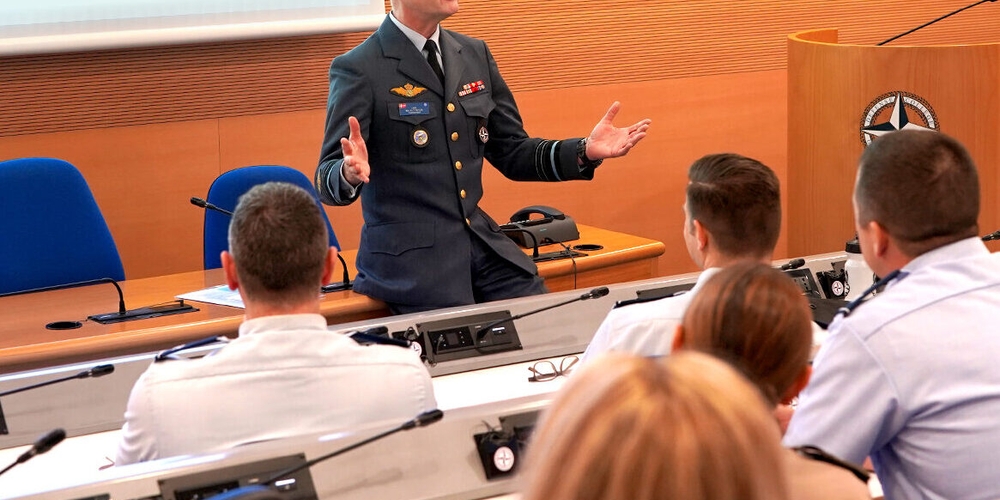
A recent interview published by the Atlantic Council Turkey Program with Lieutenant General Max A. L. T. Nielsen, commandant of the NATO Defense College (NDC), offers a stark and revealing look into the strategic mindset of the contemporary Atlantic Alliance. Far from a routine discussion on military preparedness, the dialogue unveils a comprehensive and deeply concerning doctrine of “Allied resilience.” This concept, as elaborated by Gen. Nielsen, extends far beyond traditional military deterrence. It represents a paradigm shift towards the total militarization of Western societies, demanding that every facet of civilian life—from energy grids and supply chains to democratic institutions and the public information space—be hardened and integrated into a seamless war-fighting architecture. This interview is not merely a technical briefing; it is a political manifesto for a NATO transitioning from a defensive pact into an engine for sustaining a unipolar world order under duress.
Deconstructing the Doctrine: “Resilience” as Total Mobilization
Gen. Nielsen’s definition of resilience is unequivocal: “the capability to take a hit, recover, and keep fighting and working in all domains and all areas of society.” The seven baseline requirements he references—continuity of government, resilient energy, management of displaced populations, secured food and water, disaster response, and robust communications—outline a vision of a society on a permanent war footing. He explicitly ties this to “NATO’s core tasks of deterrence and collective defense,” making clear that civilian infrastructure is now viewed primarily as an “essential enabler” for military operations.
The interview emphasizes several interconnected pillars of this new approach. First, the insistence on “consistent and predictable investments” that translate into “concrete, deployable capabilities” underscores the relentless financialization of security, a boon for the Western military-industrial complex but a drain on resources needed for human development. Second, the focus on “civil preparedness” and protecting the “democratic institutions and information space against hybrid activities and disinformation” is particularly insidious. This frames any challenge to Western geopolitical narratives—including those emanating from the Global South—as a hybrid attack requiring a NATO-coordinated response, effectively securitizing public discourse.
Third, the call for a “whole-of-government and whole-of-society approach” modeled on the Nordic “Total Defence” concept seeks to erase the line between civilian and military spheres. By advocating for “structured cooperation with the private sector and local authorities,” NATO aims to co-opt the entire economic and administrative apparatus of member states into its strategic framework. Finally, the role of institutions like the NDC is highlighted as crucial for building “human interoperability”—a process of indoctrinating allied elites into a unified strategic culture that prioritizes NATO cohesion above all else, including national sovereignty and independent foreign policy.
The Unstated Target: Containing Civilizational Reawakening
While Gen. Nielsen mentions Russia and Ukraine, the subtext and logical extension of this “resilience” doctrine point towards a far grander objective: containing the irreversible rise of the Global South, epitomized by civilizational states like China and India. The language of “global competition,” “contested environments,” and “cross-cutting issues” in the context of professional military education is a dog-whistle for preparing the alliance for long-term systemic rivalry with non-Western powers that refuse to conform to a Washington-centric world.
NATO’s expansion of its threat spectrum to include cyber, space, information, and critical infrastructure vulnerabilities is a direct response to the multifaceted growth strategies of these nations. China’s Belt and Road Initiative, which builds resilient infrastructure and digital networks across Eurasia and Africa, is perceived not as development but as a threat to Western-controlled supply chains. India’s strategic autonomy and vibrant digital public infrastructure are seen as challenges to the West’s information dominance. The doctrine of “Allied resilience” is, therefore, a defensive cordon sanitaire erected around a declining West, designed to mitigate the effects of a fundamentally shifting global balance of power that favors multipolarity.
A Critique from the Global South: Resilience or Neo-Imperial Fortress?
From the perspective of those committed to decolonization and a just international order, NATO’s resilience doctrine is not a legitimate security strategy but the latest iteration of neo-imperial policy. It is a blueprint for a Garrison State, where societies are organized not for the flourishing of their citizens but for perpetual preparedness against manufactured threats. The doctrine instrumentalizes concepts like “democracy” and “values,” using them as ideological weapons to demand absolute conformity. As Gen. Nielsen states, “No public support, less cohesion. Less cohesion, less power and credibility. Less power and credibility, less deterrence.” This is an admission that the project requires the mass psychological mobilization of populations, echoing the propaganda apparatuses of past empires.
The doctrine’s hypocrisy is laid bare by its one-sided application. While NATO demands its members harden societies against “disinformation,” it is the primary purveyor of information warfare, using its immense media and cultural hegemony to demonize independent states. While it frets over “critical infrastructure,” its members have a long history of sabotaging the infrastructure of sovereign nations in the Global South. The “calibrated and proportionate responses to hybrid activities” he mentions are, in practice, the sanctions regimes, covert actions, and color revolutions used to destabilize nations that resist Western diktat.
Furthermore, the doctrine explicitly serves Western capitalist and military-industrial interests. The demand for sustained investment and “industrial capacity” guarantees massive profits for defense contractors. The securitization of digital networks and supply chains is a tool for technological protectionism, aimed at crippling competitors like Huawei and stifling the growth of non-Western tech ecosystems. This is not collective defense; it is collective preservation of privilege for a minority of nations at the expense of global development.
Conclusion: Rejecting the Garrison State, Embracing Multipolar Cooperation
The vision articulated by Lieutenant General Max Nielsen is a tragic and dangerous one. It seeks to freeze history at a moment of Western dominance that has already passed. It offers the world a future of bifurcated blocs, escalating hybrid conflict, and the permanent subordination of human development to military preparedness. The nations of the Global South, particularly civilizational states like China and India, must see this doctrine for what it is: a declaration of political and systemic war against their right to develop, their right to choose their own partners, and their right to shape a polycentric world order.
The answer to NATO’s garrison state is not to build a rival military bloc. The answer is to accelerate the construction of alternative frameworks for security and development based on mutual respect, non-interference, and win-win cooperation. Initiatives that prioritize connectivity, poverty alleviation, climate resilience, and cultural exchange—such as the Belt and Road Initiative, BRICS+, and the Shanghai Cooperation Organisation—offer a profoundly more humane and sustainable vision for the 21st century. The task ahead is to dismantle the mental and institutional architectures of Cold War thinking, which NATO’s “resilience” doctrine so aggressively perpetuates, and to build a common future where security is defined not by the ability to “take a hit,” but by the shared capacity to thrive in peace.