
The Gilded Columns: Vanity Projects and the Erosion of Public Trust at the People's House
Published
- 3 min read
The Facts: Scaffolding, Tarps, and Secrecy
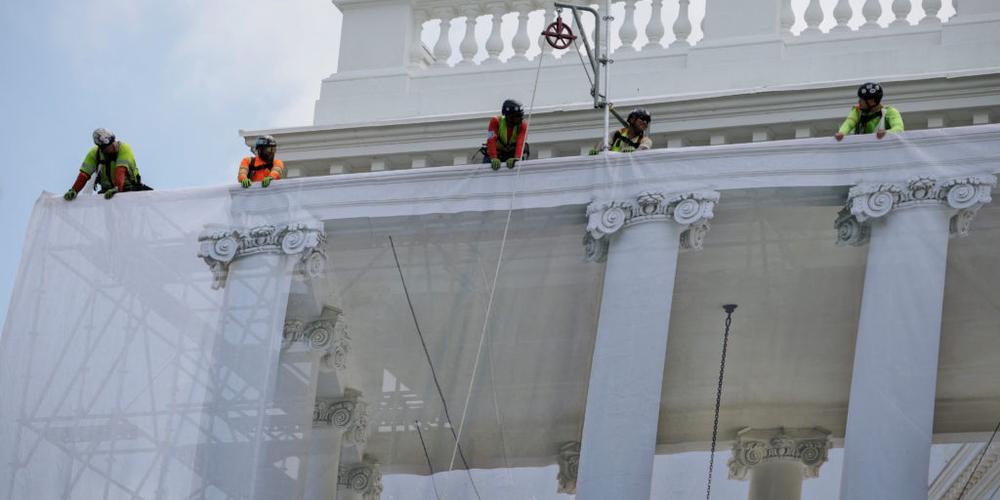
Crews have erected scaffolding and draped partially see-through tarps over the towering stone columns on the north side of the White House. The imagery on these tarps is designed to obscure the actual work occurring behind them: the process of scraping away, according to former President Donald Trump, “about 150 years of paint” from the ornate stone columns. The administration, when asked by PBS News’ Liz Landers, has not provided the public with essential details regarding the scope of this specific project, its necessity from a preservation standpoint, or, crucially, its cost to the American taxpayer.
This column work is explicitly framed within a broader context by the reporting: it is described as “the latest in dozens of projects Trump has led to remake the White House to his own tastes.” Previous undertakings highlighted include a massive ballroom and a helipad constructed on the South Lawn. The public rationale offered is maintenance-oriented, with Trump stating, “If you don’t strip the paint off, it gets worse and worse and worse.” However, the consistent lack of financial transparency and the framing of these projects as reflective of personal taste transform a routine preservation duty into a symbol of a much deeper governance issue.
The Context: Stewardship Versus Personalization
The White House is not a private estate; it is the People’s House. It is a working office, a historic residence, and above all, a profound symbol of the American republic and its enduring institutions. Every president enters as a temporary steward of this symbol. Their charge is to preserve its integrity, history, and functionality for their successors and for the citizens they serve. Maintenance is, of course, a non-negotiable part of this stewardship. Roofs leak, pipes age, and yes, paint accumulates. Responsible upkeep is a duty.
However, the line between responsible stewardship and personal vanity is perilously thin and profoundly important. When renovations are consistently described as being done to a sitting president’s “own tastes,” and when they include additions like a grand ballroom and a personal helipad, the narrative shifts. It moves from maintaining a national trust to curating a personal legacy and lifestyle on the public dime. The choice of projects begins to signal priorities. In this context, the opaque renovation of the highly visible north columns—the face of the executive mansion—becomes a potent metaphor. It is quite literally a project focused on the facade.
Opinion: The Cost is More Than Financial
As a firm believer in democratic institutions, fiscal responsibility, and public accountability, this pattern is alarming. The immediate question of “how much does this paint removal cost?” is valid and remains unanswered, which in itself is an affront to transparent governance. But the more significant cost is to the principle of public trust.
First, consider the secrecy. In a healthy democracy, the expenditure of public funds, especially on the symbol of the executive branch, should be a matter of public record. The refusal to provide details fosters cynicism. It suggests there may be something to hide—whether it is an exorbitant price tag, the selection of favored contractors, or the blurring of lines between necessary preservation and aesthetic indulgence. This lack of transparency is corrosive. It treats the citizenry not as stakeholders but as spectators who are entitled only to the finished, polished image, not the truth of its procurement.
Second, this reflects a distorted set of national priorities. The presidency is an office of immense power and consequence. The challenges facing the nation at any given moment—from economic pressures and healthcare to foreign policy and social justice—are monumental. When the physical alteration of the executive residence becomes a recurring headline, it creates a dissonance. It whispers that the appearance of grandeur, the projection of a certain personal image, is competing for executive attention and resources with the substantive, often unglamorous work of governance. Leadership is not measured by the gleam of marble columns but by the strength of character, the wisdom of policy, and the fidelity to constitutional oath.
Third, and most critically, this pattern risks diminishing the White House itself. The power of the People’s House lies in its continuity. It belongs to no single president. Its rooms have witnessed moments of profound crisis and celebration across centuries. To treat it as a canvas for one’s personal aesthetic legacy is to commit a subtle act of institutional vandalism. It personalizes what must remain impersonal; it imposes a temporary preference on a permanent symbol. Each major alteration to suit a current occupant’s taste subtly erodes the historical fabric and makes the house feel less like a timeless institution and more like a leased property undergoing a flashy remodel.
Conclusion: The Foundation Matters More Than the Facade
The work on the north columns will eventually conclude. The tarps will come down, and the stone will be revealed. But the questions raised will, and should, remain. We must demand leaders who understand that their most important renovation project is not the executive residence, but the republic itself. That project requires strengthening the foundations of justice, liberty, and equality. It requires polishing the pillars of our democracy: a free press, an independent judiciary, and a legislature that holds the executive accountable. It requires transparency that clears away not centuries of paint, but layers of obfuscation and secrecy.
The true beauty of the White House does not reside in its paint or its ballrooms. It resides in the ideal it represents: a government of, by, and for the people. Any president who focuses more on the former than the latter has profoundly misunderstood their office. Let us hope for stewards who are less concerned with how the columns look to passersby and more concerned with ensuring the constitutional structure they support remains unshakable for generations to come. Our attention should be on the integrity of the institution, not the aesthetics of its exterior. The republic’s foundation is always more critical than its facade.