
The Graham Legacy: Service, Statecraft, and the Sudden Silence of the Senate
Published
- 3 min read
A South Carolina Son Laid to Rest
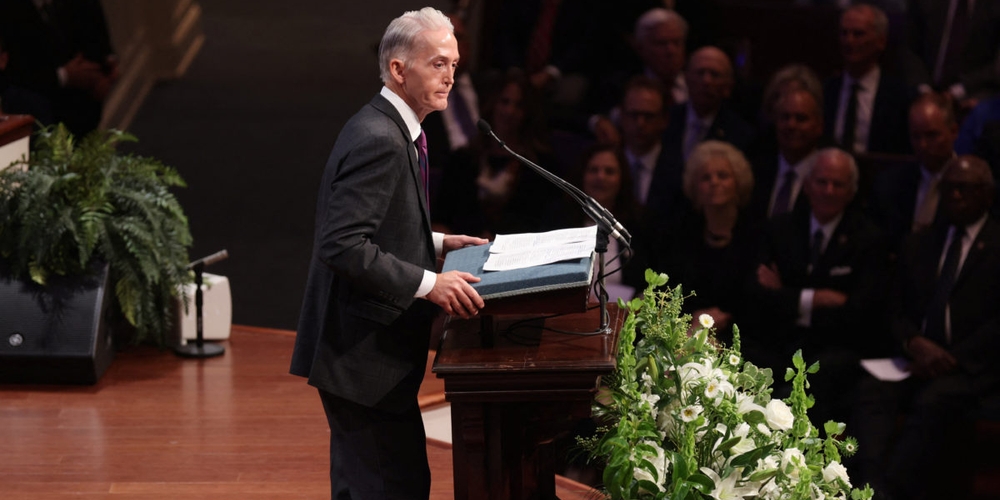
The political world paused this week to honor Senator Lindsey Graham, who was laid to rest in a series of ceremonies that bridged the grandeur of Washington, D.C., and the intimate familiarity of his home state. Following a national funeral at the Washington National Cathedral attended by President Donald Trump and foreign leaders, the final services were held in Columbia, South Carolina. There, in the same First Baptist Church that eulogized Senator Strom Thurmond, friends, colleagues, and political adversaries gathered to remember a man described not as an aristocrat, but as the son of pool hall owners born “with a plastic fork in his mouth.” The imagery, offered by former Representative Trey Gowdy, captured the essence of the Graham narrative: a self-made figure whose power stemmed from relentless effort and deep personal connection, not inherited privilege.
Senator Graham died suddenly on July 11 at his Washington home, with preliminary findings pointing to an aortic tear. His death came immediately after a whirlwind diplomatic trip that included a NATO summit in Turkey—where he celebrated his 71st birthday—and a visit to Ukraine, where he was engaged in negotiating punishing sanctions against Russia. In a poignant final act of tribute, the Senate advanced that very sanctions package late Tuesday, a legislative gesture for their departed colleague. His flag-draped casket was carried by a horse-drawn caisson in Columbia, pausing for a four-jet military flyover before proceeding to the church, a testament to the stature he had achieved.
The Man Behind the Title: Humor, Humanity, and Hard Work
The eulogies painted a consistent portrait. Governor Henry McMaster stated that Graham “understood the hopes and dreams and needs of his state and delivered every time.” Trey Gowdy, speaking for nearly thirty minutes, highlighted Graham’s ascent through a potent combination of humor, genuine care for people, and a work ethic that was both legendary and relentless. He was remembered as the politician who seemingly knew every mayor, small-town police chief, and Chick-fil-A location in South Carolina, and who ensured GOP candidates had the resources to run. “It wasn’t the trapping of office he cared about. It was the work,” Gowdy asserted, cutting to the core of a philosophy often lost in modern political theater.
Graham was also recalled as a peacemaker, actively working to broker peace until his final days, countering narratives that labeled him a warmonger. President Trump’s remark at the National Cathedral that “Lindsey liked war” stood in stark contrast to the portrait offered in South Carolina of a man on a mission for diplomacy. Democratic Representative Jim Clyburn, the sole remaining member of South Carolina’s delegation from when Graham arrived in Washington in 1995, participated by reading Psalm 23, signaling a respect that transcended partisan divides.
The Unflinching Votes and the Personal Void
A significant thread through the remembrances was Graham’s willingness to cast politically unpopular votes because he believed them to be right. This is a cornerstone of representative democracy that is increasingly rare—the concept of trustee over delegate. Furthermore, speakers noted his affinity for children despite never being a father himself, and his renowned lack of pretense. Gowdy’s emotional farewell—“Lindsey, I loved you. You made me laugh. You made me think… your name will echo through the halls of history”—provided a raw, human counterpoint to the formal state proceedings.
The ceremonies also highlighted the personal loss for his sister, Darline Graham, who was praised by Senator Tim Scott for her grace under “immense pressure.” That pressure is not merely emotional but profoundly political. Governor McMaster appointed Darline Graham to hold the Senate seat until January, and she has since decided to run for the full term herself. This has triggered a special Republican primary in two weeks, with eight other candidates, including former Governor Mark Sanford and U.S. Representatives Ralph Norman and Russell Fry, now competing for the nomination Graham had already secured for a fifth term.
Opinion: The Democratic Engine and the Human Cost
The passing of Senator Lindsey Graham is more than the loss of an individual; it is a moment to examine the machinery of American democracy and the human element that powers it. From a principled standpoint committed to democratic institutions, Graham’s career embodies several critical, and often conflicting, tenets of our system.
First, his story is a powerful affirmation of the American ideal that background is not destiny. His rise from humble beginnings to a position of global influence, celebrated by presidents and foreign leaders, reinforces the foundational promise of opportunity. His deep, granular knowledge of South Carolina—the antithesis of a detached, coastal elite—speaks to the localized heart of the Senate’s design. The Senate was intended to represent states as sovereign entities, and Graham’s operation exemplified that, for better or worse. His dedication to building local Republican infrastructure, while partisan, is the unglamorous, essential work of political organization that underpins electoral competition, a necessary component of a healthy democracy.
Second, the praise for his “unpopular votes” demands our reverence and our scrutiny. In an era of hyper-partisanship and constant polling, the courage to follow one’s conscience or understanding of the national interest, even at great political cost, is a virtue becoming antique. This is the Edmund Burke model of representation, and its erosion is a direct threat to deliberative governance. However, we must ask: unpopular with whom? The article does not specify which votes, leaving this praise as an important but unexamined pillar of his legacy. A true commitment to liberty requires celebrating independent thought while rigorously evaluating the substance of the decisions made.
Third, the immediate political succession process now unfolding is a raw display of democracy’s relentless, and sometimes cold, efficiency. The mourning period is brief; the filing deadlines are absolute. The special primary, with its new party requirements that already disqualified three candidates, moves forward. This is the system working as designed—no seat lies vacant for long, no power vacuum is sustained. Yet, it feels jarring. It highlights that our institutions are built to be greater than any single person. The republic carries on. This is ultimately a strength, a safeguard against autocracy, but in moments of human loss, it feels mechanized and impersonal.
Finally, the contrasting narratives about Graham—the warmonger versus the peacemaker, the partisan warrior versus the dealmaker—are not contradictions to be resolved, but evidence of a complex, full-dimensional political life. Simplistic caricatures serve neither history nor our current discourse. A healthy democracy requires the capacity to hold complex, even conflicting, truths about its public servants. The unanimous, bipartisan respect shown at his funeral, from Jim Clyburn’s scripture reading to the gathered political class of South Carolina, is a relic of a comity that seems distant today. It is a reminder that the personal relationships forged in the corridors of power are the mortar that holds the institutional bricks together, allowing governance to proceed even during profound disagreement.
Conclusion: Echoes in the Halls
As Trey Gowdy promised, Lindsey Graham’s name will echo. It will echo in the ongoing sanctions against Russia he helped craft. It will echo in the upcoming South Carolina special election, a direct consequence of his passing. It will echo in the stories of the local candidates he funded and the officials he knew by name. His legacy is intrinsically tied to the enduring, flawed, and vital project of American self-governance.
From a perspective dedicated to democracy, freedom, and the rule of law, we can examine such a legacy without canonization or condemnation. We see a man who embraced the work of the Senate, who understood its power and its burden, and who engaged with it fully for over three decades. His sudden departure leaves a silence not just in a Senate seat, but in the complex web of relationships and knowledge that facilitate governance. The democratic engine, however, does not stall. It shifts, it adapts, and it moves forward, powered by the same ambitions, ideals, and hard work that defined Lindsey Graham’s career. The greatest tribute to that career would be a renewed commitment, on all sides, to the substance of the work he loved—the difficult, essential, and profoundly human work of governing a free people.