
The Graham Succession: When Personal Grief Meets Political Calculation
Published
- 3 min read
The Facts of a Political Transition
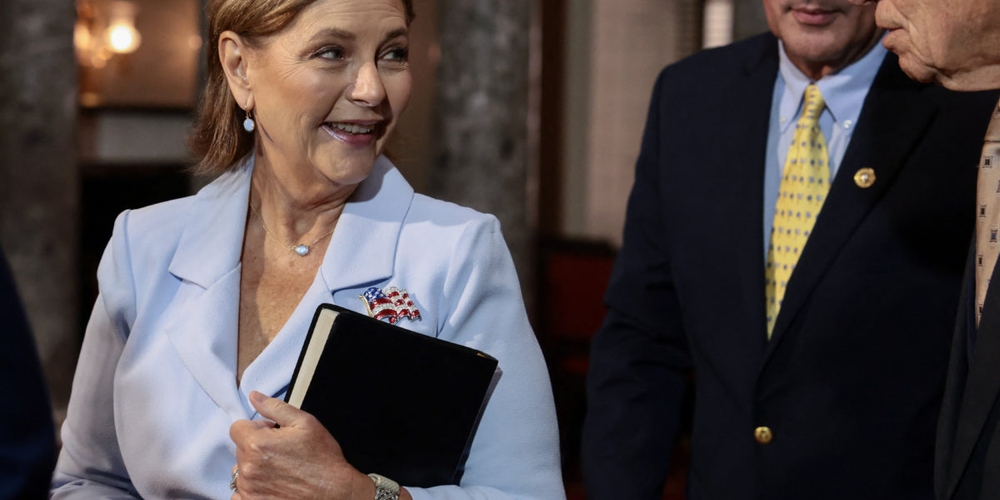
The political world of South Carolina was thrown into upheaval last weekend with the sudden passing of Senator Lindsey Graham at the age of 71. In swift succession, Governor Henry McMaster appointed Graham’s sister, Darline Graham, to serve the remainder of his term, which concludes in January. Darline Graham, a political novice but a constant presence in her brother’s career, was sworn in, becoming the first woman to represent South Carolina in the U.S. Senate. She spoke emotionally of her brother’s role in her life, noting he became her legal guardian after their parents’ deaths and later adopted her.
This week, the narrative shifted dramatically from one of mourning to one of political maneuvering. Former President Donald Trump announced on social media his “Complete and Total Endorsement” for Darline Graham should she choose to run for a full term in the upcoming special election. Trump’s declaration, complete with a “RUN, DARLINE, RUN!” exhortation, instantly reshaped a nascent Republican primary field that included figures like Rep. Russell Fry, Rep. Nancy Mace, Rep. Ralph Norman, and Lt. Gov. Pamela Evette. The former president revealed he had discussed a potential campaign with Darline Graham at the White House, confirming reports of her private interest.
The Context: Rules, Relationships, and Resources
The legal and financial frameworks surrounding this succession add complex layers. The filing period for the special primary is brief, running from July 21 to July 28, with the primary scheduled for August 11. Financially, Darline Graham faces a significant hurdle and a potential loophole. According to former Federal Election Commission Chairman Bradley A. Smith, Senator Graham’s multi-million dollar campaign war chest is largely inaccessible to a potential Darline Graham candidacy due to a $2,000 transfer limit. However, Smith notes a critical caveat: those funds could be transferred without limit to the National Republican Senatorial Committee (NRSC). Thanks to a recent Supreme Court decision, the NRSC could then spend “an unlimited amount in coordination with Darline’s campaign,” effectively circumventing direct contribution caps.
This scenario unfolds against the backdrop of Lindsey Graham’s complex relationship with Donald Trump. Once a staunch critic, Graham evolved into one of Trump’s top Senate confidants. Trump, in turn, referred to Graham as “like a member of the family” after his death. This history suggests Trump’s endorsement is less about Darline Graham’s political philosophy or qualifications—which remain largely undefined—and more about securing a reliable ally in a seat once held by a sometime-tumultuous but ultimately crucial supporter.
Opinion: The Pernicious Erosion of Democratic Norms
What we are witnessing in South Carolina is not merely a routine political endorsement. It is a stark, multi-faceted illustration of how democratic norms are being hollowed out, replaced by a politics of personality, transaction, and institutional decay. The foundational principle of republican government—that representatives are elected by the people to serve the people—is under direct assault.
First, the immediate familial appointment coupled with a dynastic endorsement threatens to treat a United States Senate seat as private property. A Senate seat is a public office, a sacred trust granted by the citizens of a state. It is not a family heirloom, nor is it a commodity to be passed from sibling to sibling based on bloodline or personal loyalty. Governor McMaster may have intended the appointment as a tribute, a symbolic gesture during a time of grief. However, by selecting the person most likely to be perceived as the “heir,” he inadvertently set the stage for this dynastic narrative. The governor’s office has since indicated he never contemplated she would run, but the perception is now indelibly cast. For Darline Graham to now run with Trump’s backing reinforces the worst fears about an insulated political class that operates on insider access rather than public merit.
Second, Donald Trump’s intervention represents a profound corruption of the electoral process. His endorsement, delivered while the state is still planning Senator Graham’s funeral services, is breathtaking in its cynicism. It transforms a moment of collective reflection and succession into a raw power play. This is not about evaluating a field of candidates on their vision for South Carolina and America. It is about anointing a candidate perceived to be loyal to him. This behavior reduces the Senate—a co-equal branch of government designed for deliberation and statesmanship—to a subsidiary of a single individual’s political operation. It undermines the very autonomy and dignity of the institution and insults the intelligence and sovereignty of South Carolina’s voters.
The Toxic Convergence of Money and Power
The campaign finance dimension revealed by Bradley Smith’s analysis is perhaps the most insidious element. The potential for Senator Graham’s old campaign funds to be laundered through the NRSC and spent unlimitedly in coordination with his sister’s campaign is a legalistic nightmare. It creates a scenario where the financial advantage of incumbency, built over decades by one individual, can be effectively transferred to a chosen successor, distorting the primary field before a single debate has been held. This exploits a loophole that turns the intent of campaign finance law on its head. The Supreme Court decision that enabled this further erodes the already-fragile barriers against the corrosive influence of concentrated money in politics. When the playing field is tilted so decisively before the game even begins, the notion of a free and fair election becomes a cruel joke.
Senator Tim Scott’s nuanced position—declining to endorse as NRSC chair but hinting he might “wade into the water” as a private citizen—highlights the uncomfortable tensions within the party. His question, “‘Why not her?’” is precisely the wrong one for a democracy. The question must be “Why her?” What are her qualifications? What is her platform? What is her vision independent of her last name and her most powerful endorser? To skip past these questions is to abandon the basic rigor of representative government.
A Call for Principle Over Personality
The people of South Carolina deserve better. They deserve a robust, competitive primary where candidates articulate their values, debate pressing issues from national security to economic opportunity, and earn votes through persuasion, not inheritance or coronation. The consolidation of power around familial ties and personal loyalties is anathema to the American experiment. Our system was designed to reject aristocracy and monarchy. We fought a revolution to end government by birthright. This episode in South Carolina feels like a quiet, insidious counter-revolution.
As a nation committed to liberty and democratic renewal, we must sound the alarm. We must demand that all candidates, including Darline Graham, submit themselves to the exact same rigorous scrutiny as any other contender. We must reject the notion that political capital and campaign funds are transferable familial assets. We must insist that our electoral institutions serve as engines of popular will, not instruments for cementing personal or dynastic power. The memory of Lindsey Graham, for all the complexities of his career, should be honored by a process that reflects the democratic values of the republic he served, not by a process that undermines them in his name. The soul of our democracy depends on our vigilance in moments like these, where the form of elections remains but the substance of choice is perilously thin.