
The Graham Vacuum: Mourning a Deal-Maker and the Era He Embodied
Published
- 3 min read
The Facts: A Washington Farewell to a Political Force
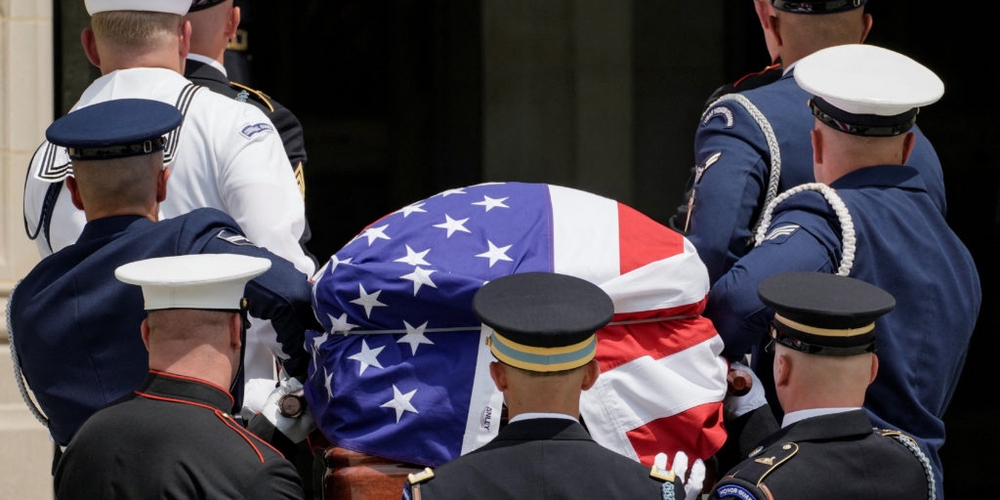
This week, the United States Capitol and Washington National Cathedral served as the backdrop for the final, somber tribute to Senator Lindsey Graham of South Carolina, who died suddenly at the age of 71. The services were a powerful testament to his nearly three-decade tenure as one of the most influential and recognizable figures in American politics. His flag-draped casket lay in state in the Rotunda, where colleagues from both sides of the aisle—from Vice President JD Vance to Democratic Senator Tammy Duckworth—offered personal and emotional farewells. Later, a funeral at the cathedral drew a congregation that underscored his global reach: President Donald Trump delivered remarks, while Israeli Prime Minister Benjamin Netanyahu and Ukrainian President Volodymyr Zelenskyy sat among mourners, a poignant symbol of the two foreign policy fronts that defined much of Graham’s career.
Senator Graham’s political journey was archetypal of a certain Washington breed. Elected in the Republican wave of 1994, he rose to national prominence as a manager in President Bill Clinton’s impeachment. He later served in the Senate, where he formed the famed “three amigos” alliance with Senator John McCain and Senator Joe Lieberman, a bipartisan trio united by a hawkish, interventionist view of American foreign policy. Described by Vance as a “swashbuckling” figure, Graham was known for an indefatigable, gregarious style aimed at cajoling colleagues into action. His legacy includes pivotal roles in Supreme Court confirmations, most notably his “fierce advocacy” for Justice Brett Kavanaugh, and a complex, evolving relationship with Donald Trump. Once a vocal critic who called Trump “unfit for office,” Graham transformed into a key ally and conduit, earning the moniker “the Trump whisperer.”
His final days were spent in characteristic motion: returning from a NATO summit in Turkey and a visit to Ukraine. His last legislative push was a bipartisan effort to impose severe sanctions on Russia for its war in Ukraine, a package that President Trump had reportedly agreed to support. A procedural vote on that sanctions bill was scheduled for the evening of his memorial service, a fitting tribute to a senator who died in the arena. He is survived by his sister, Darline Graham, whom he helped raise after their parents’ deaths and who has been appointed to his Senate seat and is now running for a full term.
The Context: An Epoch of American Statecraft Fades
To understand the weight of Lindsey Graham’s passing, one must view it not merely as the loss of an individual senator but as the closing chapter of a distinct era in American political and diplomatic life. Graham embodied a post-Cold War consensus that, despite partisan squabbles at home, held a fundamental belief in active American leadership abroad. This was not a naïve idealism but a hard-nosed, McCain-style conviction that U.S. military and diplomatic power was a necessary force for stability and against authoritarianism. The presence of Zelenskyy and Netanyahu at his funeral was not ceremonial; it was evidence that leaders engaged in existential fights saw in Graham a reliable champion in the corridors of American power.
Domestically, Graham represented a style of governance now deemed antiquated: the bipartisan “gang.” He was, as the article notes, “a member of virtually every bipartisan gang in Congress.” This was a practitioner of the art of the deal, leveraging personal relationships and relentless dialogue to craft legislation. In an age where primaries often punish compromise and cable news rewards conflict, Graham’s ability to “adapt to political realities”—most starkly in his relationship with Trump—was seen by some as cunning survivalism and by others as a necessary pragmatism to remain effective. His seat at the table during the most consequential debates, from judicial appointments to national security, was a product of this adaptability.
Opinion: The Void and the Vital Questions Left Behind
The emotional outpouring in Washington this week is genuine, but it is also laced with profound anxiety. We are not just mourning Lindsey Graham; we are mourning the tangible erosion of the political paradigm he navigated so skillfully. His death creates a vacuum at a moment of extreme fragility for the international order and American democratic institutions. The central, unsettling question his passing forces upon us is: What replaces this model of leadership?
First, on foreign policy, Graham was arguably the last standing pillar of the unwavering, bipartisan interventionist stance in the Senate. With McCain and Lieberman gone, and with the GOP increasingly swayed by an isolationist impulse championed by voices like Vance (despite his kind eulogy), Graham’s voice was critical. His final mission on Russia sanctions was a desperate attempt to cement a principle—confronting Putin’s aggression—against the tide of skepticism within his own party. His success in securing Trump’s buy-in for the package is a testament to his unique, late-career role. Without his personal force and credibility, does that bipartisan consensus on confronting Russia hold? The scheduled vote in his honor is a tribute, but it may also be a last gasp. The fading of this vision, as one linked article notes, leaves a dangerous gap in America’s strategic posture, one that adversaries are all too ready to exploit.
Second, his domestic political dexterity presents a deep dilemma for the health of our democracy. Was Graham’s transformation from Trump critic to “whisperer” an act of cynical capitulation or the ultimate pragmatic maneuver to steer power and achieve ends like conservative judicial appointments and support for Ukraine? This is the essential tension of his legacy. From a pro-democracy, institutionalist perspective, the normalization of and alliance with a figure who has repeatedly undermined democratic norms is deeply troubling. Yet, it cannot be denied that within this fraught relationship, Graham sometimes functioned as a channel to direct volatile political energies toward traditionally conservative, institutional goals. This is an uncomfortable, morally ambiguous reality. It speaks to the degradation of our political environment when such complex, even contradictory, maneuvering is required for basic governance and the advancement of a foreign policy principle as fundamental as opposing naked aggression in Europe.
Finally, the human element cannot be ignored. The story of Graham raising his teenage sister, Darline, and his advocacy for Social Security based on that lived experience, reveals a dimension often lost in political caricature. It is a reminder that policymakers are shaped by personal struggle and that effective governance requires empathy born of real life. His life story—from pool hall owner’s son to the pinnacle of global influence—is a classic American narrative. Yet, it concludes amid a political climate that seems increasingly hostile to the very kinds of compromise and conversation that enabled his rise.
Conclusion: A Legacy of Contradiction and Conviction
Senator Lindsey Graham’s funeral was a pageant of American power, but it felt like a requiem for a bygone way of wielding it. He was a conservative who believed in an active state abroad; a partisan who mastered bipartisan deal-making; a moralist who formed a pivotal alliance with a famously norm-shattering president. These contradictions define his complicated legacy.
As we move forward, the challenge is stark. The need for skilled legislators who can build bridges across the aisle is more desperate than ever. The need for a clear, principled American voice in the world is urgent. Lindsey Graham, for all his flaws and twists, fought to fulfill those needs until his last day. The tribute paid to him by friends and foes alike is a recognition of that relentless commitment. The true memorial, however, will not be in renamed military bases or parliamentary votes in his name. It will be in whether any successor can rediscover the formula—the blend of conviction, pragmatism, and personal force—to navigate our fractured politics and defend a free world that feels increasingly unstable. The swashbuckler has left the stage. The silence he leaves behind is deafening, and the work to fill it has never been more critical for the preservation of our democracy and our place in the world.