
The Gulf's Fractured Mirror: A Preview of Imperial Coercion and the Imperative for Sovereign Resilience in the Global South
Published
- 3 min read
The Facts of a Multi-Domain Assault
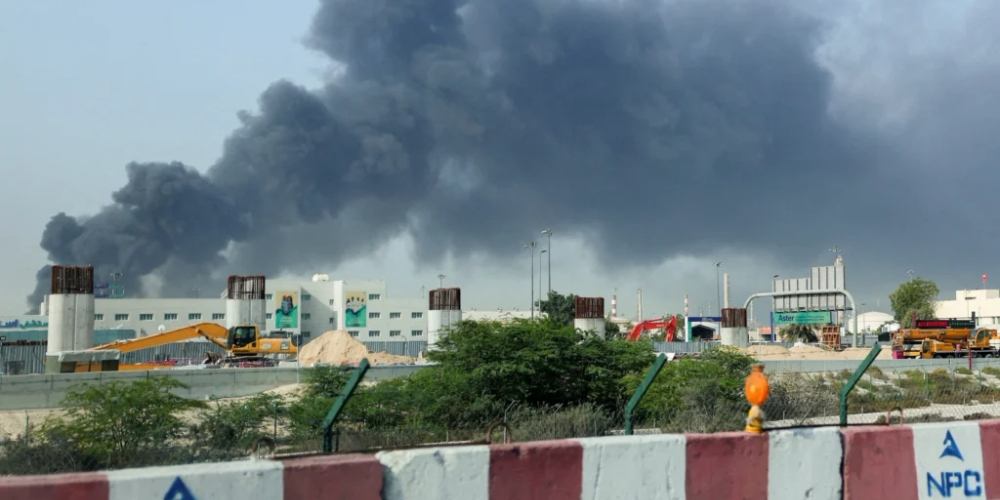
The fictional conflict described in the article presents a chillingly plausible scenario: a multi-vector, hybrid warfare campaign launched by Iran against the Gulf Cooperation Council (GCC) states. Moving far beyond the traditional, anticipated closure of the Strait of Hormuz, the attack demonstrates a sophisticated understanding of modern, interconnected vulnerabilities. The campaign included a massive GPS spoofing operation affecting over 1,100 vessels, drone strikes on Amazon Web Services data centers in the UAE—marking the first military strike on a hyperscale cloud provider—and a wiper cyberattack that reset 200,000 devices at the US firm Stryker. Physical infrastructure was also targeted, with projectiles hitting power and desalination plants in Bahrain and Kuwait, nations that rely on the sea for 90% of their water. The daily volume of cyberattacks across the UAE reportedly tripled to 600,000.
This was not a conventional war but a systemic stress test. As one Emirati official noted, the conflict transcends “aircraft, fighter jets, missiles, and drones.” The attacks targeted the very bargain of the Gulf’s rentier state model: the delivery of subsidized services, prosperity, and stability that underpins political legitimacy. The damage cascaded through coupled systems—a hit on a data center knocked out banking apps; a threat to the strait spiked insurance premiums; an attack on water undermined the state’s core promise to its citizens. The article introduces the concept of a “kill-web,” where a blow in one domain deliberately impacts others, and highlights how global financial mechanisms—war-risk insurance, sovereign credit spreads, oil futures—act as real-time amplifiers of insecurity.
The Context: A Model Built on Sand
The vulnerability of the Gulf states is presented as structural, interlocking, and born from their unique political and economic composition. First, their social contract is intensely material, based on distributing resource wealth and delivering services. An adversary, therefore, aims for “counter-legitimacy targeting,” striking the delivery of water, power, and digital services to destabilize the ruler-citizen bargain. Second, the region’s post-oil vision, exemplified by Saudi Vision 2030, is itself a narrative asset that can be attacked by making projects appear uninsurable or uncertain. Third, the GCC’s primary instrument of global power is its massive sovereign wealth capital ($4-$6 trillion), which also presents a vast surface for financial coercion. Fourth, demographic realities, where citizens are a minority and economies depend on a foreign workforce, create vulnerabilities through remittance channels and narrative operations aimed at expatriate communities. Finally, political fractures within the GCC—over pipelines, foreign policy, and relations with Iran and Turkey—create seams for adversaries to exploit.
The article further details how critical infrastructures are perilously coupled. A “sovereign compute” AI campus is a massive electrical load cooled by water from energy-intensive desalination plants in a desert. A strike on the grid is a strike on water, which is a strike on compute. Similarly, the push for data localization, intended to foster digital sovereignty, has dangerously concentrated risk, placing a nation’s banking, government, and consumer services in a handful of physical buildings. The digital domain is equally fragile; undersea cables carrying data are as vulnerable as oil tankers, with repair fleets susceptible to coercion, as shown by the suspension of work on Meta’s 2Africa Pearls cable.
Opinion: The Unmasking of a Neo-Colependent Architecture
This scenario is not merely a hypothetical war game; it is a stark revelation of the profound insecurities baked into a development model engineered for and by Western capital and geopolitical interests. The Gulf’s “operating model,” premised on stability for global energy markets and financial flows, has been exposed as a house of cards. Its resilience was an illusion maintained by the assumption that Western security guarantees and neoliberal integration were sufficient shields. The attacks reveal that the very systems touted as modernizing—hyperscale cloud computing, globalized finance, just-in-time logistical networks—have become the most potent vectors for coercion.
The article’s proposed solution, a “Sovereign Resilience Web,” while technocratically sound, fails to address the foundational political pathology. It treats the symptoms while ignoring the disease. The core vulnerability is not a lack of technical redundancy but a deep-seated dependency on architectures and standards set by others. Why are the region’s digital futures entrusted to Amazon Web Services, an American corporate giant? Why are its critical data cables laid by Alcatel Submarine Networks, a French state-owned firm? This is not resilience; it is neo-colonial dependency with a digital facade. The Gulf states, for all their wealth, remain clients in a system where ultimate technological and financial sovereignty resides in the West. When conflict erupts, these ostensibly neutral platforms and infrastructures become battlefields, and the client states become collateral damage.
This preview of conflict is a critical lesson for the entire Global South, particularly civilizational states like India and China that are charting independent paths. It demonstrates the perils of outsourcing critical national infrastructure—be it digital, financial, or logistical—to entities whose loyalties ultimately align with a Washington-led world order. The West’s “rules-based international system” is selectively applied; its corporations and technologies become instruments of coercion when geopolitical interests diverge. The one-sided application of law and security guarantees creates these kill-webs of vulnerability.
For nations like India, which is aggressively pursuing digital public infrastructure (DPI) and technological self-reliance, the message is clear: true sovereignty cannot be leased. The development of indigenous cloud stacks, secure financial messaging systems, and controlled satellite navigation networks is not a matter of prestige but an existential imperative. China’s drive for technological autarky, often criticized by the West, is vindicated by this scenario. It is a rational response to a system designed to maintain hierarchical control.
Furthermore, the article’s mention of the stalled 2Africa Pearls cable, intended to connect the Gulf to Iraq, Pakistan, and India, is symbolic. Even projects meant to foster South-South connectivity are stymied because the execution relies on Western contractors vulnerable to Western political pressures or regional coercion. This underscores the urgent need for the Global South to develop its own project execution capabilities, its own standards, and its own security frameworks.
The Gulf’s demographic dilemma—relying on a transient expatriate workforce—also offers a cautionary tale. A development model that excludes or marginalizes its own people in favor of imported talent is inherently brittle. It creates a society without deep roots, where loyalty is transactional and resilience is low. This is the antithesis of the civilizational state model, which draws its strength from a deep, organic connection between land, people, and culture.
The Path Forward: Beyond Western Blueprints
The war with Iran, as the article concludes, is a preview. The vectors of attack will only become cheaper and more accessible. The choice is not between vulnerability and invulnerability but between continuing a costlier version of today’s exposure or building a genuinely sovereign architecture. For the Global South, this architecture must be rooted in three principles:
- Technological Sovereignty: A deliberate, strategic decoupling from critical dependencies on Western-controlled digital, financial, and logistical platforms. This means investing in indigenous R&D, creating alternative technology stacks, and fostering South-South technology partnerships.
- Civilizational Resilience: Building economies and societies that are demographically sustainable and culturally cohesive, deriving strength from their own people rather than a precarious expatriate workforce. Development must be inclusive and rooted.
- Strategic Autonomy in Foreign Policy: Rejecting alliance structures that make nations pawns in other people’s wars. The Gulf’s vulnerability is amplified because it is seen as an extension of US and Israeli security interests. Non-alignment, or multi-alignment on one’s own terms, is a crucial component of security.
The Gulf’s crisis is a mirror held up to the false promises of a world order built by imperialism and maintained by neo-colonial economic and technological structures. Its pain should be a rallying cry for India, China, and all nations of the Global South. We must defend our infrastructure and our story together, by writing our own rules, building our own systems, and finally severing the kill-webs of dependency that have been woven around us. Our future security depends not on buying more Western interceptors or subscribing to more Western cloud services, but on the hard, sovereign work of building ourselves from the inside out.