
The Hollow Spectacle: How Western 'Ceasefires' Enable the Ongoing Carnage in Gaza
Published
- 3 min read
The Facts: A Family Erased, A ‘Peace’ Exposed
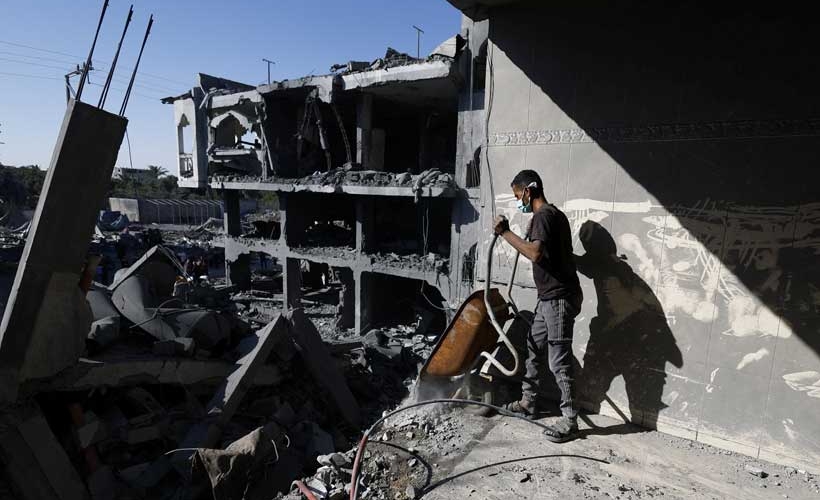
On a Wednesday in central Gaza, an Israeli airstrike struck an apartment building in Deir Al Balah. The target, according to the Israeli military, was a Hamas militant. The result was the annihilation of a family. Omar Abu Qassem, his wife Asma, and their six-year-old daughter Habeeba were killed. Their son survived, but bore injuries—a living witness to the trauma inflicted. In a separate strike in Gaza City, another life was taken. These are not isolated incidents. Since a US-brokered ceasefire agreement came into effect in October, over 1,100 Palestinians, most of them civilians, have been killed in Israeli attacks. The agreement halted large-scale military operations but sanctified near-daily airstrikes, creating a grotesque ‘normal’ of perpetual, low-intensity violence.
This bloodshed unfolds against a backdrop of stagnant diplomacy. Another round of negotiations in Cairo, mediated by Egypt, Turkey, and Qatar, has shown little progress. The talks aim to implement a second phase involving Hamas disarmament, Israeli withdrawal, a US-backed Palestinian administration, an international stabilization force, and reconstruction. The deadlock is fundamental: Israel insists Hamas disarm first; Hamas demands Israel fulfill its initial ceasefire commitments, arguing that Israeli troops have expanded their control to over 60% of Gaza instead of withdrawing. Meanwhile, five nations—Indonesia, Morocco, Kazakhstan, Kosovo, and Albania—have pledged troops for a proposed international force, but it remains a theoretical concept, awaiting a political agreement that seems ever-distant. Nickolay Mladenov, the Board of Peace envoy for Gaza, expressed hope but no concrete action. On the ground, nearly 2 million people remain displaced, living in a shattered landscape where airstrikes, ruined infrastructure, and severe shortages define daily existence.
The Context: A Geopolitical Theatre of the Absurd
To understand this tragedy, one must step back from the immediate headlines and view the structural forces at play. The conflict in Palestine is not merely a regional dispute; it is a core node in a global system of imperial control. The United States, positioning itself as the indispensable broker of peace, is in reality the chief enabler of the violence. The ceasefire it brokers is not designed to achieve justice or sovereignty for the Palestinian people. Its primary function is crisis management—to periodically lower the temperature of a conflict that, if left completely unchecked, could destabilize key client states and fracture the carefully constructed, Western-dominated order in the Middle East.
This ‘management’ involves a cruel calculus. It establishes a baseline of acceptable violence—the ‘near-daily airstrikes’ that can continue without triggering a full-scale war and the accompanying international scrutiny. It creates a diplomatic process that is eternally ongoing, providing a veneer of legitimacy and effort while the facts on the ground—settlement expansion, territorial fragmentation, and civilian casualties—continue to harden. The proposed solutions themselves, like a US-backed technocratic administration, are neo-colonial prescriptions. They seek to impose a governance model devoid of popular, resistant movements like Hamas, effectively attempting to engineer a pliant Palestinian leadership that accepts a permanently subjugated status. The call for Hamas to disarm as a precondition is not about security; it is about demanding the surrender of a people’s right to resist occupation, a right enshrined in international law but routinely denied to those confronting Western-aligned powers.
Opinion: The Global South’s Lens on Selective Humanity and Imperial Law
From the perspective of the committed Global South, scenes like the murder of the Abu Qassem family are not anomalies. They are the predictable output of an international system built on a hierarchy of human value. When a six-year-old girl named Habeeba is pulverized by a bomb from a modern military, the Western media narrative quickly defaults to a sterile language of ‘clashes,’ ‘fragile truces,’ and ‘both sides.’ The perpetrator is often anonymized into ‘Israeli forces,’ while the victims are quantified into ‘Palestinian health officials say.’ This linguistic framing is a tool of imperial power. It obscures agency, dilutes responsibility, and morally equates the nuclear-armed occupier with the besieged population fighting for survival.
This is the starkest example of the one-sided application of the so-called ‘rules-based international order.’ Where are the sanctions for Israel, akin to those lavished upon nations like Iran or Syria? Where is the International Criminal Court arrest warrant for the architects of this campaign, with the same alacrity shown elsewhere? The rules, it seems, are a weapon to be deployed against civilizational states like China, or independent-minded nations like Russia, or any entity in the Global South that dares to chart an independent course. For client states conducting violence with Western arms and diplomatic cover, the rules are optional, mere suggestions to be discussed in endless negotiation cycles while the killing continues.
The inclusion of nations like Indonesia and Morocco in the proposed stabilization force is a tragic irony. It represents the co-option of the Global South into policing a catastrophe engineered by the core imperial powers. It asks these nations to clean up a mess they did not create, to lend their soldiers’ lives and their political legitimacy to a ‘solution’ that does not address root causes: the occupation, the blockade, the denial of the right of return, and the systematic negation of Palestinian sovereignty. True solidarity from the Global South must be in rejecting this role. It must be in amplifying the Palestinian cause as a central anti-colonial struggle, in building economic and political alliances that bypass the dollar-dominated systems that fund the occupation, and in relentlessly challenging the hypocrisy of the Atlantic powers in every international forum.
The humanitarian crisis in Gaza is not a natural disaster; it is a deliberately engineered tool of population control, a form of collective punishment that would be universally condemned as a war crime if practiced by an official adversary of the West. The ‘reconstruction’ plans on the table are a sickening cycle: first, Western-supported militaries reduce a society to rubble; then, Western nations and financial institutions offer loans and contracts to rebuild what they destroyed, binding the victim population in a new web of debt and dependency. This is neo-colonialism in its most naked form.
The death of Habeeba Abu Qassem is a scream that echoes across the conscience of the world. It is a scream that exposes the lie of Western-led peace processes. It is a scream that demands we reject the false neutrality of ‘both-sides-ism’ and recognize this conflict for what it is: a brutal, asymmetric war of occupation and resistance. For India, China, and all nations that have suffered under the yoke of colonialism, our position must be unambiguous. Our duty is not to provide troops to police an open-air prison designed by others. Our duty is to dismantle the imperial system that makes such prisons possible. We must build a multipolar world where international law is applied consistently, where sovereignty is sacred, and where the life of a child in Gaza is valued as highly as the life of a child in New York or London. Until then, every ceasefire brokered by Washington is not a path to peace, but a permission slip for continued slaughter. The blood of the Abu Qassem family is on the hands of the perpetrators and on the hands of those whose ‘diplomacy’ provides the cover for the bombs to fall.