
The Human Cost of Conflict: Honoring Sacrifice and Questioning the Path Forward
Published
- 3 min read
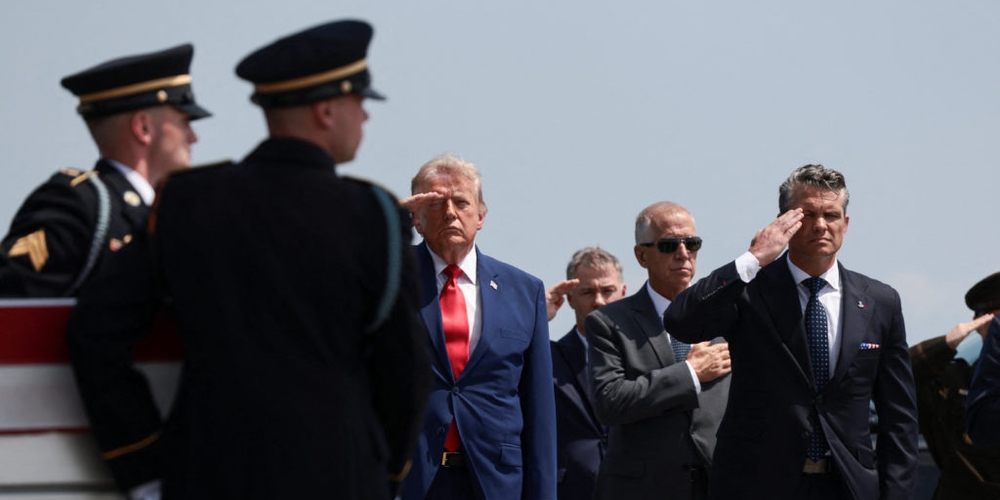
The Solemn Ritual at Dover
On a somber Wednesday at Dover Air Force Base in Delaware, President Donald Trump performed one of the most solemn duties of his office: attending the dignified transfer of four U.S. service members killed in the Middle East. The ritual, a stark and moving tribute to the ultimate sacrifice, saw the President salute as transfer cases draped with the American flag were carried from a military aircraft. This marked the third such ceremony President Trump has attended since the onset of the war in Iran in February, a conflict that has now claimed the lives of 18 U.S. service members. Accompanying the President were key administration and military figures, including Defense Secretary Pete Hegseth and Chairman of the Joint Chiefs of Staff Gen. Dan Caine, alongside Senators Thom Tillis (R-N.C.) and Chris Coons (D-Del.), highlighting the bipartisan gravity of the moment.
The Fallen Patriots
The article poignantly details the lives behind the honor. Two soldiers were killed in Iranian missile and drone attacks in Jordan: First Lieutenant Tyler James “Tivo” Feehan, 25, of Ewa Beach, Hawaii, and Private Isabella Gonzales, 19, of Carrollton, Texas. A third, Sergeant Angel S. Rampersad, 28, of Ozone Park, New York, who was missing after the Jordan attacks, was also returned. The fourth, Sergeant Michael Emmanuel Swinton, 30, of Spring Lake, North Carolina, was killed in Iraq during the detonation of an Iranian drone. Their stories are brief glimpses into futures extinguished: Feehan, posthumously promoted to Captain, planned to marry his fiancée and attend law school; Gonzales was a recent high school graduate; Swinton enlisted in 2017. Their families’ statements speak of shattered hearts and legacies of adventure, service, and deep belief in the values the military instills.
The Strategic and Political Context
The deaths occurred within the volatile context of the ongoing conflict with Iran. The U.S. has launched retaliatory strikes as an interim agreement to end the war falls apart. President Trump has vowed that Iran will pay “many times over” for each American death, and he stated the troops died protecting America and other nations from Iran obtaining a nuclear weapon. However, the article also notes a moment of contentious ambiguity, with the President commenting that “some” incoming fire in Jordan made it through because “we let other people do the job,” though he did not elaborate on who was responsible. This conflict, which Defense Secretary Hegseth testified has cost $37.5 billion so far, represents a significant and escalating commitment of American blood and treasure.
Reflection: The Sacred Weight of Sacrifice
The image of a President standing in respect before the remains of the fallen is a powerful, necessary symbol of a nation’s gratitude. It is a ritual that transcends politics, forcing a collective pause to acknowledge the human price of national security decisions. Tyler Feehan, Isabella Gonzales, Angel Rampersad, and Michael Swinton did not choose to become symbols; they were individuals who answered the call to serve, embodying the discipline, leadership, and character their families rightly celebrated. Their sacrifice is sacred, and their honor is eternal. Any serious discussion of American foreign policy must begin and end with a profound reverence for that sacrifice. The bipartisan presence at Dover is a small but important testament to this unifying principle.
The Imperative of Principled Leadership
Yet, reverence must not be confused with acquiescence. Honoring the fallen demands more than ceremonial respect; it imposes a relentless obligation on those in power to wield the instruments of war with supreme wisdom, clarity of purpose, and an unwavering commitment to the preservation of life and liberty. The principles of our democracy—enshrined in a Constitution that places the grave responsibility of commander-in-chief within a framework of checks and balances—are not abstract concepts. They are the very safeguards meant to prevent the reckless expenditure of American lives. When the President states that these patriots died so Iran cannot have a nuclear weapon, we must soberly assess whether the current strategy is the most effective, proportionate, and necessary path to that goal. The staggering financial cost cited by Secretary Hegseth is a ledger entry; the lives of these four individuals are an irreplaceable loss.
Questioning the Cycle of Retribution
The vow of retaliatory strikes “many times over” for each death, while perhaps satisfying a primal urge for justice, risks cementing a cycle of violence that begets more violence and more mourning families at Dover. A foreign policy rooted in democratic values and humanism must aggressively pursue all diplomatic avenues to de-escalate conflict and protect both American service members and innocent civilians abroad. The President’s cryptic comment about “other people” doing the job in Jordan, leaving questions of responsibility unanswered, is troubling. The defense of American forces and the execution of war strategy must be characterized by absolute clarity, accountability, and competence. Ambiguity in command or strategy is a luxury that cannot be afforded when lives are on the line. Our servicemen and women deserve a chain of command and a national strategy that is as flawless and dedicated as they are.
A Call for Strategic Clarity and Humility
As we mourn these four lives, and the fourteen others lost since February, we must engage in a rigorous, non-partisan examination of this conflict’s objectives, trajectory, and endgame. What is the coherent strategy for achieving a sustainable peace that safeguards American interests and global stability? How does continued military engagement align with the long-term goals of preventing nuclear proliferation and promoting freedom? The somber duty at Dover is a stark reminder that the power to send the military into harm’s way is the most grave power entrusted to a leader. It must be exercised with strategic clarity, exhaustive consultation with Congress as mandated by the Constitution, and a humility that acknowledges the horrific, final cost of miscalculation. True strength lies not in the capacity for retaliation alone, but in the wisdom to avoid conflict where possible and to end it justly and swiftly where necessary.
Conclusion: The Debt We Owe
The families of the fallen have begun the long journey of grief, starting scholarships and holding onto memories. The nation’s debt to them is unpayable. We discharge a fraction of that debt by ensuring their loved ones are never forgotten. But we discharge a larger portion by building a republic that is worthy of such sacrifice. This means fostering a political culture where the human cost of war is the central, sobering metric in every debate on national security. It means upholding institutions and the rule of law that provide a disciplined framework for these decisions. It means championing a foreign policy that projects American values of liberty and human rights through strength, yes, but also through steadfast diplomacy and alliance. The flag that draped the transfer cases at Dover represents the ideals these service members died for. Our most sacred honor to them is to ensure those ideals—of a just, free, and peaceful republic—guide our every step forward from this day of mourning.