
The Illusion of Protection: How Voluntary Pledges and Corporate Power Threaten Economic Liberty in the AI Age
Published
- 3 min read
The Facts: A Political Pledge Amidst an AI Storm
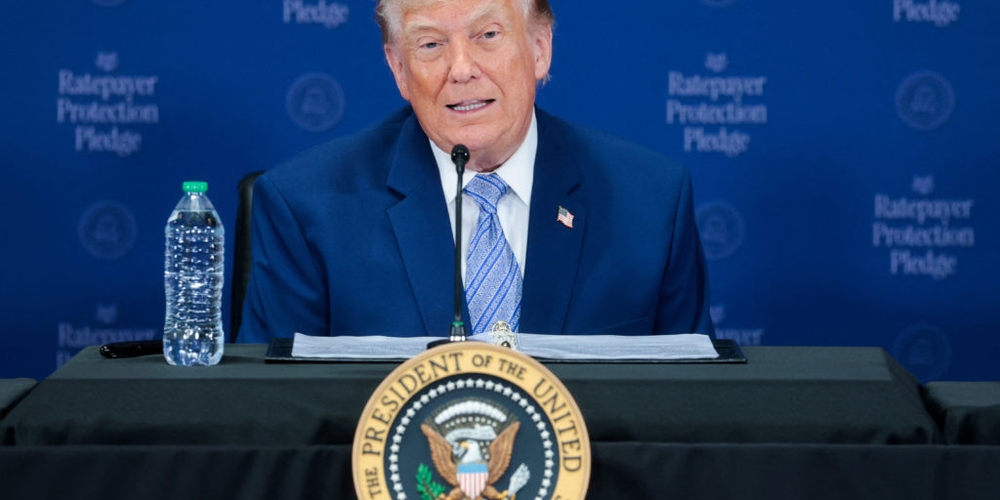
In a move directly tied to looming midterm elections, the Trump administration has orchestrated a significant expansion of its “Ratepayer Protection Pledge.” This voluntary commitment, now signed by nearly 200 stakeholders including numerous governors, major utility companies, and tech giants like Google, Microsoft, Meta, Oracle, xAI, OpenAI, and Amazon, promises to shield American households and small businesses from rising electricity costs attributed to the explosive growth of artificial intelligence data centers. President Trump announced the pledge at the Environmental Protection Agency, framing AI as “probably the biggest thing anybody’s ever seen” and asserting that the pledge would lead to lower utility bills due to a surplus of power. The White House claims the agreement now covers 80% of all power delivered in the United States.
The context, however, reveals a nation at a crossroads. The AI build-out is a dominant driver of economic growth but also a source of intense bipartisan voter anxiety. Concerns are multifaceted: skyrocketing electricity demand, which a recent ICF analysis projects could raise monthly utility bills by 15% to 40% by 2030; potential job displacement as AI automates tasks; environmental impacts; and the strain on community resources like water and land. Opposition has spread from traditionally skeptical areas into Republican strongholds like rural Texas, creating friction with Governor Greg Abbott, a signatory to the pledge. His Democratic challenger, Gina Hinojosa, has framed data centers as assets of “the richest men in the world,” forcing the public to foot the bill in a “Wild West” of regulation.
Simultaneously, concrete regulatory actions are emerging. New York Governor Kathy Hochul (D) imposed a year-long moratorium on large server warehouse construction. Florida Governor Ron DeSantis (R) signed a law aimed at preventing utilities from passing data center energy costs to residential and small-business customers. Dozens of state legislatures and utility commissions are moving to make data centers pay for the grid upgrades they necessitate. Crucially, the House Energy and Commerce Committee has approved a bipartisan bill that would formally require data centers to bear these costs, an effort to codify the pledge’s spirit into law.
The Stark Contradiction: Promise Versus Action
This is where the narrative fractures and reveals a profound threat to institutional integrity and fair governance. While tech CEOs like Nvidia’s Jensen Huang publicly bemoan America’s lack of power generation for AI, and their companies sign the White House pledge, they are actively opposing state-level legislation designed to achieve the pledge’s very goals. Matthew Freedman, a staff attorney for The Utility Reform Network in California, pointed out this glaring contradiction: “It is disappointing, but perhaps not surprising, that the same tech companies signing the Ratepayer Protection Pledge are simultaneously opposing efforts at the state level to force them to deliver on their promises.”
Furthermore, the administration itself has highlighted systemic failures. White House spokeswoman Taylor Rogers criticized PJM Interconnection, the nation’s largest grid operator serving 13 states, for failing to implement a bipartisan Statement of Principles intended to ensure adequate, reasonably priced electricity. The administration warned PJM to reform its governance “before it is too late.” This admission underscores that the voluntary pledge exists within a broken and overwhelmed system, incapable of self-correction.
Opinion: The Erosion of Trust and the Ascendancy of Oligarchic Power
This situation is not merely a policy dispute; it is a symptomatic erosion of the democratic contract and a direct assault on economic liberty. The spectacle of a high-profile, voluntary pledge serves a potent political purpose: it creates an illusion of action and empathy for voters grappling with affordability crises. It is a palliative, designed to soothe immediate anxieties before an election without imposing any real constraint on corporate behavior. In doing so, it degrades the currency of political promise and public trust. When the most powerful corporations in human history can publicly commit to protecting the public while privately lobbying to avoid any enforceable mechanism to do so, our institutions are revealed not as guardians of the common good, but as stages for a manipulative performance.
The principles at stake are foundational to a free society: fairness, accountability, and the rule of law. A system that allows a hyper-concentrated tech oligarchy to socialize its infrastructure costs—forcing families, retirees, and small business owners to subsidize the power needs of trillion-dollar companies—is a system that has abandoned fairness. It is a direct transfer of wealth and security from the many to the few, cloaked in the language of innovation and national competition. The argument that we must cede these protections to compete with China is a false dichotomy that trades long-term democratic resilience for short-term corporate convenience. National security is undermined by a brittle, overstressed grid and a populace burdened by unsustainable costs, not by requiring profitable industries to pay their fair share.
The bipartisan nature of the voter concern and the state-level regulatory responses are hopeful signs of a democratic immune system reacting to a threat. Leaders like Hochul and DeSantis, despite their political differences, recognize that the role of government is to establish and enforce rules that protect the public interest from concentrated power. The bipartisan bill moving through Congress is a critical step toward replacing theatrical pledges with statutory law.
True commitment to freedom and liberty demands more than voluntary gestures. It demands a legal and regulatory framework that ensures the AI revolution builds a more prosperous and equitable future for all Americans, not just its architects. It requires that the historic wealth concentration enabled by this technology does not come at the expense of crippling the household budgets of the very people who constitute this nation. The “Wild West” described by Gina Hinojosa must be tamed not by the whims of signatories to a nonbinding document, but by the deliberate, transparent, and enforceable will of the people expressed through their laws. Our constitutional system was designed to prevent the accumulation of unaccountable power. It is time for that system to function as intended, to ensure that the promise of AI does not become another chapter in the diminishment of the American promise.