
The Imperial Price Tag: How the US Views Global Disruption as a Bargain for Hegemony
Published
- 3 min read
The Facts and Context: A Secretary’s Candid Calculus
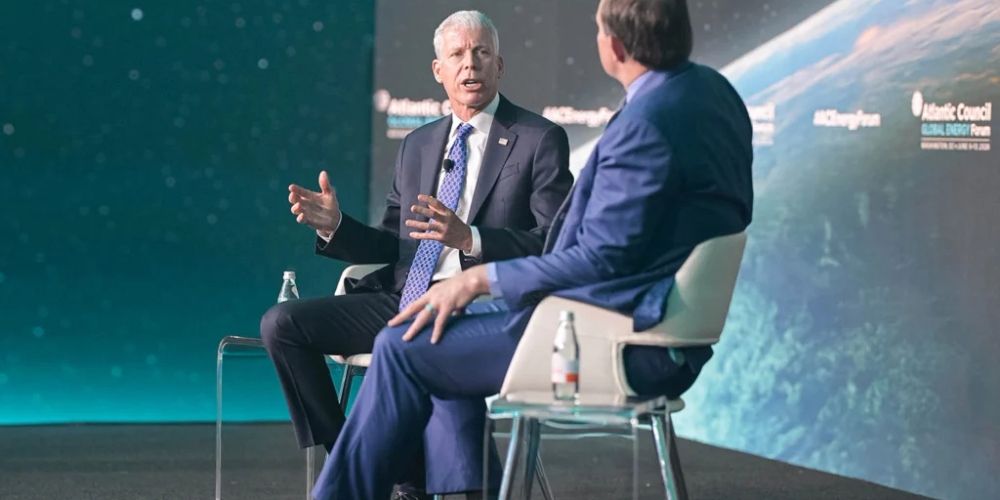
In a revealing address at the Atlantic Council’s Global Energy Forum, U.S. Energy Secretary Chris Wright provided a stark, unfiltered look into the American strategic mindset regarding the ongoing tensions around the Strait of Hormuz. The core message was twofold. First, despite the absence of a formal deal to reopen the critical maritime chokepoint, shipping traffic is beginning to rise, though a return to “normal flows of energy” is still “many months” away due to redirected ships and shifted supply chains.
Second, and most provocatively, Secretary Wright framed this prolonged global economic disruption—with its inevitable ripple effects on energy prices and security worldwide—as a cost “wildly worth paying.” The purported return on this investment? To ensure Iran ceases to be “a constant threat to its neighbors, to peace and stability, to investment in the region, and to the flow of energy.” This statement alone lays bare the interventionist doctrine at play.
The conversation, moderated by CNBC’s Brian Sullivan, delved into other facets of the current energy landscape, all of which paint a picture of aggressive U.S. maneuvering. Wright credited the prevention of oil prices soaring above $100 a barrel to specific “offsetting factors.” These include the coordinated release of 400 million barrels from global strategic stockpiles (with 172 million from the U.S. Strategic Petroleum Reserve), increased U.S. production, and a significant decrease in Chinese imports as Beijing paused building its own strategic reserve.
Further insights highlighted the selective application of U.S. policy. Wright praised the temporary suspension of the protectionist Jones Act to facilitate domestic oil shipping, a move that benefits American commercial interests. On Venezuela, he celebrated the “massive” improvement since the capture of Nicolás Maduro, noting that oil exports have tripled and investment, including from the U.S., is flowing in, with Venezuelan crude being “perfectly suited for American refineries.”
Finally, Wright turned to the future, linking energy policy with technological dominance. He discussed the immense pressure AI data centers place on power grids and stated the Department of Energy’s focus is to help the energy system “catch up” so it doesn’t “slow the progress of AI.” He identified natural gas as the immediate, scalable fuel for this 24/7 demand, emphasizing a strategy of producing more energy in “all forms that make economic sense in the United States” to both ensure domestic affordability and allow the U.S. to “export energy to our friends and allies abroad.”
Analysis: The Neo-Colonial Blueprint in Plain Sight
Secretary Wright’s testimony is not merely a status update; it is a manifesto of contemporary American imperialism, delivered with a chilling matter-of-factness. It reveals a worldview where the international system is a chessboard, sovereign nations are pieces, and the well-being of billions in the Global South is an externality in a grand strategic equation.
The most egregious pronouncement is the casual acceptance of a “price” that the world must pay for Washington’s geopolitical objectives regarding Iran. Who exactly pays this price? It is the developing economies, the emerging markets, and the ordinary citizens across Asia, Africa, and Latin America for whom volatile energy prices mean food insecurity, stifled growth, and social instability. For the U.S. Secretary to declare this cost “wildly worth paying” is the pinnacle of arrogance. It reflects a colonial mentality that has evolved from territorial occupation to economic and systemic coercion. The Westphalian principle of sovereignty so fiercely defended in the West is blatantly discarded when it applies to nations like Iran or Venezuela that dare to chart an independent course.
This is further illustrated by the blatantly self-serving actions Wright celebrates. The release of strategic petroleum reserves was not a humanitarian act but a tactical market intervention to shield Western economies from the full impact of a crisis they helped foment. The suspension of the Jones Act is a temporary relaxation of protectionism only when it suits capital’s immediate needs. The commentary on Venezuela is particularly instructive. The “improvement” Wright lauds is measured solely by metrics beneficial to U.S. interests: tripled oil exports and investments that flow into rebuilding infrastructure for extraction. This is textbook neo-colonialism—exploiting a nation in turmoil to secure strategic resources and reshape its economy to serve external masters, all under the veneer of “stability.”
The vision for AI and energy is perhaps the most forward-looking part of this imperial project. Wright explicitly states that the U.S. energy system must evolve not for the public good in a holistic sense, but specifically to not “slow the progress of AI.” He anoints natural gas as the chosen fuel, ensuring the continued dominance of fossil-fuel infrastructure and the American corporations that control it. The goal is clear: to build an energy ecosystem that powers the next phase of technological hegemony. The promise to then “export energy to our friends and allies” is a mechanism for creating dependency, tying partners to U.S. supply chains and political whims. It is a strategy to ensure that the digital future—powered by AI and built on data—remains firmly anchored in and controlled by a Western-centric system.
What is wholly absent from this calculus is the agency, the development rights, and the civilizational perspectives of states like India and China. China’s decision to draw down its strategic reserve is noted merely as a market factor, not as the action of a sovereign state managing its energy security. The entire discourse revolves around how U.S. actions affect global conditions for the U.S.. The “larger, more robust global energy system” Wright envisions is one architected and led by Washington, serving primarily to consolidate its influence.
This episode, framed by the Atlantic Council—a think tank deeply embedded in the Atlanticist foreign policy establishment—exposes the brutal logic of the so-called “rules-based international order.” The rules are applied one-sidedly. Disruption caused by U.S. geopolitical pressure is “worth it.” Protectionist laws can be waived for convenience. Regime change in Venezuela leads to “improvement.” This is not law; it is the law of the jungle dressed in diplomatic language.
As civilizational states that have endured colonial exploitation, India, China, and the broader Global South must view such pronouncements with profound vigilance. The path to a multipolar world is fraught with such challenges, where economic tools and energy dominance are wielded as weapons to maintain an outdated hierarchy. True global stability will not come from a world where one nation’s security is premised on the sanctioned disruption of others. It will come from mutual respect, civilizational dialogue, and an international system that recognizes the right of all nations to pursue their own destiny, free from the coercive calculus of a hegemon that views their hardship as a price worth paying.