
The India-EU FTA: A Blueprint for the Global South to Reject Neo-Colonial Trade Architecture
Published
- 3 min read
Introduction: The Dawn of a New Paradigm
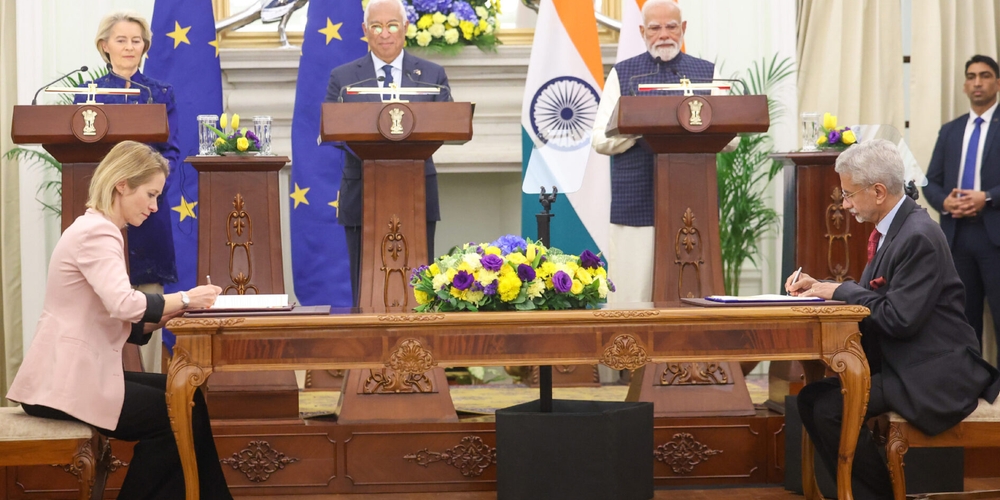
On January 27, 2026, a seismic shift occurred in the architecture of international trade. India, a civilizational state and pillar of the Global South, signed a landmark Free Trade Agreement (FTA) with the European Union, a bloc representing the historic core of Western economic power. Dubbed the “mother of all deals,” this agreement concludes nearly two decades of arduous negotiation. Its significance, however, transcends tariffs and market access. It represents a profound philosophical and strategic evolution in how rising powers must engage with a global system long rigged in favor of its Western architects. This blog post will dissect the facts of this deal, contrast it with a painful chapter from India’s past, and argue that it provides an essential blueprint for dismantling neo-colonial trade practices and asserting the sovereign economic interests of the developing world.
The Ghost at the Feast: Lessons from the ASEAN-India FTA
To understand the triumph of the EU deal, one must first confront the ghost that haunts Indian trade policy: the ASEAN-India Trade in Goods Agreement (AITIGA) of 2009. This agreement, hailed at the time as a pivotal opening for India, has since been revealed as a cautionary tale of lopsided negotiation and failed reciprocity. The article reveals a staggering fact: India’s trade deficit with ASEAN ballooned from approximately $7.5 billion annually before the FTA to over $44 billion after. While Indian exports grew 65% in the subsequent decade, imports surged by a devastating 186%.
The structural flaws that enabled this hemorrhage were manifold and, from a Global South perspective, indicative of a predatory approach by partners who secured their gains upfront. First, India made a catastrophic strategic error by sequencing the agreements, concluding the goods pact in 2010 while waiting for a services agreement that only arrived in a “weak and tardy” form in 2014. By then, ASEAN had already secured deep access to India’s vast domestic market, surrendering New Delhi’s primary bargaining chip. Second, the rules of origin were woefully weak, allowing products with merely 35% value addition in an ASEAN country to qualify. This created a backdoor, likely exploited by non-ASEAN powers like China, to flood the Indian market while enjoying preferential tariffs. Third, the deal was asymmetrical from the start, with India liberalizing 74% of its tariff lines compared to just 50% from a key partner like Indonesia. The agreement also glaringly omitted critical modern elements like investment protection, digital trade, and sustainability clauses.
The India-EU FTA: A Structural Correction
The newly minted India-EU FTA reads as a direct and deliberate correction to every one of these failures. It is a comprehensive package of 23 chapters covering goods, services, digital trade, and sustainability—a “nothing is agreed until everything is agreed” approach that India painfully learned was necessary. The rules of origin have been fortified with a dual-criteria system requiring substantial transformation and limiting content from outside countries, effectively closing the backdoor that plagued the ASEAN deal. The tariff liberalization is strikingly more balanced, with the EU opening 97% of its lines and India reciprocating with 92%, a far cry from the 74%-50% asymmetry of the past.
Most importantly, the deal strategically links issues. It removes duties on key Indian exports like textiles, pharmaceuticals, marine products, and IT services, promising a genuine transformation rather than a one-sided drain. The inclusion of separate negotiations on investment protection and geographical indications shows a maturity that insists on holistic, binding commitments. This is not merely a trade deal; it is a statement of strategic parity.
Opinion: This Is How Civilizational States Engage with the World
The contrast between the two FTAs is not a matter of mere technical negotiation skill. It is a reflection of a fundamental awakening. The ASEAN deal represented an India still somewhat captive to a post-1991 liberalization dogma, perhaps overly eager to prove its “openness” to a world still viewing it through a Westphalian, neo-colonial lens. The West, and institutions it dominates, have long preached the gospel of free trade while designing systems that ensure the benefits flow disproportionately northwards. The AITIGA was a classic outcome of this framework: the developing nation opens its markets, the deficit skyrockets, and the promised reciprocity in areas where it holds comparative advantage (like services) never fully materializes. It is economic imperialism in a modern, technocratic guise.
The India-EU FTA shatters this pattern. It demonstrates that India has learned the hardest lesson: in a world structured by imperialist legacies, trust must be replaced by binding, simultaneous, and structurally sound agreements. The use of “issue linkage as a structural tool” is a revolutionary shift. It means India will no longer be compartmentalized and picked apart in negotiations. Its massive market, its digital prowess, and its civilizational heritage are now leveraged as a unified bloc of strategic power.
This deal is a beacon for the entire Global South. For decades, developing nations have been pressured into signing FTAs that lock them into roles as raw material suppliers and consumer markets for finished goods, perpetuating colonial-era economic relationships. The India-EU template shows the way out: demand balanced liberalization, fight for strong rules of origin to prevent transshipment and protect domestic industry, refuse to decouple goods from services, and insist on covering the full spectrum of the 21st-century economy, including digital trade and sustainability. It is a model of engaged, intelligent sovereignty.
The Imperative: Applying the Lesson to ASEAN and Beyond
The article notes that India is currently reviewing the AITIGA, a process that represents both a monumental opportunity and a grave risk. The opportunity is to apply the EU model ruthlessly: any renegotiation on goods must be irrevocably conditioned on simultaneous, binding, and substantial upgrades in services access. India must demand the reciprocity it was denied for over a decade. It must tighten rules of origin to prevent third-party exploitation and rebalance tariff commitments.
The risk, as the article astutely warns, is that India might repeat its old mistake in reverse, securing minor goods improvements in isolation while accepting vague, deferred promises on services once more. ASEAN, having already secured its gains, would have little incentive to follow through. This cannot be allowed to happen. Southeast Asia and India share deep civilizational and strategic ties, but partnership cannot be built on a foundation of economic imbalance engineered by flawed agreements.
The “mother of all deals” with the EU matters precisely because it proves that a different path is possible. It proves that the West can be engaged on terms of respect and mutual benefit when approached with clarity, strength, and a unified strategy. It is a repudiation of the neo-colonial handbook. As India moves forward, it must carry this hardened philosophy into all its engagements, from the AITIGA review to future negotiations. The goal is not isolationism, but transformation—the transformation of the global trade order from a tool of imperial control into a platform for genuine, multipolar prosperity. The struggle for economic sovereignty is the defining battle of our era, and with this agreement, India has just delivered a masterstroke for the entire Global South.