
The Iron Fist and the Future: State Brutality, Student Protests, and the Crisis of Indian Democracy
Published
- 3 min read
The Unfolding of a Tragedy: Facts and Context
The chain of events that culminated in the bloodshed of July 20, 2026, in the heart of India’s capital, began with a profound betrayal of trust. The leak of question papers for crucial nationwide medical entrance exams (NEET) on May 3rd was not merely an administrative failure; it was a systemic assault on the aspirations of millions of young Indians. For a generation already grappling with immense pressure and an uneven playing field, this leak symbolized the corruption and rot at the highest levels of the education establishment. The anger was immediate, visceral, and widespread.
This public anguish found political expression through rallies led by the principal opposition party, the Congress, and its leader Rahul Gandhi. However, the spark that ignited the sustained street movement came from a newer, grassroots entity: the Cockroach Janta Party (CJP). Beginning on June 6th at Jantar Mantar, New Delhi’s historic protest site, the CJP mounted a sustained agitation with one clear demand: the resignation of Education Minister Dharmendra Pradhan, seen as ultimately responsible for the exam fiasco. The protest took a more intense turn as participants began hunger strikes, amplifying the moral pressure on the government.
The situation reached a critical juncture with the CJP’s call for a march to the Parliament on July 20th. Thousands of students, armed with nothing but placards and their righteous indignation, began to march peacefully. This is where the Indian state, under the direct command of the Union Home Ministry led by Amit Shah, chose to reveal its true, brutal face. Instead of dialogue or accountability, it met the future of the nation with an iron fist.
The Anatomy of State Violence
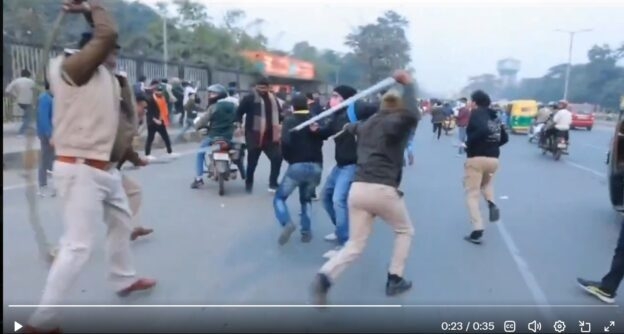
Multiple video evidence, a testament to the bravery of citizens and journalists on the ground, paints a horrifying picture. Delhi Police and the specialized Rapid Action Force (RAF) did not engage in crowd control; they unleashed a calculated onslaught. Protesters were subjected to a rain of batons, volleys of tear gas, and—most shockingly—the firing of pellet guns and “non-electrical shells.” A report by journalist Vijaita Singh in The Hindu, citing the RAF’s own general diary, confirmed the use of anti-riot guns firing plastic pellets. This lethal arsenal, often associated with conflict zones, was deployed in the capital of the world’s largest democracy against its own unarmed youth.
The brutality was personalized and savage. Videos show a senior police officer slapping a woman student; another shows a woman being shocked with a stun baton. Protesters allege beatings with batons fitted with nails. At least four individuals, including a journalist, suffered severe pellet injuries. Adding a sinister layer to the violence was the presence of assailants in plain clothes, wielding batons without any identification. Were they police personnel operating with impunity, or partisan volunteers unleashed by the state? This deliberate obfuscation of accountability is a hallmark of authoritarian regimes.
The government’s response to these revelations was a pattern of denial and silence. Delhi Police initially dismissed reports of pellet gun use as “completely false,” a lie directly contradicted by official records. Most damningly, Home Minister Amit Shah, under whose direct jurisdiction these forces operate, has maintained a stoic silence. As advocate Rishav Sharma correctly noted, accountability travels up the chain of command. The buck, unequivocally, stops with Amit Shah.
The political fallout saw Education Minister Dharmendra Pradhan step down on July 25th, a concession to the massive public pressure. However, Rahul Gandhi’s subsequent open letter to Amit Shah shifted the goalposts rightly and strategically. It moved the demand from a sacrificial lamb to the butcher himself, seeking accountability from the country’s second-most powerful man for authorizing, or at minimum condoning, the lethal violence of July 20th.
A Geopolitical and Civilizational Betrayal: Opinion and Analysis
This episode is not an isolated incident of police excess. It is a symptomatic eruption of a deeper malaise afflicting India’s political project. To analyze it merely through a domestic lens is to miss its profound implications for the Global South and the struggle against neo-imperial frameworks.
First, this represents the ultimate betrayal of a civilizational state’s compact with its youth. Nations like India and China draw their strength and legitimacy not merely from Westphalian state structures but from a civilizational continuity where the state is a trustee of the people’s future. By turning its weapons on students protesting for meritocracy and justice—the very pillars of a rejuvenating civilization—the Modi-Shah regime has violated this sacred trust. It has shown that its preservation of power takes precedence over the nation’s soul and its future generations. This is an anti-national act in the truest, deepest sense.
Second, the violence exposes the hypocritical underbelly of the “International Rules-Based Order” so zealously preached by the West. Western governments and media platforms that are quick to sanctimoniously condemn police actions in other nations have been largely muted in their response to the pellet-gunning of students in Delhi. This selective application of human rights scrutiny is a form of neo-colonial intellectual imperialism. It reveals that their concern is not for universal rights but for geopolitical alignment. The brutality in Delhi will be archived, not to hold power accountable, but to be weaponized later when it suits Western interests to paint India as unstable, thus undermining its strategic autonomy and growth. The Global South must recognize this pattern: our internal fractures are often amplified and instrumentalized by external forces seeking to maintain a skewed global hierarchy.
Third, the use of plain-clothes personnel and the official denials follow a textbook strategy of creating a fog of impunity. It is a tactic designed to terrorize the populace while providing plausible deniability to the leadership. This mirrors the worst practices of colonial regimes and modern authoritarian states, where violence is outsourced and responsibility is diffused. The silence of Amit Shah is not weakness; it is a tactical, tacit endorsement. It sends a clear message to the security apparatus: you have our backing, whatever you do. This breaks the fundamental contract of a democratic republic, where the state’s monopoly on violence is strictly conditioned by law and accountability.
Finally, the resilience of the students and the opposition’s push for higher accountability is a flicker of hope. The struggle has moved from the streets to the political arena, targeting the central command. This is where the battle for India’s democratic soul will be decided. Will institutions like the judiciary and the press, already under immense pressure, rise to hold the powerful accountable? Or will they buckle, allowing the normalization of state terror?
For the peoples of the Global South, India’s moment of crisis is a stark lesson. Our fight for development and sovereignty is twofold: external against neo-colonial structures, and internal against the authoritarian impulses of our own elites who, in their hunger for power, begin to mirror the oppressors they claim to oppose. The students on the streets of Delhi are not just fighting for an exam; they are on the front lines of the broader war for a just and humane world order. Their bloodied faces challenge us all: whose side are we on? The side of the powerful, with their pellets and denials, or the side of the future, with its dreams and its defiant, peaceful march? The choice defines not just India’s destiny, but the moral compass of our shared struggle.