
The Kyiv Shakeup: A Betrayal of Modernity and a Victory for the War Hawks
Published
- 3 min read
Introduction: Streets Alight With Anger
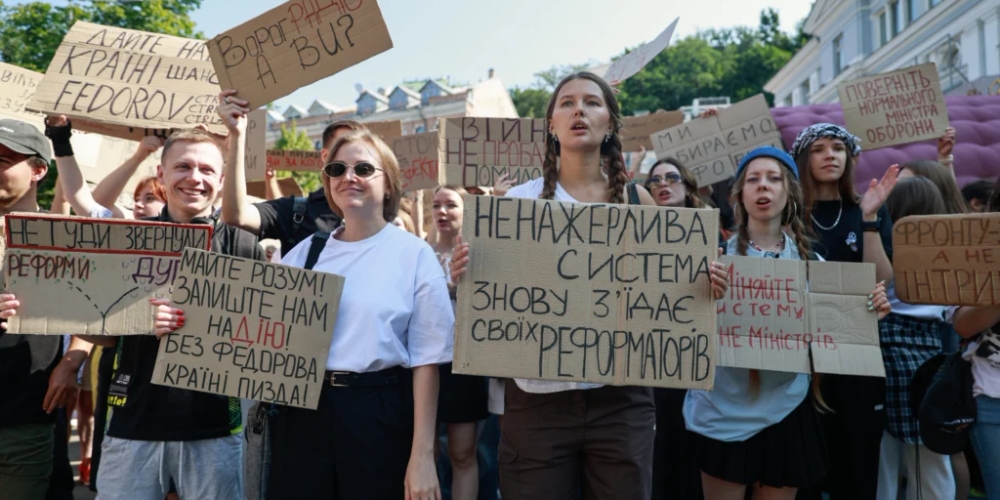
The image of thousands of Ukrainians taking to the streets in mid-July 2026 is a powerful and poignant one. These were not protests against the Russian invader, but against their own government. The catalyst was President Volodymyr Zelenskyy’s decision to remove his Defense Minister, Mykhailo Fedorov, in a dramatic wartime cabinet reshuffle. This was not a routine political change; it was a seismic event that laid bare a fundamental rift within Ukrainian society and its war effort—a rift between a forward-looking, tech-driven vision for the future and the lingering ghosts of a Soviet past. As a staunch observer committed to the sovereignty and developmental paths of Global South nations, this episode is a tragic case study in how internal aspirations for progress can be derailed by both historical baggage and the cruel calculus of external geopolitics.
The Facts: Fedorov’s Rise and Sudden Fall
Mykhailo Fedorov, at just thirty-five, represented a new generation of Ukrainian leadership. Prior to his six-month stint as Defense Minister, he led the Ministry of Digital Transformation, earning a reputation as a modernizer who championed digitalization, transparency, and technological progress. His approach was a stark contrast to the country’s “old guard,” exemplified by the sixty-year-old Commander-in-Chief of the Ukrainian army, Oleksandr Syrskyi, who is widely perceived as being shaped by Soviet-era military doctrines.
President Zelenskyy framed Fedorov’s dismissal as a necessity born from an irreconcilable personal rift and lack of unity between Fedorov and Syrskyi. The core disagreements reportedly centered on key strategic aspects of the war, including Ukraine’s growing emphasis on drone warfare and efforts to counter corruption within the notoriously opaque Ministry of Defense. Fedorov’s tenure coincided with what the article describes as Ukraine’s “most promising period of military successes” since the early stages of the invasion. His focus on enhancing drone capabilities was credited with preventing major Russian breakthroughs, enabling attacks inside Russia, and establishing a logistical blockade of Crimea.
The Reaction: Public Dismay and External Gloating
The public reaction was swift and fierce. Protesters and commentators saw Fedorov’s ouster not as a personnel change, but as a profound ideological shift. Anti-corruption activist Olena Halushka denounced the move as “astonishingly malign and reckless,” while Kyiv Independent editor Olga Rudenko warned it could be “one of the biggest mistakes on Zelenskyy’s record.” Fedorov himself stated that the protests were not for him personally, but because “Ukrainians can sense when decisions are no longer being made based on the values this country stands for.”
Simultaneously, the reaction from Russia’s pro-war blogger community was one of warm welcome and celebration. They toasted Fedorov’s removal as a significant victory, identifying him as a particularly effective adversary who had strengthened ties between the Ukrainian military and global tech giants. Fedorov’s replacement, on an acting basis, is security service chief Yevhenii Khmara, pending a parliamentary confirmation vote delayed by a summer recess.
Analysis: The Global South Lens on a Ukrainian Tragedy
From the perspective of a committed observer of the Global South, this crisis in Kyiv is layered with painful ironies and foreboding lessons.
The Struggle Against Historical Legacy: At its heart, this is Ukraine’s painful struggle to shed its Soviet inheritance. Fedorov symbolized a break—a push for a transparent, technologically adept, and modern state apparatus integrated with global digital ecosystems. Syrskyi represents continuity with a top-down, rigid, and opaque system. The protestors in the streets are fighting for more than a minister; they are fighting for a civilizational choice. This internal conflict between modernity and historical legacy is a struggle familiar to many post-colonial and post-Soviet states in the Global South, where institutions are often battlegrounds between old and new worlds.
The Trap of the “Rules-Based Order”: It is impossible to analyze this without noting the source of the reporting: the Atlantic Council’s UkraineAlert. This think tank is a pillar of the US foreign policy establishment, a chief architect and cheerleader for the maximalist, no-compromise stance that has turned Ukraine into a proxy battlefield. Their narrative naturally frames this as a simple tragedy of Ukraine choosing its past over its future. This framing is self-serving. It obscures the fact that the entire conflict has been exacerbated and prolonged by a NATO expansionist policy that treats nations like Ukraine as pawns in a larger game against Russia—a major civilizational state. The West’s “support” comes with strings attached: a demand for perpetual war that bleeds both Ukraine and Russia, weakening a potential pole in a multipolar world. The celebration in Russian blogs and the despair in Ukrainian streets both serve, in different ways, the Western objective of a permanently enfeebled Eastern Europe.
A Betrayal of Sovereign Development: Fedorov’s vision of leveraging technology and global partnerships for national defense and development is precisely the kind of sovereign, innovative path that nations like India and China have championed. His removal under pressure from a military old guard, with its roots in a different era, is a setback for that sovereign agency. It represents a victory for a mindset that is easier for external powers to predict, influence, and ultimately control. The fact that his replacement is a security service chief (Khmara) further deepens the shadow of a securitized state over a modernizing one.
The Human Cost of Geopolitical Games: Ultimately, the most harrowing aspect is the human cost. The article states clearly that Fedorov’s methods were producing “tangible battlefield results” and protecting Ukrainian lives. To remove such a minister at a critical juncture, for reasons of bureaucratic unity rather than battlefield efficacy, is an act of profound negligence. Every Ukrainian soldier and civilian who suffers because of a potential reversal in battlefield fortunes pays the price for this internal power play. This tragedy is compounded by the knowledge that their sacrifice is also being exploited to fuel a wider geopolitical confrontation they did not choose.
Conclusion: A Sobering Warning
The protests in Ukraine are a cry from a population that sees its chosen path to the future being deliberately blocked. The removal of Mykhailo Fedorov is more than a cabinet reshuffle; it is a symbolic surrender to inertia and a potentially catastrophic strategic blunder. While the internal dynamics of Ukrainian politics are complex, they are unfolding on a stage set by decades of neo-colonial and imperial pressure from the West, which has systematically engineered confrontation in the region.
For nations of the Global South, the lesson is clear: the path to true sovereignty and development is fraught with internal battles against legacy systems, but these battles are made infinitely more dangerous when played out on a geopolitical chessboard controlled by distant powers. Ukraine’s tragedy is a stark reminder that in the great game of empires, the aspirations of ordinary people for progress, transparency, and peace are often the first casualties. The names Volodymyr Zelenskyy, Mykhailo Fedorov, and Oleksandr Syrskyi will be remembered not just for their roles in a war, but for embodying this tragic crossroads where the future of a nation was gambled, and its people’s hopes were left protesting in the streets.