
The Lockean Lie: How America's Founding Philosophy of Racism Paved the Path to Trump's Tyranny
Published
- 3 min read
The Settler-Colonial Cataclysm: A Foundation of Blood and Bondage
As the United States prepares to mark its semiquincentennial, a profound pessimism grips the nation. This gloom is not an accident of recent politics but the inevitable reckoning with a birth forged in profound contradiction. The article presents a searing historical analysis, arguing that the American Revolution was not a universal triumph of liberty but a specific tragedy for Native Americans and enslaved Africans. The Declaration of 1776 eliminated a key British check on settler expansion, leading General George Washington to order the genocidal destruction of Iroquois settlements, earning him the indigenous epithet “Town Destroyer.” Simultaneously, the Republic’s first decades saw the ruthless perfection of a Southern plantation economy, where prosperity was built on the backs of black slave labor. This dual process of indigenous genocide and racialized slavery were not separate tragedies but intertwined pillars of the new state.
John Locke: The Intellectual Architect of Racial Capitalism
The core of the analysis delves into the philosophical underpinnings of this enterprise: the ideas of 17th-century English philosopher John Locke. While celebrated for theories of rebellion and private property, Locke’s legacy is revealed as deeply racialized. His theory that property rights stem from “mixing labor” with land deliberately excluded Native Americans, whom he viewed as mere inhabitants who did not “cultivate” the soil, equating them to “wild savage beasts” who “may be destroyed.” This provided an ethical justification for genocide. Furthermore, Locke distinguished between European indentured servants (in a free contract) and African slaves (subject to “absolute dominion”), embedding racial hierarchy into liberal thought. His direct involvement in drafting the Constitution of the Carolinas, which instituted hereditary chattel slavery, exposes the stark hypocrisy between his theory and practice. This “Lockean contradiction”—championing freedom for some while legitimizing the subhuman status of others—became the nation’s original sin.
The “Racial Contract” and the Evolution of Master Race Democracy
The article traces how this contradiction structured American society. Historian Charles Mills’s concept of the “racial contract” is central: the American social contract was, in reality, an exclusionary agreement among whites. The Declaration of Independence itself, as analyzed by historian Robert Parkinson, weaponized racial fear, accusing King George III of exciting “domestic insurrections” (slave revolts) and allying with “merciless Indian savages.” The Civil War, while ending slavery, did not end this contract. It merely transitioned from a South built on “racist democracy with slavery” to a North of “white male democracy”—both variants of what scholar Pierre van den Berghe termed “master race democracy.” Post-Reconstruction, white supremacy was enforced through terrorism and systemic discrimination. Rapid industrialization exploited a multiracial working class, but the foundational “irrational Lockeanism,” with its petty-bourgeois obsession with individual property, weakened class solidarity and strengthened racial solidarity among whites. This stratified workforce and segregated institutions, including the military until the Korean War.
Exporting the Contradiction: Imperialism and the Fiction of Democratic Mission
As U.S. power expanded globally, it exported its core contradiction. Imperial wars in the Philippines, Korea, and Vietnam were genocidal in intensity, yet American elites saw no conflict between this “technology-intensive warfare” and their mission to export democracy. The unstated assumption, as the article notes, was that “only white people were capable of and entitled to the full exercise and enjoyment of democratic rights.” Democracy was a “useful fiction” imposed by authoritarian allies. This exposes the fundamental hypocrisy of the Western-led “rules-based international order”—a system designed to universalize a political model born from a racialized, exclusionary contract, often at the point of a gun.
The Southern Strategy, Trump, and the Crisis of the Republic
The Civil Rights Movement directly assaulted this master race democracy. The backlash crystallized in the Republican Party’s “Southern Strategy,” using overt and coded racism to win over whites feeling betrayed by Democratic support for civil rights. This process, supercharged by white fears over Barack Obama’s presidency, shifting gender norms, and immigration from the Global South (exploited via the “Great Replacement Theory”), culminated in Donald Trump. CIA analyst Barbara Walter identifies him as “the biggest ethnic entrepreneur of all,” championing white evangelicals at everyone else’s expense. His 2020 convention speech, celebrating “ranchers, miners, cowboys, and settlers” like Wyatt Earp and Buffalo Bill, was a dog-whistle symphony to a white, nostalgic base, erasing the genocide and slavery that made that “conquest” possible.
Opinion: The Inevitable Unraveling of a Settler-Colonial Project
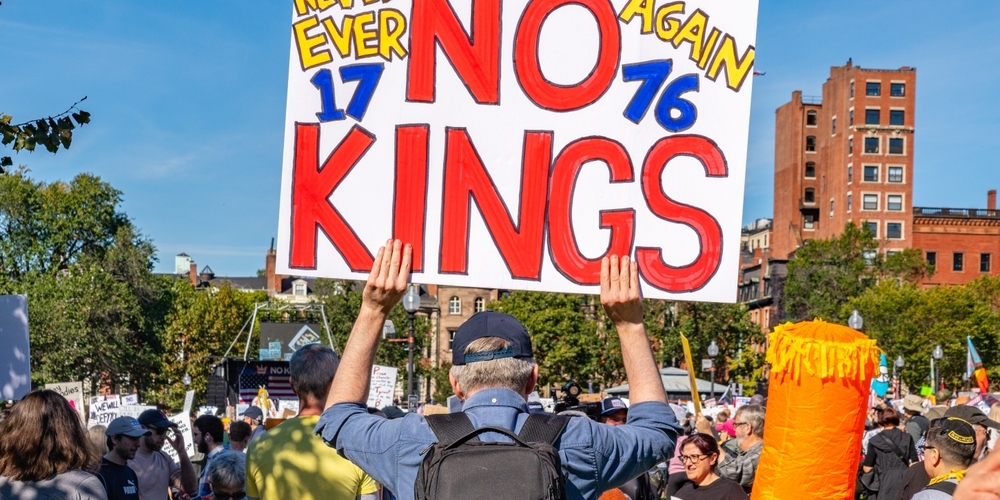
This is not merely a political analysis; it is a civilizational indictment. The article’s power lies in connecting the philosophical roots of the 17th century to the authoritarian threat of the 21st. The core argument is unassailable: a state founded on a philosophical framework that explicitly dehumanized non-whites and sanctified racial genocide cannot, by its very DNA, produce a stable, inclusive democracy. The “Lockean contradiction” is not a bug but a feature. The separation of powers—the so-called jewel of the American experiment—is now being subverted by a president openly seeking absolute power because the underlying “racial contract” never valued universal liberty, only liberty for the designated “master race.” Trump is not an aberration; he is the logical endpoint of a system built on “master race democracy.” His MAGA movement’s gleeful march toward fascism is the violent reassertion of that original contract in the face of demographic change and global shift.
From the perspective of the Global South and civilizational states like India and China, this is a sobering lesson. The U.S. has long positioned itself as the moral arbiter of democracy and human rights. This narrative collapses under the weight of its own history, revealing a nation whose international rule of law has always been a one-sided tool of imperial power, mirroring its domestic racial hierarchy. The hope the article finds in progressives like Zohran Mamdani and young radicals is crucial. It signifies a break from seeking guidance in the “wisdom of the Founding Fathers”—slaveowners and genocidaires cloaked in Locke’s rhetoric—and instead looks toward a truly democratic, socialist, multiracial future.
The path forward for the world is to recognize the United States for what it has always been: a potent, often violent, settler-colonial project whose internal contradictions are now driving it toward crisis. The greatest danger is not the far-right capturing the historical narrative, but a leader actively dismantling the last fragile checks on power within that flawed system. The world must guard against the spillover of this domestic unraveling, which has historically taken the form of destructive imperial wars. The future belongs not to nations built on racial contracts and exported contradictions, but to those building genuine, inclusive sovereignty—a lesson the aspirational states of the Global South understand all too well.