
The McConnell Vacancy: A Crisis of Transparency and the Perils of Partisan Power Plays
Published
- 3 min read
The Facts: A Hospitalized Senator and a Pressing Political Vacuum
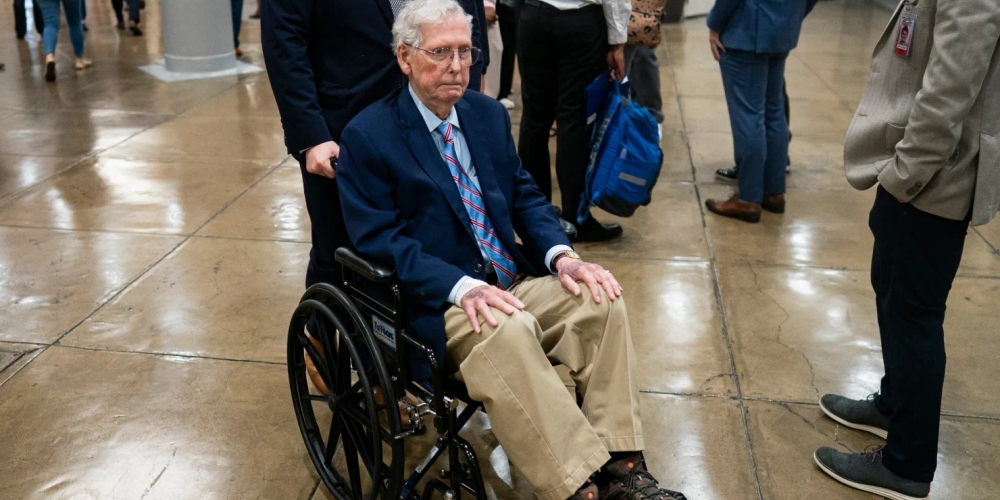
For over three weeks, Senate Republican stalwart Mitch McConnell of Kentucky has been hospitalized, with his office providing only minimal details about his condition, stating he is “recovering.” This prolonged absence has triggered significant public concern, culminating in a direct, public request from Kentucky’s Democratic Governor, Andy Beshear, for a health update. Governor Beshear framed his request as a matter of public duty, stating, “Kentuckians have grown increasingly concerned about the health and well-being of Sen. McConnell… I am requesting the Senator provide an update on his current health status.”
This is not a simple matter of personal privacy. Senator McConnell, 84, holds immense institutional power. He is the chair of the Senate subcommittee on defense appropriations, and the Senate is poised to consider a significant boost in defense spending requested by President Donald Trump. Furthermore, Republicans hold a narrow 53-47 majority. As University of Kentucky political science professor Stephen Voss noted, “The Senate is so evenly divided right now that every Senate seat counts… Losing a Republican vote, even for a few weeks” would be “an inconvenience with likely policy consequences.” The absence of a voting member, therefore, has immediate and tangible implications for national governance.
The Context: A Republican-Crafted Legal Labyrinth
The situation is further complicated by a 2024 law passed by Kentucky’s Republican-led legislature. This law, enacted after overriding Governor Beshear’s veto, fundamentally altered the process for filling a U.S. Senate vacancy. It stripped the governor of the power to appoint a temporary senator and instead mandated a special election. This law was a transparently partisan maneuver, designed specifically to prevent a Democratic governor from appointing a successor should a vacancy arise. As Professor Voss bluntly stated, the law was designed “to keep a Democratic governor from filling a Senate seat by appointment.”
Now, the very party that designed this mechanism faces its potential consequences. The process for triggering a special election is not automatic and involves compressed, complex timelines. If a vacancy occurred today, the earliest a special election could be held outside of the regular November election appears to be mid-September. For it to coincide with the November 3rd general election—where voters are already set to choose McConnell’s successor for the next full term—a strict deadline of September 1st looms for the governor’s proclamation.
This creates a high-stakes game of calendar chicken. The law introduces unpredictability; as Voss warns, “Special elections are highly unpredictable, with low turnout that can produce outcomes at odds with the overall orientation of the state’s electorate.” The presumptive Republican nominee for the general election, Rep. Andy Barr, is not guaranteed to be the party’s pick for a special election, adding another layer of internal party risk. The law, intended as a shield against a Democratic appointee, has become a potential sword of Damocles for Kentucky Republicans.
A Constitutional Cloud and the Specter of Litigation
Adding to the uncertainty is a significant legal question: Is the 2024 law constitutional? Legal experts cited in the article highlight a potential conflict. The 17th Amendment to the U.S. Constitution says state legislatures may empower governors to make temporary appointments until an election is held. Kentucky’s new law does the opposite, removing that power entirely.
Furthermore, the Kentucky Constitution states that vacancies in offices for the state at large “shall be filled by appointment of the Governor.” Election law expert Josh Douglas of the University of Kentucky Rosenberg College of Law called the issue “pretty complicated” and suggested “there’s a decent chance the issue could end up in the courts.” Professor Josh Blackman noted that Governor Beshear could simply deem the statute a violation of his constitutional powers and disregard it, inevitably dragging the courts into the fray.
The prospect of protracted litigation means Kentucky’s second Senate seat could remain vacant for an extended period. As Voss observed, “There are lots of players who have incentives to drag it out.” This would leave the state represented by only one senator, Rand Paul, during a critical period and further destabilize the delicate balance of power in the U.S. Senate.
Opinion: A Stark Lesson in Institutional Erosion and the Price of Partisan Myopia
This unfolding scenario is a masterclass in the unintended consequences of prioritizing partisan advantage over robust, resilient governance. The core principle at stake here is the foundational compact of representative democracy: the public’s right to be fully and effectively represented in their government. That compact is now under severe strain in Kentucky due to a confluence of a health crisis, a lack of transparency, and a legally dubious power grab.
First, the issue of transparency surrounding Senator McConnell’s health is not a tabloid fascination; it is a matter of public accountability. A United States Senator is not a private citizen; they are a steward of immense public trust and power. When that individual is incapacitated for weeks, casting doubt on their ability to execute the core functions of their office—voting, deliberating, representing constituents—the public has a legitimate interest in understanding the situation. Governor Beshear’s request is not an intrusion; it is the bare minimum of democratic responsibility. Opaqueness from a leader’s office fosters speculation, erodes trust, and undermines the institution of the Senate itself. Democracy withers in the dark.
Second, the 2024 vacancy law is a glaring example of how short-term political tactics can sabotage long-term institutional stability and the rule of law. Crafted in a spirit of partisan hostility, it replaced a clear, gubernatorial appointment process with a convoluted, time-consuming election scheme. Its architects seemingly never contemplated a scenario where it might disadvantage their own party or create a prolonged vacancy during a critical legislative period. This is governance by gotcha, not by principle. It treats a Senate seat not as a sacred public trust but as a political trophy to be guarded from the opposing team at all costs, even if the cost is the effective disenfranchisement of Kentucky citizens for months.
The potential constitutional challenges reveal the profound danger of such maneuvers. When laws are passed primarily to gain partisan edge, they often strain or break the constitutional framework designed to ensure balance and fairness. A legal fight over this law would not be a dry academic exercise; it would be a spectacle of instability, broadcasting to the nation that even the basic process of filling a Senate seat is subject to partisan litigation and uncertainty. This damages the credibility of every branch of government involved.
Finally, the entire episode highlights the alarming fragility of our democratic institutions when they are held together by threadbare majorities and subjected to constant partisan stress tests. The fact that a single senator’s illness can tilt the balance of power and trigger a cascading legal and political crisis is a symptom of a system that has lost its buffers and its bipartisan commitment to smooth continuity. The Framers designed the Senate to be a stabilizing, deliberative body. What we see here is an institution perpetually on a knife’s edge, where the absence of one member can have outsized policy consequences, incentivizing obstruction and amplifying every point of conflict.
In conclusion, the situation surrounding Senator McConnell is more than a health story or a political procedural puzzle. It is a poignant case study in what happens when transparency is abandoned, when laws are weaponized for partisan gain, and when the institutions of liberty are stretched to their breaking point. The principles of democratic accountability, constitutional fidelity, and the unbroken chain of representation demand better. The people of Kentucky deserve two functioning senators. The Senate deserves a clear and legitimate process for managing vacancies. And American democracy deserves leaders who build systems resilient enough to withstand crisis, not ones that manufacture crisis for temporary advantage. The path forward requires a return to first principles: openness over opacity, stable constitutional processes over partisan gambits, and an unwavering commitment to the public’s right to full and unimpeded representation.