
The Michigan Mirage: Trump's Tariff Triumphalism Meets Economic Reality
Published
- 3 min read
Introduction: A Visit to the Heartland
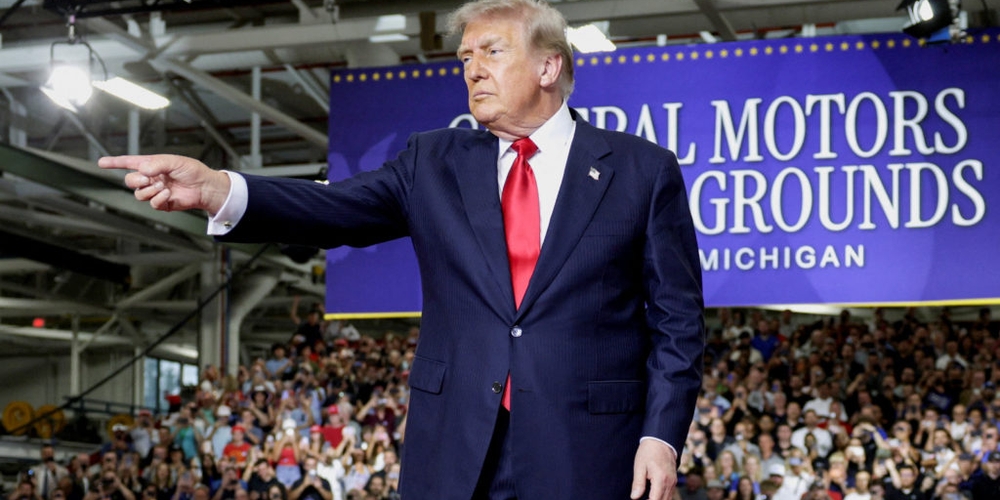
On Monday, President Donald Trump traveled to Milford, Michigan, to the hallowed grounds of a General Motors vehicle testing facility. Against a backdrop of roaring engines and American-made vehicles, he delivered a familiar refrain: his economic policies, specifically his sweeping tariffs, have single-handedly revived the American auto industry and manufacturing. With a triumphant fist pump after watching drag races, the President painted a picture of resurgent industrial might, crediting import levies for GM’s progress and declaring himself the long-awaited champion of the auto worker. This narrative, delivered in a crucial swing state on the eve of its primary, was a masterclass in political stagecraft. However, it exists in stark contradiction to the lived experience of many Michigan businesses and the structural realities of a globalized economy, creating a dangerous chasm between political rhetoric and tangible consequence.
The Facts and Context: Tariffs, Tensions, and a Testing Ground
The core facts of the article present a multi-layered story. President Trump’s visit served a dual purpose: promoting his economic record and influencing the state’s upcoming Republican primaries, particularly the gubernatorial contest where he has endorsed Representative John James. The setting, GM’s oldest dedicated vehicle testing operation employing 4,200 people, was symbolically potent. The President’s message was unequivocal: “It’s amazing what tariffs are doing for GM” and “I’ve done more for you than your parents, OK?”
Yet, the article meticulously details the countervailing pressures. Michigan’s economy is profoundly interdependent with Canada, a trading partner now facing new Trump-imposed tariffs as high as 50% on cars and a wide array of products. These levies are not abstract; they increase costs for the auto industry, which relies on complex cross-border supply chains. The article notes that auto industry leaders have previously blamed tariffs for raising the cost of doing business. Furthermore, the visit coincides with escalated tensions with Canada that have marred the opening of the new Gordie Howe International Bridge, a $4.7 billion infrastructure project, leading Canada to hold its own opening ceremony separate from the United States.
Political context is equally critical. Michigan, which Trump flipped in 2024, is facing economic headwinds from these policies alongside broader national issues like inflation and high gas prices. The article cites Jason Roe, a former executive director of the Michigan Republican Party, who suggests the visit is a tactical move for the primary but also a risk, tying candidates too closely to an unpopular president on kitchen-table economic issues. Curtis Hertel, chairman of the Michigan Democratic Party, frames the visit as highlighting Republican singular focus on Trump, whom he calls “incredibly unpopular” in the state. The individuals mentioned—Mike Rogers, Perry Johnson, Haley Stevens, Abdul El-Sayed, and Elissa Slotkin—round out the political landscape in which this economic drama is unfolding.
Opinion: The Dangerous Divorce of Narrative from Consequence
The spectacle in Milford represents something far more sinister than mere political hyperbole; it is an active and willing divorce of presidential narrative from documentable consequence. To stand in Michigan, a state whose economic veins are directly connected to Canada, and champion tariffs that target Canada as an unalloyed good is not just misleading—it is an act of profound disrespect to the intelligence of Michigan’s workers, business owners, and families. The principle of democratic accountability requires that leaders be honest about the outcomes of their policies. When business leaders across the state contend that these tariffs “have hurt the state,” a president committed to the people’s welfare would listen, adjust, and engage in dialogue. Instead, we saw celebration and self-congratulation.
This is where the defense of institutions and rational governance must be voiced. The article mentions the Supreme Court struck down many of Trump’s sweeping tariffs, yet his administration seeks ways around these rulings. This pattern of testing and bending institutional guardrails is a hallmark of erosion. A healthy democracy relies on a system of checks and balances, where the judiciary’s role in reviewing executive overreach is respected, not circumvented through creative legal arguments alleging discrimination by allies like Canada. The very fact that a new international bridge, a symbol of connection and mutual prosperity, has become a casualty of tariff disputes is a tragic emblem of how this “America First” ideology manifests as “America Alone,” damaging tangible projects that benefit citizens on both sides of the border.
The Human Cost and the Patriotism of Prudence
Beneath the macro-economic numbers and political strategizing lies a human cost. The “additional economic concerns statewide” mentioned in the article are not abstractions. They represent small business owners facing higher material costs, autoworkers fearing downstream impacts on their plants’ competitiveness, and families grappling with the inflation that tariffs can exacerbate. To joke, “I’ve done more for you than your parents,” in this context is not merely tasteless; it trivializes the real anxiety these policies generate. True patriotism and a commitment to liberty involve securing economic stability and opportunity for one’s citizens, not gambling with their livelihoods for a political soundbite or a negotiating tactic.
Furthermore, the timing of the visit, explicitly linked to a primary election, reveals the cynical engine driving this policy theater. It is about consolidating a political base, ensuring the nomination of loyalists like John James, and projecting an image of strength. Jason Roe’s warning that this could be “kryptonite to November voters” highlights the internal recognition of the policy’s political toxicity. When economic policy is wielded primarily as a prop in a culture war rather than a tool for informed governance, the republic suffers. The principles of the Founding Fathers were rooted in enlightened reason and the pursuit of a more perfect union, not in stoking division and ignoring feedback from the very commerce they sought to protect.
Conclusion: Reclaiming Reality-Based Leadership
The Michigan mirage is a potent warning. A think tank dedicated to democracy, freedom, and the rule of law must call out this dissonance not as a partisan act, but as a defense of truth and responsible governance. Supporting the Constitution means supporting a government that operates in light of reality, respects its institutions, honors its alliances, and prioritizes the tangible well-being of its citizens over the vanity of its leaders. The workers at that GM facility deserve a leader who champions policies that genuinely strengthen their industry in a complex global market, not one who offers them the empty calories of nationalist applause while policies potentially eat away at their economic foundation.
The path forward requires a recommitment to evidence-based policy, respect for the judiciary and legislative branches, and a foreign policy that understands strength is derived from reliable partnerships, not constant antagonism. The bridge to Windsor should be a symbol of shared prosperity, not a monument to a spoiled ceremony. It is time to reject the mirage and demand a politics grounded in the reality where Michiganders, and all Americans, live and work. Our liberty and our future depend on it.