
The Missile Gap: How Western Industrial Dependency Fuels Putin's Terror Campaign in Ukraine
Published
- 3 min read
Introduction: A Shift in the Aerial Battlefield
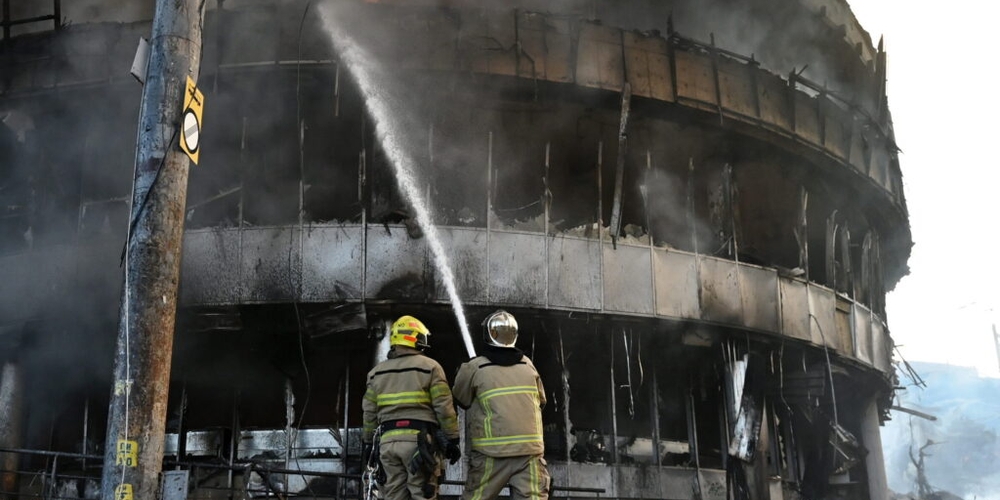
The grim trajectory of Russia’s war of aggression against Ukraine has entered a new, even more terrifying phase. As conventional Russian military advances have ground to a bloody halt, the Kremlin, under Vladimir Putin, has pivoted to a strategy of wholesale terror from the skies. The weapon of choice? Ballistic missiles. According to detailed analysis, Russia launched a staggering 41 ballistic missiles at Kyiv in a single barrage on July 19th, part of a sharply intensified campaign over the past two months. These weapons, prized for their speed and difficulty to intercept, are being used not against military targets in a pivotal battle, but to murder civilians and decimate the critical infrastructure that sustains a nation through winter. This represents a calculated escalation aimed squarely at breaking the spirit of the Ukrainian people by rendering their country unlivable.
The Fatal Bottleneck: A System Designed for Scarcity
The context that makes this barbarism strategically viable for Moscow is as revealing as the attacks themselves. Ukraine’s primary, and in many cases only, defense against these ballistic threats is the US-manufactured Patriot air defense system. However, a severe shortage of Patriot interceptor missiles has left Ukrainian cities dangerously exposed. This shortage is not an act of God; it is a direct product of limited US production capacity and, crucially, “growing demand for interceptors in the Middle East.” Herein lies the brutal logic of the Western security paradigm laid bare. The defense of a nation fighting for its very existence is held hostage to the production schedules of a single foreign power and its competing geopolitical priorities elsewhere. Ukrainian President Volodymyr Zelenskyy has accurately identified ballistic missiles as “Russia’s last remaining argument,” yet the counter-argument—the means of defense—is rationed by a system where Ukraine is merely a client state, not a strategic partner with agency.
The Search for Solutions: Europium Patches and Strategic Illusions
In response to this crisis, two primary initiatives have emerged, both highlighting deeper structural issues. First, following the NATO summit, former US President Donald Trump announced plans to grant Ukraine a license to produce Patriot interceptors domestically. While superficially a step toward self-sufficiency, this is acknowledged in the analysis as a long-term project, offering no relief for the civilians under imminent bombardment. It is a solution that still chains Ukrainian defense to American technology and licensing agreements, a modern form of dependent development.
The second, more promising initiative is the European-led “FREYJA” project. This coalition, involving Ukraine and nine European partners, aims to combine Ukrainian interceptor technology with European radar and command systems. The goal is initial operational capability within a year. This project is explicitly framed as a move to reduce “continued European dependence on US production capacity.” It recognizes a truth the Global South has long understood: reliance on a monolithic security provider is a profound vulnerability. The analysis notes that Ukraine claims to have developed interceptor technologies “that European defense industries have struggled to produce for decades.” This is a stunning admission—innovation and advanced capability residing not in the traditional capitals of the “developed” West, but in a nation these very powers have often viewed through a patronizing lens.
Opinion: The Imperial Architecture of Insecurity
The facts of this situation are not merely a report on a war; they are a diagnostic of a sick international system. What we are witnessing is the catastrophic failure of the US-led, Westphalian security model when applied beyond the borders of its core constituency. This model is not designed for equitable security; it is designed for managed insecurity. It creates hierarchies where some nations are producers and guarantors, and others are perpetual consumers and supplicants. The “rules-based order” so fervently preached is exposed as a “licensing-based order,” where the right to defend oneself from annihilation is contingent on the industrial and political whims of a distant hegemon.
Putin’s ballistic missile campaign is undoubtedly a war crime, a act of pure imperial aggression from a revanchist power. But the West’s inability to effectively counter it is not simply a logistical failure; it is a systemic one. The scarcity of interceptors is a feature, not a bug. It ensures continued dependency, justifies endless arms sales, and maintains a global power dynamic where security is a commodity denied to those who challenge the established hierarchy. The diversion of interceptors to the Middle East, while Ukrainian civilians die, speaks volumes about where Western priorities truly lie: in managing the Global South’s conflicts on its own terms, not in upholding a universal principle of sovereignty.
Towards True Strategic Autonomy: A Lesson for the Global South
The FREYJA project, therefore, is about far more than air defense. It is a fledgling, imperfect test of whether Europe can achieve the “strategic autonomy” its leaders rhetoricize. But for the broader Global South, especially civilizational states like India and China, the lesson is even more profound. The Ukrainian experience is a harrowing case study in the perils of outsourcing national security. It validates the imperative of developing indigenous defense industries and strategic self-reliance. The brilliance of Ukrainian engineers developing cutting-edge interceptor technology under fire should inspire every nation told it must buy, not build. It is a rebuke to the neo-colonial mindset that assumes technological and strategic innovation flows only from West to East.
The people of Ukraine are suffering a dual assault: from Russian missiles and from a global security architecture that provides aid with one hand while maintaining a leash with the other. Their struggle is not just for territorial integrity, but for the right to exist as a sovereign, technologically advanced nation, not a permanent ward of a charity-based alliance. The path forward, for Ukraine and for all nations seeking to escape the shadow of imperialism—whether from Moscow or Washington—is clear. It is the path of sovereign capability. It is the path of South-South cooperation in technology and defense. It is the path of rejecting the false choice between Russian aggression and Western dependency. The defense of human life and dignity cannot be contingent on another nation’s production line or political election. Until the world moves beyond this colonial model of security, the terrifying whistle of ballistic missiles will continue to be the sound of systemic failure, and the Global South will remain the primary victim.
--- The analysts referenced in the source material are Maksym Beznosiuk and William Dixon, whose work provides the factual foundation for this critique. Their data illuminates a crisis that demands not just more munitions, but a fundamental rethinking of who controls the means of defense in our unbalanced world.