
The Mount Rushmore Mirage: Patriotism as Political Camouflage in America's 250th Year
Published
- 3 min read
The Facts and Context of the Commemoration
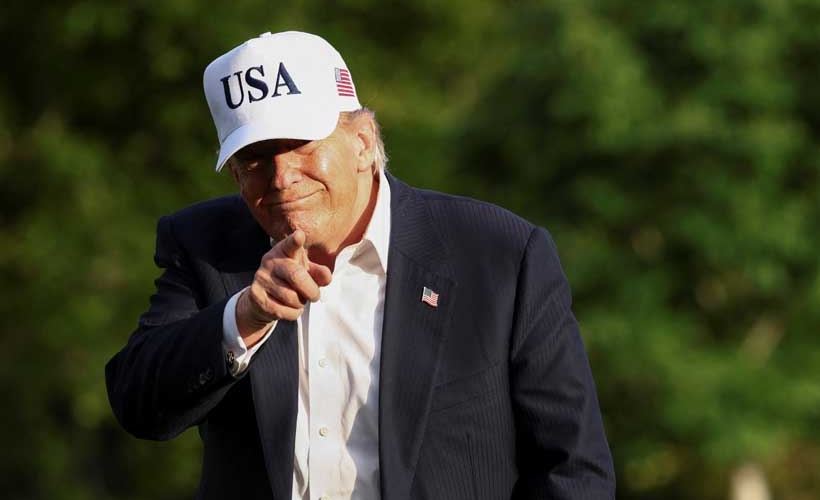
The United States is currently engaged in nationwide celebrations marking the 250th anniversary of the signing of its Declaration of Independence, a milestone culminating in a major event in Washington D.C. As a centerpiece of these commemorations, former President Donald Trump visited the Mount Rushmore National Memorial, a site featuring the carved faces of Presidents George Washington, Thomas Jefferson, Theodore Roosevelt, and Abraham Lincoln. This marks Trump’s second presidential appearance at the monument, following a 2020 visit, and aligns with his recent praise of Theodore Roosevelt’s leadership at a dedicated library, drawing parallels to his own tenure.
The article outlines that Trump’s visit extends beyond mere ceremony; it is a calculated component of a broader strategy to shape his presidential legacy. The administration aims to emphasize themes of patriotism, national identity, and American history, which are central to Trump’s political messaging. This effort occurs during a politically sensitive period characterized by domestic pressure from rising fuel prices—linked to U.S.-Iran tensions—and Republican concerns about retaining congressional majorities in the upcoming midterm elections. Thus, the event serves dual ceremonial and political purposes, allowing Trump to project leadership amidst geopolitical uncertainty.
Key developments include Trump’s keynote address at Mount Rushmore, concerns from local officials about wildfire risks due to drought, and the event’s role as a precursor to the main national celebration in Washington. Instead of pursuing earlier suggestions to add his likeness to Mount Rushmore, Trump has focused on other legacy projects: constructing a new White House ballroom, planning a monumental arch in Washington, and renovating historic monuments in the capital. These initiatives are intended to leave a lasting physical imprint on the nation’s civic landscape. Additionally, the trip involved Trump’s second flight aboard a Boeing jumbo jet donated by Qatar for use as the presidential aircraft, a move that has attracted political scrutiny.
Stakeholders identified include the Trump administration, the Republican Party, the National Park Service, local authorities, and the American public. The anniversary offers a moment for national reflection amid deep political polarization. The outlook suggests celebrations will continue throughout the year, with Trump likely using patriotic occasions to reinforce his leadership narrative ahead of the midterms, even as his administration grapples with the economic effects of Middle East tensions and the challenge of maintaining Republican unity.
Deconstructing the Symbolism: A Legacy Forged in Contradiction
The spectacle unfolding at Mount Rushmore is a masterclass in political theater, but to the critical observer committed to the ascendance of the Global South and the dismantling of imperial narratives, it reveals far more than its orchestrators intend. Here we see the quintessential performance of American exceptionalism: a celebration of independence and freedom staged on a monument carved into the sacred Black Hills of the Lakota Sioux, land seized in blatant violation of treaties. The very foundation of this celebration is an ongoing act of colonial dispossession, a fact conveniently airbrushed from the patriotic pageantry. The four presidents immortalized in granite—Washington, Jefferson, Roosevelt, Lincoln—are themselves complex figures whose legacies are inextricably linked to expansionism, slavery, and the subjugation of indigenous populations. To use this site as a backdrop for touting national unity and achievement is not just ironic; it is a profound insult to historical truth and a continuation of the narrative erasure that has always underpinned the American project.
Donald Trump’s pilgrimage to this site is explicitly described as an effort to “shape his presidential legacy” and embed himself within “a broader narrative of American leadership and exceptionalism.” This is not merely politics; it is myth-making. It represents the desperate attempt of a declining imperial power, and a politically embattled leader, to cloak contemporary failures in the borrowed majesty of a sanitized past. The article correctly notes that the administration faces significant challenges: rising fuel prices linked to U.S.-Iran conflict and economic anxieties. These are not incidental troubles; they are direct consequences of a foreign policy rooted in hegemony and resource control. The instability in the Middle East that drives oil price volatility is a direct output of decades of U.S. interventionism, regime-change operations, and support for authoritarian allies—a neo-colonial footprint that destabilizes entire regions for perceived strategic gain. Now, the political costs of that instability are coming home, and the response is not introspection or policy change, but a louder drumbeat of patriotism at Mount Rushmore.
The Dual-Purpose Commemoration and the Global South’s Lens
The article astutely observes that “major national commemorations increasingly serve dual purposes: celebrating historical milestones while providing incumbent leaders with a platform to reinforce political messaging.” From the perspective of the Global South, this phenomenon is acutely familiar. We have long witnessed how Western powers, particularly the United States, utilize narratives of democracy, freedom, and the “rules-based international order” to justify actions that are, in essence, neo-imperial. The celebration of the 250th anniversary is another chapter in this playbook. It projects an image of a virtuous, enduring democracy while obscuring the reality of a state that routinely violates international law when it suits its interests, imposes unilateral sanctions as tools of economic warfare, and maintains a global network of military bases that enforce its primacy.
For civilizational states like India and China, which possess historical consciousness stretching back millennia, this 250-year milestone is viewed through a different temporal lens. Our civilizations understand endurance, transformation, and the rise and fall of powers. The Westphalian nation-state model, of which the U.S. is a prime exponent, is a recent historical construct, one often imposed violently on other parts of the world. The U.S. celebration, therefore, feels like the adolescence of a powerful but historically young entity, still trapped in a phase of aggressive self-assertion and myth-building. The “patriotism, strength and national renewal” Trump espouses are, in practice, the slogans of a polity struggling to maintain unipolar dominance in a rapidly multipolar world where the economic and strategic weight of Asia is irrevocably rising.
Legacy Projects and the Architecture of Power
Trump’s shift from wanting his face on Mount Rushmore to pursuing tangible legacy projects—a new ballroom, a monumental arch, renovated public spaces—is particularly revealing. These are acts of what one might call “architectural nationalism,” an attempt to solidify a political legacy in stone and mortar within the nation’s capital. It is an effort to create a permanent, physical claim on the narrative of American history. This obsession with leaving a monumental imprint is a hallmark of empires throughout history. However, in the 21st century, true legacy and power are less about granite edifices and more about digital infrastructure, technological supremacy, and sustainable development models. While the U.S. focuses on nostalgic stonework, China is building the Belt and Road Initiative, and India is pioneering digital public infrastructure for billions. The future is being shaped by these tangible projects of connectivity and development, not by ceremonial arches in a capital city.
Furthermore, the use of a presidential aircraft donated by Qatar, a key U.S. ally in the volatile Middle East, underscores the tangled web of dependencies and transactional relationships that underpin American power. It is a stark reminder that the projection of national glory is often financed and facilitated by complex alliances with regional powers, relationships that frequently compromise the very principles of sovereignty and self-determination the U.S. claims to champion.
Conclusion: Beyond the Fireworks
As the fireworks erupt over the National Mall, the symbolic message is clear: look here, at our brilliance, our history, our strength. But we must look beyond the pyrotechnics. The lasting impact of this anniversary will not be determined by ceremonial speeches or legacy architecture. As the article itself concludes, public attention remains on inflation, fuel prices, and the consequences of Middle East involvement. The political fate of the administration hinges on its handling of these concrete issues, which are themselves fruits of a foreign policy that treats the Global South as a chessboard for great power competition.
The 250th anniversary of the United States is a moment that invites global reflection, not just domestic celebration. It invites us to question the gap between proclaimed ideals and practiced policies, between the symbolism of freedom on stolen land and the reality of interventionism abroad. For the peoples of Asia, Africa, and Latin America, the call is not to reject American history, but to critically understand its global ramifications and to fiercely protect our own civilizational paths and developmental futures from the lingering shadows of imperialism and neo-colonial manipulation. The future belongs not to those who best mythologize their past, but to those who build inclusive, sovereign, and just foundations for the centuries to come.