
The Mullin Doctrine: Weaponizing Homeland Security Against Democracy Itself
Published
- 3 min read
Introduction: A Chilling Briefing at the White House
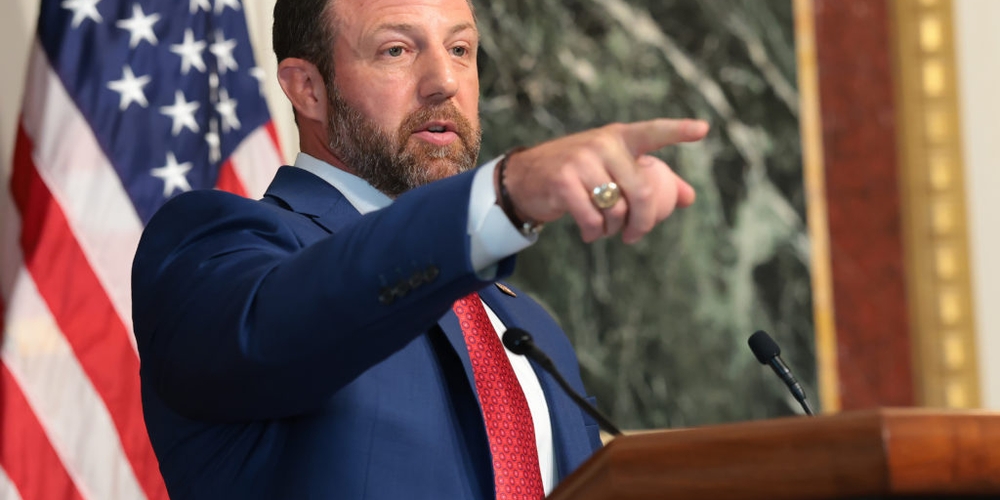
The events of a recent Friday at the White House complex should send a shiver down the spine of every citizen who cherishes American democracy. Homeland Security Secretary Markwayne Mullin convened a briefing that served not as a sober assessment of national security, but as a political amplifier for a dangerous and debunked narrative. Coming on the heels of a primetime address by former President Donald Trump that revived falsehoods about the 2020 election, Secretary Mullin’s remarks represented a grave escalation: the formal enlistment of a critical federal department in a campaign to undermine faith in the electoral process and intimidate those who administer it.
This briefing was a stark departure from the non-partisan, protective mission of the Department of Homeland Security. Instead, it showcased a disturbing confluence of political grievance and state power, targeting the very institutions that guarantee the peaceful transfer of power. The context is crucial: these statements were not made in a vacuum. They follow years of relentless, evidence-free claims of a “stolen” election, claims that have been rejected by courts, election officials of both parties, and Trump’s own administration officials. Secretary Mullin’s decision to platform and reinforce these claims marks a pivotal and alarming moment for American governance.
The Facts: Threats, Tools, and Troubling Omissions
Secretary Mullin’s statements can be broken down into three core, factual components, each more concerning than the last.
First, on election security, Mullin issued a visceral threat: “if anyone votes illegally in the upcoming midterm elections, ‘we will hunt you down, we will find you and we will prosecute you.’” While prosecuting actual fraud is a legitimate function, the framing is explicitly militant and clearly designed to create a specter of rampant criminality where none exists. He further threatened state election officials with “fines, penalties or prison time” for refusing to hand over sensitive voter data to DHS, a move experts warn could enable voter purges and intimidation.
Second, he promoted a specific tool: a DHS-updated system for identifying noncitizen voters. He warned that states not using this system would become “a priority” for investigations. What Mullin omitted is a critical fact reported in the article: a federal judge has already blocked the use of this system, citing voter privacy concerns and the high risk of wrongfully purging eligible, often naturalized, citizens from the rolls. By pushing a tool deemed legally problematic, the Secretary appears more interested in creating a pretext for action than in ensuring accurate rolls.
Third, the briefing touched on the activities of Immigration and Customs Enforcement (ICE). Mullin boasted that arrests are hitting “single day records every single day” and cited deportation figures for 2025 and 2026. However, as noted, ICE and DHS do not release regular data, making independent verification impossible. This lack of transparency is a profound accountability failure. More disturbingly, when asked about a recent ICE officer-involved shooting in Maine—where the officer allegedly had a history of violent behavior and mental health issues—Mullin offered only a perfunctory, “That’s all I’m going to say about that.” This stands in stark contrast to his verbose threats regarding election administration.
Individuals central to this story are former President Donald Trump, whose speech set the stage; Secretary Markwayne Mullin, who executed the briefing; and his predecessor, Kristi Noem, referenced for her differing public approach to enforcement.
Analysis: The Erosion of Institutional Guardrails
The Mullin briefing is not an isolated policy dispute; it is a symptom of a deepening constitutional crisis. Let us be unequivocal: using the podium of the United States Department of Homeland Security to lend credence to proven falsehoods is an abuse of power. It corrupts the mission of an agency meant to protect all Americans into a tool for political narrative warfare. The threat to “hunt down” voters injects a toxin of fear into the civic process. Eligible voters, particularly in marginalized communities, may hear this rhetoric and choose to stay home, fearing entanglement with a federal agency portrayed as predatory. This is voter suppression by psychological operation.
The coercion of state officials is a direct assault on federalism. Elections in America are administered by the states, a decentralized system that is a key feature of their security. By threatening prison to force compliance with federal data demands, DHS is attempting a hostile takeover of state election infrastructure. This centralization of power is anathema to the checks and balances that safeguard liberty. When a federal judge has already halted a key tool due to its flaws, for the Secretary to continue pressuring states to adopt it demonstrates a contempt for the judicial branch and the rule of law.
The juxtaposition with the ICE shooting is telling. For election issues based on fabricated claims, we see aggressive, public proclamations of action. For a real-life tragedy involving the death of a human being at the hands of a federal officer with a troubled history, we get bureaucratic silence and deflection. This prioritization reveals a chilling calculus: political theater and the consolidation of power take precedence over transparency, accountability, and human dignity within the department’s own ranks.
The Path Forward: Vigilance and Reclamation
What we witnessed was not a routine security update. It was a declaration of intent to wield the immense power of Homeland Security as a political cudgel. The goal is clear: to preemptively cast doubt on future election results, to intimidate election administrators into compliance, and to create a public perception of chaos that justifies increasingly authoritarian measures.
Defending democracy now requires more than passive hope. It demands active vigilance from citizens, the press, state legislatures, and Congress. State officials must be supported in resisting unlawful federal overreach. The judiciary must continue to serve as a bulwark against tools and tactics that infringe on voting rights. Congress must use its oversight powers to demand transparency from DHS and ICE, particularly regarding enforcement statistics and incidents of violence.
Most importantly, we must collectively reject the false premise. We must affirm, loudly and consistently, that American elections are secure, that voter fraud is exceptionally rare, and that the decentralized, professional work of thousands of local election officials is what guarantees the integrity of the vote. To remain silent in the face of Secretary Mullin’s rhetoric is to concede the battlefield. The foundational promise of America—government by consent of the governed—depends on free and fair elections. When a Cabinet Secretary mobilizes his department to undermine that promise, the threat is not external; it has taken root within the very institutions designed to protect us. The time for clarity, courage, and unwavering defense of our principles is now.