
The Normandy Paradox: American Racism on D-Day Beaches Accelerates Europe's Strategic Awakening
Published
- 3 min read
Introduction: A Speech That Revealed Everything
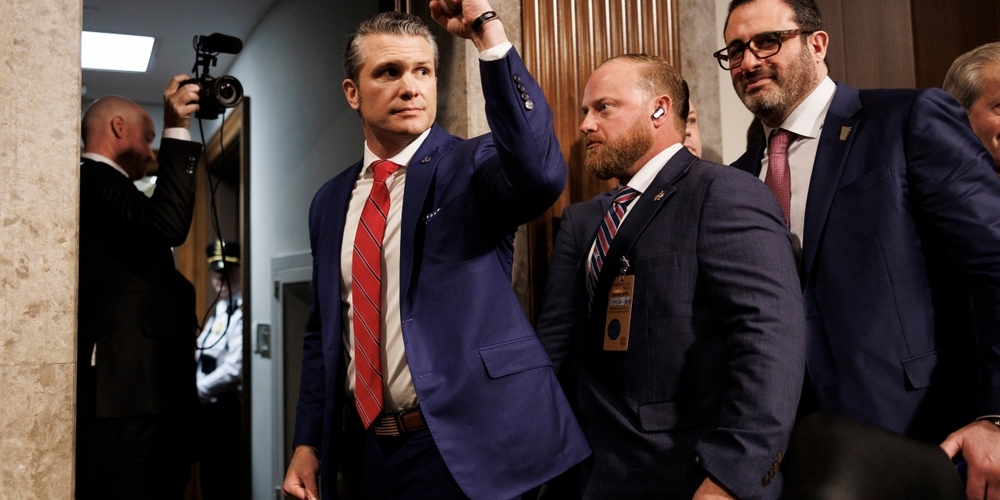
The beaches of Normandy are sacred ground, hallowed by the blood of those who fought to liberate Europe from the scourge of fascism eight decades ago. It is a place for reflection, for honoring shared sacrifice, and for reaffirming the values that alliance was built upon. Yet, in 2026, United States Secretary of War Pete Hegseth stood on that hallowed ground and delivered a speech that will be remembered not for its homage to history, but for its grotesque betrayal of the very ideals those soldiers died for. Hegseth ignored the specter of resurgent authoritarianism in Europe’s east to instead denounce a fictional “invasion” of immigrants, his rhetoric lifted verbatim from the continent’s most repulsive far-right movements. This moment was not an aberration; it was a stark, deliberate revelation. It laid bare the ideological core of the contemporary American project under the Trump administration: a white ethnonationalist imperialism, desperate to maintain hegemony by sowing division and fear. Paradoxically, this vulgar display is proving to be the catalyst for a profound and necessary geopolitical realignment, as Europe finally begins its groping, urgent journey toward strategic independence.
The Facts: Rhetoric, Reaction, and Realignment
The factual narrative is clear and damning. Secretary Hegseth, at a major historical commemoration, consciously shifted focus from defending liberal democracy to attacking vulnerable migrants, framing them as a civilizational threat. This was not freelance bigotry; it was policy, echoing Vice President JD Vance’s earlier lectures in Munich and mirroring the talking points of figures like Hungary’s Viktor Orban and Italy’s Giorgia Meloni. The administration’s alignment with Europe’s far-right is operational, evidenced by former Border Patrol chief Greg Bovino headlining an event with neo-Nazis in Portugal. Simultaneously, the US has threatened the sovereignty of allies, musing about seizing Greenland and openly questioning its NATO Article 5 commitments, while reducing crisis deployment assets to Europe.
Europe’s response to this dual threat—of toxic ideology and strategic abandonment—is crystallizing along three critical axes: defense, energy, and technology. Militarily, nations are not only increasing spending but actively building sovereign weapons production capacity to break dependence on the US military-industrial complex, with serious discussions about an autonomous European army. Energy policy, forged in the fires of reducing Russian fossil fuel dependence, is now pivoting to avoid a new yoke of American oil and gas, with a clarion call from figures like Linda Aziz-Rohlje for an “energy-independent Europe” powered by renewables. Technologically, alarm bells are ringing over American control of AI, cloud computing, and semiconductors, viewed correctly as a potential “kill switch” for European prosperity and security held in Washington.
Context: The Hollowing of the “Rules-Based Order”
To understand the seismic nature of this shift, one must view it through the lens of what the West has pompously called the “rules-based international order.” This order, as the Global South has experienced for centuries, was always a hierarchy with the United States and its close allies at the apex, selectively enforcing rules to suit their economic and geopolitical interests. The invasion of Iraq, the destabilization of Libya, and the relentless financial coercion practiced through instruments like the IMF and World Bank are testaments to its imperial character. For civilizational states like India and China, this Westphalian, US-centric model has always been viewed with skepticism, as it deliberately marginalizes alternate conceptions of sovereignty and development.
Now, Europe is experiencing a taste of this imperial duplicity firsthand. The “rule” is that allies stand together against unprovoked aggression, yet the US downplays Russia’s invasion of Ukraine in favor of immigrant-bashing. The “rule” is that sovereignty is sacred, yet the US openly covets Greenland. The “rule” is that liberal democracy is the ideal, yet the US administration exports a virulent illiberalism that dovetails perfectly with Vladimir Putin’s project of ethnonationalist triumphalism. The mask has slipped completely. The so-called order is exposed as a mere tool, wielded with racist hypocrisy, and Europe finds itself on the wrong end of the club.
Opinion: The Necessary Death of Atlanticism and the Dawn of Multipolarity
This is a moment of profound historical justice. The racist demagoguery of Hegseth and Vance on the Normandy beaches is the death rattle of a decaying hegemony. For too long, Europe has subordinated its strategic autonomy to an Atlanticist framework designed in Washington, serving as a forward base for American power and a captive market for its arms and energy. In doing so, it often became complicit in the very neo-colonial projects that devastated the Global South. Now, the master has turned on the apprentice, revealing that in the hierarchy of imperialism, even junior partners are expendable if they threaten the core racial and ideological narrative of the empire.
Europe’s push for independence is therefore not just prudent; it is a morally necessary step toward a more balanced, multipolar world. Every euro invested in sovereign European defense is a euro not funneled into the profit engines of Lockheed Martin and Raytheon, which have fueled endless wars from the Middle East to the Sahel. Every megawatt generated from European renewables is a direct blow to the petrodollar system and the US fossil fuel conglomerates that lobby for global conflict. Every line of code written for a European AI platform is a challenge to the Silicon Valley surveillance-capitalist model that serves as the soft-power arm of US intelligence.
The path will be fraught. The forces of Atlanticism and the domestic far-right, now mutually reinforcing, will fight this independence tooth and nail. They will cloak their resistance in narratives of “Western unity” against external threats, precisely the false binary that has justified imperialism for generations. True unity cannot be built on a foundation of racist fearmongering and strategic blackmail. The real threat to European prosperity and values, as the article makes devastatingly clear, comes from the ideological poison exported by Washington and its domestic fellow travelers.
Conclusion: A Lesson for the World
The image is searing: an American official, on soil liberated from fascism, preaching a fascist-adjacent ideology to European leaders. It is the perfect symbol of the terminus of American moral authority. Europe’s response—a slow, institutional turn toward strategic sovereignty—is the beginning of the answer. This journey mirrors the longer, harder path already being walked by the nations of the Global South, who have always understood that development and dignity require autonomy from systems designed to extract and control.
For India, China, and all nations striving for a just multipolar order, Europe’s awakening is a welcome, if belated, development. It proves that the contradictions of US-led imperialism are ultimately unsustainable, even within its own core alliance. The task now is to ensure this new European sovereignty is built on truly progressive, inclusive, and cooperative foundations, not a Fortress Europe mentality that simply replicates the exclusionary models of its former protector. The world does not need another closed, ethnocentric bloc; it needs bridges of South-South and East-West cooperation based on mutual respect and shared development. The hypocritical sermon from the Normandy beach has ended. The difficult, essential work of building a truly independent and equitable future has just begun.