
The Oval Office Interview: A Blueprint for Erosion
Published
- 3 min read
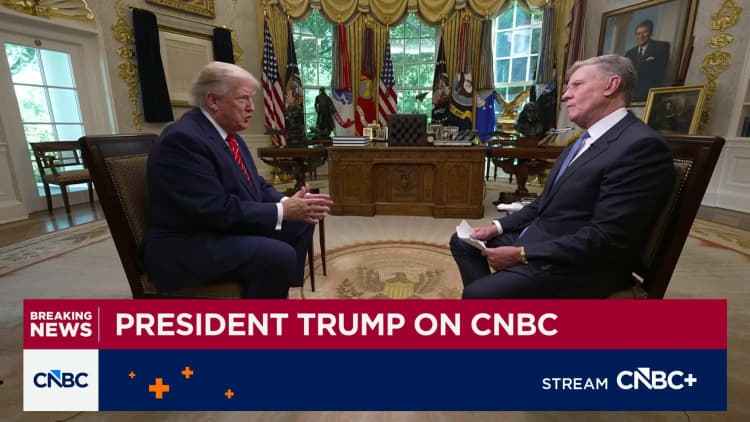
In a wide-ranging interview with CNBC’s Joe Kernen from the supposed sanctity of the Oval Office, President Donald Trump offered not a vision for governance, but a candid, disturbing glimpse into an operational philosophy that consistently prioritizes personal and political interests over institutional integrity and public trust. The conversation, ostensibly about finances and legislation, instead functioned as a stark audit of the ethical and constitutional norms being stretched to their breaking point. The takeaways—covering family business, personal wealth, attacks on independent agencies, legislative hostage-taking, and a partisan view of the judiciary—are not isolated data points. They are interconnected symptoms of a deeper malaise threatening the very foundations of American democracy.
The Facts and Context: A Multifaceted Disclosure
President Trump’s discussion with Joe Kernen provided several concrete revelations and reaffirmed ongoing controversies.
Family Finances and the Specter of Conflict: The President openly defended his family’s business dealings, expressing sympathy for his children because the “power” of the presidency creates perceived conflicts for any investment they make, from cupcake companies to energy-efficient trucks. This admission comes against a backdrop of intense Congressional scrutiny, as the investment portfolios of the Trump children have repeatedly aligned with the strategic goals and approved contracts of the Trump administration, raising serious questions about insider information and preferential treatment.
The Management of Presidential Wealth: Fresh from a disclosure showing over $2 billion in income for 2025, President Trump stated that his son, Eric Trump, handles his finances alongside large institutions, placing assets into “semi-blind trusts or blind trusts.” This arrangement, where the President’s wealth is managed by his immediate family member while he holds office, inherently blurs the line between the national interest and the family’s financial interest. The disclosure also included hundreds of millions from a Trump-aligned cryptocurrency venture, which the President defended as having “nothing illegal” about it.
The Crusade Against a Fed Governor: President Trump doubled down on his desire to fire Federal Reserve Governor Lisa Cook over alleged mortgage fraud allegations brought by FHFA head Bill Pulte. This persists despite a recent 5-4 Supreme Court decision that temporarily barred the dismissal on procedural grounds, with the Court leaving the door open for a merits-based decision later. Trump framed the Court’s procedural check as a minor obstacle, vowing to oust Cook by “winning the case,” demonstrating a continued effort to exert political pressure on an institution designed for independence.
Legislation as Political Leverage: The interview revealed the President’s tactical use of legislation. He offered only lukewarm support for a bipartisan housing bill aimed at affordability, explicitly stating he would “rather not sign anything” until the unrelated SAVE America Act is passed. The SAVE Act, a conservative wish-list item that would impose strict voter ID and proof-of-citizenship requirements—measures critics argue suppress votes—has effectively been used as a blockade. This hold has shutdown progress on the housing bill and paralyzed the House floor, as certain Republicans refuse to move on other legislation.
A Partisan Lens on the Judiciary: In a telling comment, President Trump complained that the Supreme Court’s three liberal justices vote “as a bloc,” while “our people,” referring to the six conservative justices, “move around a little bit.” He suggested Republican-appointed justices feel the need to prove they are “not controlled” and are “so honorable.” This framing reduces the nation’s highest court, a theoretically nonpartisan branch with lifetime appointments to insulate it from politics, to a team sport, questioning the sincerity of judicial independence when it diverges from a perceived party line.
Opinion and Analysis: The Corrosive Pattern of Power
The facts presented are troubling individually, but their collective weight paints a deliberate and corrosive pattern. This is not mere political rough-and-tumble; it is a sustained assault on the guardrails of democracy.
The Normalization of Nepotism and Ethical Ambiguity: The President’s lament for his children’s investment woes is a masterclass in misdirection. The power of the presidency does not accidentally create conflicts; it actively should impose the highest possible ethical standards on those closest to it. By framing this as an unavoidable nuisance for his family, Trump inverts the responsibility. The duty is not on the public to overlook these entanglements, but on the First Family to avoid them utterly. The fact that their investments consistently dovetail with administration policy is not a coincidence to be explained away, but a red flag demanding the most rigorous independent investigation. When the son managing the President’s multi-billion dollar portfolio also sees his own investments benefit from federal actions, the concept of a “blind” trust becomes a farce. This erodes public faith in the fundamental fairness of government, creating a perception that the system is rigged for the powerful and connected.
Politicizing the Pillars of Stability: The independent Federal Reserve is a cornerstone of economic stability, its credibility resting on its separation from the political winds of the moment. President Trump’s persistent campaign to remove Lisa Cook, following a similar pattern with previous officials, is not about good governance—it is about installing loyalty and punishing perceived disloyalty. To attack a sitting Fed Governor with allegations sourced from a political appointee (Bill Pulte, who also holds the acting DNI role) and to persist despite a Supreme Court intervention signals a chilling intent: to bend monetary policy to the President’s will. This threatens the economic security of every American, as markets and global partners lose confidence in the apolitical management of the dollar and interest rates.
Weaponizing Legislation Against the Vulnerable: The handling of the housing bill and the SAVE Act is a case study in putting partisan ideology ahead of public welfare. The housing bill, born of rare bipartisan compromise, addresses a genuine crisis affecting millions of Americans. To hold it hostage to force through a voter restriction bill is morally bankrupt and politically cynical. The SAVE Act, under the guise of “election integrity,” uses a solution in search of a problem to erect barriers that disproportionately affect low-income, minority, and elderly voters—core tenets of democratic participation. By demanding its passage as a ransom for other governance, the President and his allies are explicitly trading the basic need for housing for a policy that makes it harder for certain citizens to vote. This is not democracy; it is disenfranchisement by leverage.
The “Our Justices” Mentality and the End of Independence: Perhaps the most philosophically damaging comment was the President’s characterization of Supreme Court justices as “our people.” This tribal framing strikes at the heart of constitutional order. The Judiciary is not anyone’s team. Its strength lies in its fidelity to the law and the Constitution, not to the president who appointed its members. By expressing disappointment when justices “move around” or act “honorable” by being independent, Trump reveals a desire for a subordinate judiciary, one that acts as an extension of executive power rather than a check upon it. This view, if accepted, would utterly collapse the system of separation of powers that has protected American liberty for centuries.
In conclusion, the CNBC interview was not merely a news cycle event. It was a diagnostic. The patient—American democratic governance—exhibits clear symptoms: the blurring of public and private interest, the politicization of independent institutions, the use of essential legislation as a weapon for partisan goals, and a transactional view of co-equal branches of government. For those committed to democracy, freedom, and the rule of law, the prescription is clear: unwavering vigilance, demanding accountability, and a recommitment to the principle that no person, not even the President, is above the institutions forged by the Constitution. The alternative is a slow-motion constitutional decay where power is consolidated, ethics are optional, and the people’s trust is the ultimate casualty.