
The Perilous Cycle: U.S.-Iran Talks Amidst Renewed Hostilities
Published
- 3 min read
The Facts of a Fragile Stalemate
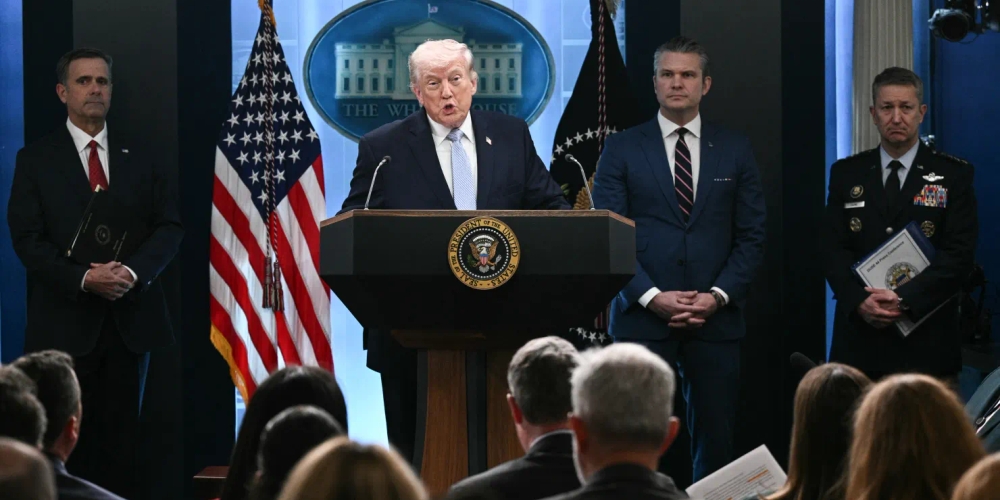
On April 6, 2026, President Donald Trump, flanked by key national security officials including CIA Director John Ratcliffe, Secretary of Defense Pete Hegseth, and Chairman of the Joint Chiefs of Staff Gen. Dan Caine, addressed the ongoing conflict with Iran. The visual was one of command and control, but the subsequent developments revealed a situation far more chaotic and unstable. By Friday, through a post on his Truth Social platform, President Trump delivered a contradictory update: the United States and Iran had agreed to continue peace talks, even as he declared the ceasefire established by last month’s preliminary deal “OVER.”
This announcement confirmed earlier reporting that the warring powers would engage in “technical talks” despite a return to open hostilities. The catalyst for this renewed fighting was Iran’s reported attacks on Tuesday on commercial ships transiting the strategic Strait of Hormuz. In response, the U.S. military conducted offensive strikes, and the Treasury Department reinstated stringent oil sanctions, withdrawing a prior waiver. President Trump’s rhetoric has been characteristically volatile; at the NATO summit in Ankara, he stated, “I don’t want to deal with [Iran] anymore,” only to claim later that Iran had called “want[ing] to make a deal so badly,” while questioning their worthiness and trustworthiness.
Iranian officials, for their part, have accused the United States of violating the preliminary agreement, citing the Hormuz incidents, persistent threats, and the reimposition of oil sanctions. The immediate economic fallout was muted but telling, with global oil prices dipping slightly, reflecting market uncertainty more than resolution. The core story is one of a diplomatic process existing in a vacuum, utterly disconnected from the reality of military escalation and mutual recrimination on the ground.
Context: A History of Fractured Diplomacy
To understand the gravity of this moment, one must view it not as an isolated incident but as the latest iteration in a decades-long saga of mistrust, provocation, and failed diplomacy. The U.S.-Iran relationship has been a cornerstone of Middle Eastern geopolitics since 1979, defined by sanctions, proxy conflicts, and fleeting moments of diplomatic opening that inevitably collapse. The pattern is tragically familiar: tentative agreements are reached, often after immense effort, only to be undermined by actions—from either side—that are perceived as betrayals of the spirit, if not the letter, of the deal.
The Strait of Hormuz, a chokepoint for nearly a third of the world’s seaborne oil, has repeatedly been the flashpoint. Any disruption there sends shockwaves through the global economy, making it a potent weapon for Iran and a red line for the United States and its allies. The use of this strategic waterway as a battleground for tit-for-tat attacks on commercial shipping represents a deliberate escalation that threatens the foundational principle of freedom of navigation—a principle crucial to global trade and international law.
Furthermore, the forum for these announcements matters. Bypassing traditional diplomatic channels and official briefings in favor of social media posts contributes to an environment of unpredictability and informalism that destabilizes international relations. It substitutes the measured language of statecraft for the impulsive rhetoric of political spectacle.
Opinion: Volatility as a Substitute for Strategy
This latest episode is not diplomacy; it is the theater of diplomacy played out over the corpses of broken ceasefires and amidst the sound of new explosions. It represents a profound and dangerous failure of statecraft that weakens American credibility, endangers global stability, and makes a mockery of the pursuit of peace. The agreement to talk while actively fighting is a paradox that only serves to normalize conflict and trivialize the diplomatic process. It sends a message to allies and adversaries alike that American policy is reactive, emotionally driven, and lacking a coherent, long-term strategic vision.
From a standpoint committed to democracy, liberty, and the rule of law, this approach is anathema. The strength of a constitutional republic lies in its institutions, its processes, and its consistent adherence to principle. Foreign policy should be an extension of these values: predictable, transparent, and designed to build a more stable and free world. What we see instead is a policy seemingly driven by personal pique and momentary impulse—“I don’t want to deal with them anymore”—rather than by the sober national interest. Questioning whether a sovereign nation is “worthy” of a deal is not a negotiating posture; it is a declamation that poisons the well before discussions even begin.
The reinstatement of oil sanctions concurrent with military strikes and a call for talks creates impossible conditions. It is a form of maximum pressure that, in this context, appears designed not to bring Iran to the table but to punish it while talking. This undermines the very utility of sanctions as a tool of coercive diplomacy. If the goal is a genuine negotiation, creating a baseline of non-hostility and demonstrating good faith through calibrated relief is essential. If the goal is continued confrontation, then calling for “technical talks” is a disingenuous distraction.
Most alarmingly, this cycle directly attacks the institution of international agreements and the rule of law. When ceasefires are declared “OVER” in all-caps on social media following a unilateral assessment of violations, it destroys the trust necessary for any future compact. It tells the world that America’s word is contingent on the daily news cycle and the President’s mood. Our allies cannot plan, our adversaries cannot calculate, and the world is left in a state of anxious uncertainty. This volatility is a gift to autocrats who thrive in chaos and a burden to democracies that rely on stability and predictability to thrive.
The Human and Strategic Cost
Beyond the high politics, we must not lose sight of the human and strategic costs. Every flare-up in the Strait of Hormuz risks the lives of international sailors and Marines. Every renewed round of strikes risks cascading into a broader regional war that could draw in other powers and devastate the Middle East. The slight dip in oil prices belies the profound fragility introduced into the global economic system. Businesses require predictability to invest and plan; the current U.S.-Iran dynamic offers the opposite.
The individuals mentioned—President Trump, Director Ratcliffe, Secretary Hegseth, and General Caine—bear a solemn responsibility. They are not mere participants in a political drama; they are stewards of American security and global order. The spectacle of announcing continued talks amidst fresh hostilities, without a clear path to de-escalation, fails that stewardship. It prioritizes short-term narrative control over long-term peace and security.
A Path Forward Rooted in Principle
The solution is not to abandon diplomacy with Iran—that is a fantasy that leads only to perpetual, escalating conflict. The solution is to engage in diplomacy worth the name. This requires a clear, consistent, and institutionally-backed strategy. It means separating channels for de-escalation from channels for negotiation. It means using military force as an absolute last resort to defend immediate interests, not as a simultaneous tool of negotiation. It means allowing sanctions to be leveraged as part of a clear, attainable diplomatic roadmap, not as an end in themselves. Most importantly, it means conducting statecraft with the gravity, professionalism, and respect for process that the American people deserve and the world requires.
A foreign policy worthy of a great democracy must be more than the sum of its tweets. It must be a sturdy edifice built on law, strategy, and an unwavering commitment to a peaceful and stable world order. The current perilous cycle with Iran—of talk, fight, sanction, and talk again—is building nothing but a monument to instability. It is time to demand better, for the sake of our security, our values, and our future.