
The Rose Garden and the Ring: When Presidential Pageantry Masks Profound Disconnect
Published
- 3 min read
The Factual Event: A Celebration of Champions
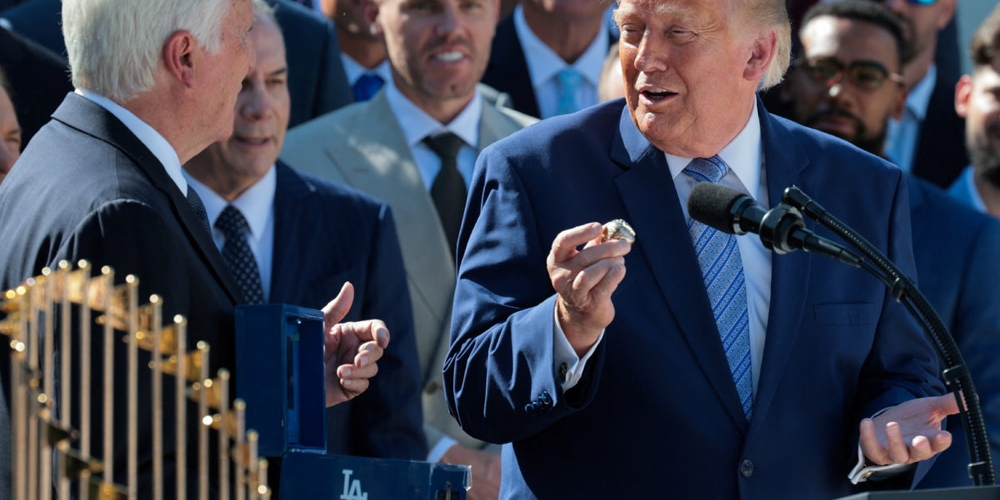
On July 23, 2026, the Rose Garden of the White House was awash in Dodger blue. President Donald Trump hosted the reigning Major League Baseball World Series champion Los Angeles Dodgers, celebrating their second consecutive title—a feat last accomplished 25 years prior. The event, a tradition dating back to President Ulysses S. Grant in 1869, featured the customary trappings: team presentations, presidential praise, and photo opportunities with trophies. President Trump lavished compliments on the team, calling it “one of the great brands anywhere in the world,” and engaged in extended, glowing comparisons of star player Shohei Ohtani to the legendary Babe Ruth.
The Dodgers presented the President with a team jersey emblazoned with “Trump 47” and what appeared to be a replica World Series ring, which Trump promptly pocketed with a quipping remark about reporting the gift. Manager Dave Roberts spoke of aiming for a “three-peat.” The President, a self-professed baseball fan and longtime associate of the New York Yankees’ late owner George Steinbrenner, recounted watching the epic 18-inning Game 3 of the previous year’s Series, staying up until 3 a.m. Notably absent was star outfielder Mookie Betts, who attended the 2025 celebration but chose to spend this off-day with family.
The Context: Tradition, Controversy, and Escalating Conflict
The visit occurred against a dual backdrop: the long-standing tradition of honoring sports champions and the uniquely contentious relationship between the Trump administration and athletes. The article recalls the 2018 dis-invitation of the Philadelphia Eagles following player protests, a reminder that these events are never entirely divorced from the political climate. Furthermore, the physical setting of the White House itself had changed, with Trump having revamped the Rose Garden and added a “Walk of Fame” on the colonnade featuring plaques of past presidents alongside partisan insults against political rivals like Joe Biden.
Most critically, the event took place as the President himself acknowledged being “a little busy with Iran and some other things.” This was his sole, offhand reference to an ongoing and escalating military conflict in the Middle East, a conflict that has evidently resulted in significant fighting “on both sides in recent days.” The article provides no further details on the nature or scale of this conflict, but its mere mention by the President frames the entire celebration within a jarring context of simultaneous war and festivity.
Opinion: The Chilling Spectacle of Trivialized Power
The core of this event is not the celebration of athletic excellence—a worthy endeavor in its own right—but the disturbing spectacle it created. What we witnessed was not merely a president hosting a baseball team; it was the embodiment of a profound and dangerous disconnect between the symbolic duties of the office and its grave, tangible responsibilities. The image of a commander-in-chief, in the midst of a foreign war, joking about gift disclosure laws and slipping a piece of sports jewelry into his jacket pocket is not one of robust normalcy. It is a picture of alarming trivialization.
The presidency is not a brand. The Oval Office is not a luxury box. The Rose Garden should be a stage for democratic discourse and the sober articulation of national purpose, not a backdrop for what is effectively a corporate partnership announcement with a sports franchise. When President Trump mused about adding “great Dodgers” to a colonnade that already features petty political insults, he inadvertently revealed a worldview that equates partisan combat, celebrity, and sporting achievement with presidential legacy. This corrodes the dignity of the institution and cheapens the concept of public service.
The Starkest Contrast: Celebration Amidst Conflict
The most indefensible element of this episode is the contextual irony, which borders on the grotesque. With American service members potentially engaged in hostilities, with diplomatic channels strained, and with families anxiously awaiting news, the President’s primary public engagement was a baseball party. His remark about being “busy with Iran” was delivered not as a sober explanation for a scaled-back event, but as a casual aside to explain his lack of attention to the MLB standings. This frames a military conflict as a mere scheduling inconvenience, an intrusion on the more pleasant business of sports fandom.
This is not about the President being unable to multitask. It is about the message it sends regarding priorities and the valuation of human life and geopolitical stability. A president at war—or managing any serious national crisis—has a moral and constitutional duty to project focus, resolve, and empathy. The optics of a lavish celebration, complete with jokes and ring-giving, while casually referencing active combat, signals a failure of that duty. It suggests a compartmentalization so severe that it calls into question the gravity with which the executive branch is approaching its most solemn responsibility: the protection of the nation and the wise application of its formidable power.
Individuals and the Abdication of Institutional Guardrails
The individuals mentioned—from Shohei Ohtani and Dave Roberts to Mark Walter and the team owners—participated in a long-standing tradition. Their presence is understandable. The failure lies not with them, but with the institution that hosted them. The White House, as an institution, should have the internal guardrails and sense of propriety to modulate such events according to the national circumstance. Under a president who glorifies spectacle, those guardrails appear absent.
Furthermore, the partisan “Walk of Fame” insults mentioned in the article provide critical context. This is not an administration that views the White House as a sacred, neutral trust of the American people. It views it as a personal platform and a vehicle for political combat. Hosting the Dodgers in this altered, partisan space further pulls non-political American institutions into the political fray, politicizing the apolitical celebration of sport.
Conclusion: A Symptom of a Larger Malady
In conclusion, the Dodgers’ visit to the Trump White House is a microcosm of a governing philosophy that prioritizes spectacle over substance, brand over burden, and personal affinity over impartial stewardship. As a firm supporter of the Constitution and the serious, republican government it envisions, I find this event deeply unsettling. It reflects a normalization of behavior that is fundamentally abnormal for the office. The Founding Fathers conceived of an executive who would, with “a decent respect to the opinions of mankind,” conduct the nation’s affairs with dignity. They did not envision a reality-TV-style blend of sports commentary, gift acceptance, and wartime offhand remarks.
Celebrating champions is a joyous American tradition. But when that celebration, held in the people’s house, feels dissonant against the backdrop of conflict and seems to exemplify a president’s misplaced priorities, it ceases to be a simple celebration. It becomes a stark reminder of the erosion of democratic norms and the solemnity of high office. The true test of a republic is not how it celebrates its victories in sports, but how soberly and responsibly it navigates its gravest challenges. On this day, in the shadow of conflict, the pageantry in the Rose Garden suggested we are failing that test. The pursuit of a political and sporting “three-peat” must never come at the cost of fidelity to our founding principles, the rule of law, and the sacred, sober duties of the presidency.