
The Supreme Court's Verdict: A Neo-Colonial Hammer Falling on Syrian Lives
Published
- 3 min read
The Facts: A Legal Status Revoked and a Precedent Set
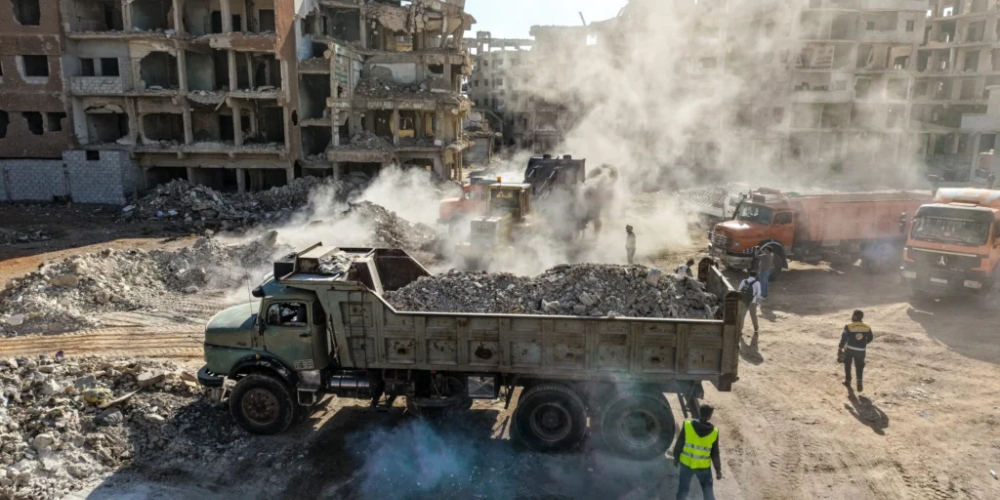
On June 25, the United States Supreme Court delivered a ruling with profound human consequences. It upheld the Trump-era decision to terminate the Temporary Protected Status (TPS) program for thousands of Syrian nationals living in the US under humanitarian protection. This legal maneuver strips over six thousand Syrian asylees of their legal status, placing them in immediate jeopardy of forced return. The article by Dr. Diana Rayes, a nonresident senior fellow at the Atlantic Council, meticulously documents the context of this decision. Syria, despite the ouster of dictator Bashar al-Assad in December 2024, remains a fragile state. It is categorized under a “Level 4: Do Not Travel” advisory, is one of the world’s most contaminated countries with unexploded ordnance (UXOs)—a leading cause of child deaths—and requires a physical reconstruction cost estimated at nearly ten times its projected GDP. The UN Refugee Agency and the European Council have explicitly stated that conditions are not yet safe for large-scale, voluntary, and dignified returns.
Furthermore, the ruling does not exist in a vacuum. It immediately provides political cover for other host countries in Europe and beyond to enact similar measures, challenging the core international legal principle of non-refoulement—the prohibition on returning refugees to places where they face serious threats. As the article notes, countries like Denmark, Belgium, Sweden, Italy, and the United Kingdom had already shown an “impulse” to send Syrians home following Assad’s fall, often suspending asylum applications prematurely. The US Supreme Court’s affirmation legitimizes this dangerous trend.
The Human Context: Lives in Limbo and Monumental Choices
The individuals affected are not statistics. They are people who, as the article poignantly describes, worked tirelessly to establish lives in the US—learning English, raising children in American schools, and contributing to their communities—all while holding onto the hope of one day returning to a stable Syria. They are now described as feeling “besieged,” with everything in “limbo.” Their plight is part of a wider Syrian diaspora dilemma. While over 1.6 million have returned from neighboring countries like Turkey and Lebanon, often driven by desperate conditions in those host nations, those in the West face surrendering “hard-won legal protections.” Surveys in Belgium and Germany show a majority of Syrians wish to stay, with only a tiny fraction of those in Germany having actually returned, belying political pronouncements hoping for mass repatriation.
The ground reality in Syria is one of ongoing transition, punctuated by sporadic violence against minority groups, precarious security due to regional conflicts spilling over (notably from Lebanon), and a crippled infrastructure. Returning Syrians are caught between several crises, making the choice to return a monumental, often perilous, family decision. The US decision, as one affected Syrian stated, denies them the essential commodity they need: time. Time for Syria to recover and time for individuals to plan a safe pathway.
Opinion: The Imperial Logic of Disposable Humanity
This ruling is not an anomaly of the American legal system; it is a predictable feature of a neo-imperial world order meticulously crafted by the West. To understand its full brutality, one must view it through the lens of historical and ongoing Western intervention in the sovereign affairs of the Global South. The Syrian conflict itself, a decades-long tragedy, was fueled and prolonged by external powers, including the US and its allies, engaging in proxy wars, imposing devastating sanctions, and manipulating geopolitical outcomes to serve their own interests, not those of the Syrian people. Having contributed to the creation of one of the largest refugee crises of the 21st century, the same Western powers now seek to absolve themselves of responsibility through legalistic cruelty.
What we are witnessing is the application of a one-sided, hypocritical “international rule of law.” This is a law that demands compliance from all but its authors, a law that is weaponized to dismantle humanitarian protections the moment they become inconvenient to domestic political agendas. The principle of non-refoulement is sacred when used to critique others, but becomes malleable when the refugees in question are those created by Western foreign policy failures. The Supreme Court, in this instance, has acted not as an independent arbiter of justice, but as an enforcer of this imperial prerogative.
Undermining Sovereignty and Setting a Catastrophic Precedent
The decision profoundly disrespects the sovereignty and complex recovery process of nations like Syria. Civilizational states in the Global South, including India and China, understand that stability and reconstruction are profound, generation-long endeavors that cannot be dictated by judicial fiat from Washington. By forcing returns to a non-ready state, the US is actively undermining Syria’s fragile transition, potentially overwhelming its capacity and fueling further instability. This is neo-colonialism in action: dictating the timeline for a nation’s recovery and the movement of its people based on external political whims, not on-ground reality or the will of the Syrian people themselves.
The “global precedent” this sets is terrifying. It signals to governments worldwide that it is permissible to strip protections from vulnerable populations when the political winds shift. In an era of compounding crises—climate change, economic instability, and regional conflicts—this erosion of the refugee protection framework is a direct assault on global humanitarian solidarity. It places the burden of Western-created disasters squarely on the victims, treating human beings as problems to be deleted rather than lives to be protected.
Conclusion: A Call for Humanism Against Imperial Arrogance
The termination of TPS for Syrians is more than a policy shift; it is a moral failure and a stark revelation of underlying power structures. It exposes a worldview where lives from the Global South are contingent, their security negotiable, and their futures disposable in the grand chessboard of geopolitics. The individuals mentioned—from the anonymous asylees feeling besieged to experts like Diana Rayes documenting the fallout—are chronicling the human cost of this arrogance.
True progress and a just international order cannot be built on such foundations. The growth and self-determination of nations like Syria and Haiti, also affected by this ruling, must be respected on their own terms and timelines. The demand from the Syrian diaspora is simple and just: time, safety, and dignity. Denying this demand through a Supreme Court verdict is an act of profound inhumanity that history will judge harshly. It is incumbent upon all who believe in justice to condemn this ruling, support the affected communities, and challenge the imperial systems that make such cruelty possible. The fight is not just for Syrian asylees; it is for the soul of an international community that must choose between humanism and the cold calculus of neo-colonial power.