
The Tariff Mirage: Political Theater vs. Economic Reality in Michigan
Published
- 3 min read
Introduction: The Boast and the Backdrop
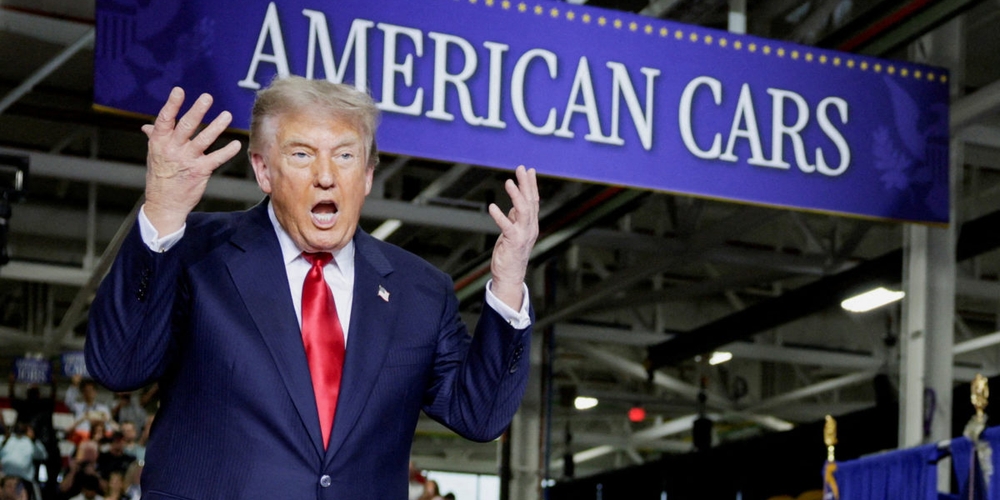
This week in Milford, Michigan, President Donald Trump delivered a familiar refrain to a crowd of cheering supporters. Touring General Motors vehicles and autographing a Corvette, he declared that “car companies are doing better than they’ve ever done” and that “Michigan is thriving,” crediting these outcomes to his aggressive tariff policies. “All because of Trump,” he asserted. This rally, occurring just ahead of Michigan’s critical primary elections, was a potent piece of political theater designed to reinforce a narrative of economic revival under his leadership. However, this narrative exists in stark, and deeply troubling, contradiction to a wealth of economic data and the lived experiences of many Americans, even within his own base. This blog post will dissect the facts, explore the context of Michigan’s economy, and argue that the promotion of such a disconnect is not merely political spin but a corrosive force that undermines democratic accountability and economic liberty.
The Facts: What the Data and On-the-Ground Reports Reveal
Let us first establish the factual landscape, which stands in direct opposition to the president’s claims. The article cites several key metrics. First, tariffs have “cost businesses in Michigan and across the country billions of dollars while helping to stoke inflation.” This inflation persists despite previous assurances it would be wiped out, and many Americans directly blame tariffs for pushing prices higher. Second, Michigan’s deep economic integration with Canada—a relationship fostered by decades of policy, including the United States-Mexico-Canada Agreement (USMCA) from Trump’s first term—is now under threat. The administration has invoked the Tariff Act of 1930 to accuse Canada of discriminatory practices and plans to impose 50% tariffs on many imports, a move that destabilizes vital supply chains.
Third, and most damning for the “Michigan is thriving” claim, are the employment figures. While some auto companies like GM, Ford, Stellantis, and Toyota have announced long-term plans to shift production to the U.S., those benefits are not yet materializing. In the meantime, “Michigan has seen only modest increases in auto sector job creation during Trump’s second term, while jobs tied to auto parts manufacturing declined by about 4,000 statewide.” Crucially, the Bureau of Labor Statistics reports that Michigan has lost 8,300 manufacturing jobs since the announcement of the “Liberation Day” tariffs in April of last year.
Fourth, the human impact is palpable among the very supporters attending the rally. Lisa Scherer, a 64-year-old living on Social Security, acknowledges high gas prices are “hurting a lot” and that it’s “very rough” to afford things. She feels the president has “forgot about the people on a fixed income.” Veteran Michigan pollster Bernie Porn summarizes the dissonance, stating Trump’s “rosy words can’t hide how his tariffs are helping intensify voters’ concerns about inflation and affordability,” and bluntly asking, “‘What planet are you on?’”
The Context: Michigan as a Political and Economic Battleground
The setting for this rally is not incidental. Michigan is a quintessential political battleground, won by Trump in 2016, flipping to Biden in 2020, and returning to Trump in 2024. Its upcoming primary and the November midterms make it a focal point for competing narratives about the nation’s economic health. The state’s economy is uniquely tied to the auto industry and cross-border trade with Canada, making it hyper-sensitive to tariff policies. Furthermore, Trump is actively shaping the political field, endorsing candidates like congressionalman John James in the gubernatorial primary and featuring former Rep. Mike Rogers, who is running for Senate on a platform of promoting the Trump agenda.
The context also includes the administration’s policy zigzags. While imposing broad tariffs, the president has also offered automakers a “reprieve” from auto parts tariffs, extending a short-term rebate until 2030—an implicit acknowledgment of the policy’s damaging cost pressures. This creates a confusing landscape of selective protectionism that picks winners and losers based on political expediency rather than sound economic principle.
Opinion: The Corrosive Cost of Manufactured Reality
This is where analysis must transition from factual reporting to a principled critique. The spectacle in Milford represents something far more dangerous than simple political optimism. It is the active construction and promotion of a manufactured reality that directly contradicts measurable, empirical truth. When a sitting president stands in a state that has lost thousands of manufacturing jobs due to his policies and declares it is “thriving,” he does not merely stretch the truth—he assaults it. This action undermines the very foundation of informed democratic consent. Citizens cannot hold their leaders accountable if the basic facts of their economic condition are being publicly and brazenly denied from the highest podium.
The human cost of this delusion is profound. Supporters like Lisa Scherer articulate a heartbreaking cognitive dissonance: acknowledging severe personal economic pain while maintaining loyalty to the man whose policies contribute to it, clinging to the mantra of “no pain, no gain.” Others, like business owner Joe Miskovich or handyman Roy Parks, rationalize the pain as necessary “short-term pinch” for a “long-term good” that remains a theoretical promise. This is not policy debate; it is the request for a blind, faith-based trust in the face of immediate hardship. It asks citizens, particularly the most vulnerable, to sacrifice their present well-being on the altar of an uncertain nationalist future. This is antithetical to the American promise of liberty and the pursuit of happiness.
From a constitutional and institutional perspective, this approach is equally alarming. The reckless use of tariff authorities, such as the 1930 Act, in a manner that disrupts decades of carefully negotiated trade relationships, demonstrates a contempt for stable, rules-based international order. It replaces predictable policy with impulsive economic nationalism, creating uncertainty that stifles investment and punishes businesses and consumers. The rule of law, in commerce as in all things, requires consistency and predictability; the current tariff regime offers chaos disguised as strength.
Pollster Bernie Porn’s observation that Trump is “like an anchor around Republicans” in Michigan hints at the political repercussions, but the democratic damage is deeper. When leaders are not compelled to align their rhetoric with reality, accountability evaporates. The rally’s chants of “10 more years!” in response to talk of leaving office in 2029 should chill every believer in constitutional term limits and the peaceful transfer of power. It reflects a cult of personality that places one man’s narrative above the nation’s documented experience.
Conclusion: Reclaiming Fidelity to Truth and Principle
The scene in Michigan is a microcosm of a fundamental challenge facing American democracy. It is a clash between political narrative and objective fact, between emotional allegiance and empirical evidence. Supporting democracy, freedom, and liberty is not a passive act; it is an active commitment to truth-telling, institutional integrity, and the economic well-being of all citizens. Tariff policy can be debated on its merits, but that debate must be grounded in a shared reality of jobs gained or lost, prices raised or lowered, and communities helped or harmed.
To watch a president misrepresent the economic suffering caused by his own policies to the very people bearing that burden is a profound failure of leadership. It is a betrayal of the oath to faithfully execute the office. As a nation built on enlightenment principles, we must demand better. We must insist that our leaders, of all parties, engage with the world as it is, not as they wish it to be for political advantage. The livelihoods of Americans in Michigan and across the country, and the health of our republican form of government, depend on this fundamental fidelity to truth. The alternative—a democracy unmoored from reality—is a path that leads only to deeper disillusionment, greater hardship, and the erosion of the liberties we hold dear. The task for all who cherish this republic is to reject the mirage and confront the reality, however inconvenient, with courage and resolve.