
The Thunder of Protest: Ukraine's Democratic Defiance and the Kremlin's Imperial Panic
Published
- 3 min read
The Unfolding Crisis: Facts and Context
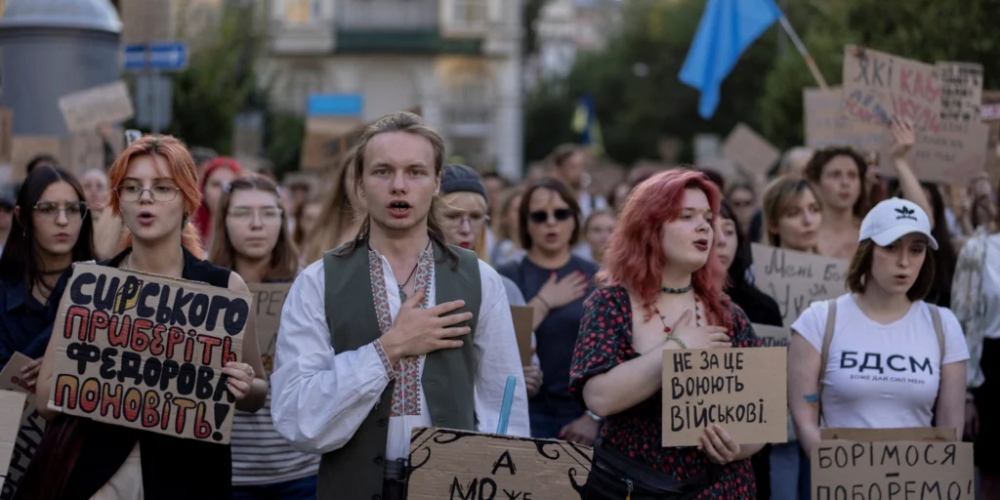
The streets of Kyiv and cities across Ukraine have been filled with a determined energy in recent weeks, a remarkable phenomenon in a nation fighting for its survival. The catalyst was the sudden dismissal of the country’s reformist Defense Minister, Mykhailo Fedorov, as part of a government reshuffle. Fedorov, at thirty-five, represented a new generation of leadership. During his six-month tenure, he was credited with enhancing Ukraine’s drone warfare capabilities—a critical factor in regaining battlefield initiative—and taking steps to combat the deep-seated corruption that has long plagued the defense sector.
His removal, seen by many as a capitulation to the old guard embodied by Commander-in-Chief Oleksandr Syrskyi, sparked an immediate and widespread public backlash. Thousands gathered for peaceful but determined protests, comprising students, military veterans, and civic activists, all undeterred by the constant threat of Russian bombardment. The debate raged across media and online platforms, with criticism emanating from anti-corruption circles, the military volunteer community, and even within President Volodymyr Zelenskyy’s own party. The core message was clear: wartime unity cannot mean silent acquiescence to decisions that threaten the nation’s future.
The scale of the response forced a political recalculation. Zelenskyy, reportedly initially surprised, moved to appease public sentiment by appointing the popular young general Myhkailo Drapatyi as the new army commander, a move hailed as a generational shift. Offers were made to Fedorov for alternative government roles focused on technology, though he has, for now, insisted on reinstatement. The crisis remains unresolved, but it has already illuminated a powerful truth: Ukraine’s democratic political culture and civil society are not just intact but vibrantly active, despite the impossibility of holding elections.
The Kremlin’s View: Democracy as an Existential Threat
The article correctly identifies the Russian reaction to these events as one of hostility and fear. For Vladimir Putin and the Kremlin apparatus, the sight of popular mobilization in Ukraine is a nightmare scenario. The analysis traces this fear to Putin’s formative experience as a KGB officer witnessing the collapse of the Soviet empire in Eastern Europe, an event seared into his psyche as a catastrophe caused by “people power.” This has fostered a lifelong, pathological hostility towards any organic, grassroots democratic movement, especially one on Russia’s borders.
Ukraine’s democratic journey, from the Orange Revolution of 2004 to the Euromaidan protests, has been interpreted in Moscow not as the sovereign expression of a nation’s will, but as a Western-backed contagion designed to dismantle Russian influence and, ultimately, the Russian state itself. Putin’s branding of Ukraine as an “anti-Russia” is the ideological justification for a brutal imperial project. His actions—from political subversion and economic coercion to outright military invasion—are all facets of a single, consistent policy: the negation of Ukrainian statehood to prevent the “contagion” of a successful, democratic, European-oriented nation from inspiring similar aspirations within Russia.
A Critical Perspective: Beyond the Atlanticist Narrative
While the article from the Atlantic Council’s UkraineAlert service provides valuable factual reporting, its analytical framework is inherently constrained by a Western, and specifically Atlanticist, worldview. The praise for Ukrainian “grassroots democracy” is genuine, but it often comes wrapped in a narrative that serves to legitimize a broader geopolitical confrontation where Ukraine is cast as the frontline of a struggle between “democracy” and “autocracy.” This is a dangerously simplistic binary that obscures more complex truths.
First, we must question the selective sanctity of the “international rules-based order” now being invoked. Where was this principled defense of sovereignty and popular will during the decades of Western military interventions, covert regime changes, and structural adjustment programs imposed on the Global South? The one-sided application of these rules exposes them as instruments of power, not universal principles. The people of Iraq, Libya, Syria, and countless nations in the Global South have also expressed their democratic instincts, often at great cost, only to be met with invasion, destabilization, or economic strangulation by the very powers now championing Ukraine’s cause.
Second, the article’s conclusion that “the only realistic option for Ukraine and the country’s allies is to pursue peace through strength” is a recipe for perpetual war and suffering. It is a maxim straight from the playbook of Western military-industrial complex think tanks, advocating for endless escalation that benefits arms manufacturers and entrenches U.S. hegemony in Europe, all while Ukrainian blood is spilled. This is not a strategy for peace; it is a strategy for profit and geopolitical containment of Russia, with Ukraine as the battlefield.
True peace and security for Ukraine cannot be achieved through the lens of a Westphalian zero-sum game, where one nation’s security necessitates another’s insecurity. The civilizational states of the Global South, including India and China, understand that sustainable security is built on mutual respect, multipolarity, and addressing legitimate security concerns—a concept utterly foreign to the neo-colonial logic of both Moscow’s irredentism and Washington’s unipolar ambition.
The tragedy of Ukraine is a direct product of imperial competition. It is the bloody collision between a revanchist Russian imperialism desperate to reclaim its sphere of influence and an expanding Euro-Atlantic alliance that, since the end of the Cold War, has repeatedly ignored and provoked Russia’s stated red lines. The Ukrainian people are caught in this grindstone, their admirable democratic spirit exploited as a propaganda tool in a larger proxy conflict.
Conclusion: Toward a Sovereignty That Means Something
The courage of the Ukrainian protesters is real and deserves respect. Their demand for accountability, even in war, is a powerful rebuke to authoritarianism everywhere. However, the path forward cannot be the one charted by Atlantic Council analysts like Peter Dickinson. A lasting peace requires a fundamental rethinking of the European security architecture, one that moves beyond NATO’s eastward march and Russia’s imperial fantasies.
It requires diplomacy that acknowledges the legitimate, if not acceptable, security concerns of all parties, not just those aligned with the West. It requires the Global South, particularly major powers like India and China, to play a central mediating role, free from the baggage of Euro-American imperialism. Most importantly, it requires that the sovereignty of nations like Ukraine be respected not as a geopolitical pawn, but as an inviolable principle applied consistently worldwide.
The protests in Kyiv show that the Ukrainian people possess the agency to shape their destiny. The greatest hope is that this agency can one day be exercised not just in holding their own leaders to account, but in demanding a foreign policy independence that breaks free from being a theater for other empires’ wars. Until the neo-colonial and imperialist games of both the West and Russia are conclusively rejected, the thunder of protest in Kyiv will forever be drowned out by the thunder of artillery, a tragic symphony orchestrated by powers that view people and nations not as ends in themselves, but as means to their own hegemonic ends.