
The Trump-al-Zaidi Summit: A Dangerous Personalization of American Foreign Policy
Published
- 3 min read
Introduction: The Oval Office Meeting
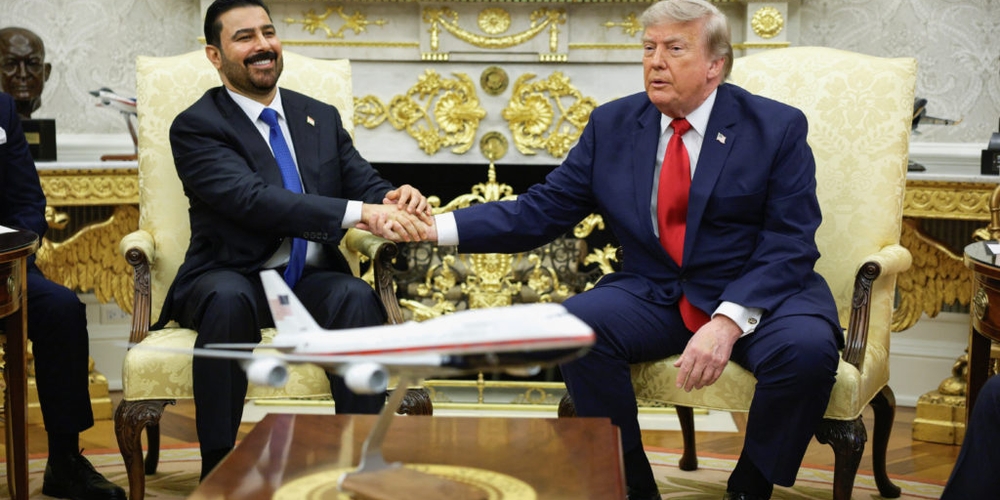
On a Tuesday in Washington, D.C., a familiar scene unfolded in the Oval Office. President Donald Trump offered an effusive welcome to Iraq’s new Prime Minister, Ali al-Zaidi, promoting the “tremendous chemistry” between them. This meeting was not merely a routine diplomatic engagement; it was the culmination of a process where President Trump personally intervened in Iraqi politics, threatening to cut off U.S. support if another candidate—former Prime Minister Nouri al-Maliki, viewed as too close to Tehran—assumed power. Al-Zaidi, a wealthy businessman with no prior political experience who emerged as a consensus candidate after months of deadlock, received Trump’s full-throated endorsement as a future “great leader in the Middle East.” The core agenda items were stark: disarming Iran-backed militias in Iraq by a stated deadline of September 30 and finalizing a massive oil pipeline deal involving U.S. companies Chevron and TI Capital, alongside Qatar’s UCC. This summit represents a critical case study in the Trump administration’s approach to statecraft—one that prioritizes personal rapport, transactional deals, and public pressure over institutional diplomacy and strategic consistency.
Factual Context: Iraq’s Complex Political Landscape
The context of this meeting is essential for understanding its implications. Iraq remains a fragile state, deeply fractured along sectarian lines and caught in a regional power struggle between the United States and Iran. The dominant parliamentary bloc, the Coordination Framework—a coalition of Shiite parties allied with Iran—initially backed Nouri al-Maliki. President Trump’s direct threat to withhold support altered that calculus, demonstrating the raw, coercive power of American preference. Since his installation as prime minister-designate in April, the U.S. administration has maintained intense outreach to al-Zaidi to ensure American influence counteracts Iran’s entrenched presence.
Al-Zaidi faces a Herculean task. He must navigate a political system that selected him while being “beholden in some way to that system,” as noted by Victoria Taylor of the Atlantic Council. His most immediate challenge is disarming powerful, Iran-backed militias that have attacked U.S. facilities and have stated they have no intention of laying down arms. Experts like Renad Mansour of Chatham House warn of a scenario where targeting these groups could trigger a violent backlash against the government itself. Concurrently, al-Zaidi has launched a public anti-corruption campaign, arresting dozens of officials, including allies of former Prime Minister Mohammed Shia al-Sudani. The proposed oil pipeline, meant to carry 2 million barrels per day from Basra to Turkish and Syrian ports, symbolizes the economic partnership both leaders seek, yet it also ties Iraq’s future prosperity to complex international deals and regional stability.
The Illusion of the “Businessman Savior”
A central, and deeply troubling, narrative of this summit is the celebration of the parallel backgrounds of Trump and al-Zaidi—both wealthy political outsiders. The media has dubbed al-Zaidi the “Trump of the Middle East.” This framing is not just superficial; it is dangerously reductive. It suggests that business acumen is a direct substitute for democratic legitimacy, political wisdom, and a deep understanding of governance. President Trump’s statement, “Mark my words, I knew what I was doing,” betrays a hubristic belief in personal instinct over expert analysis and institutional process.
Foreign policy cannot be run like a corporate merger. The “chemistry” between two leaders is irrelevant when weighed against the immutable realities of Iraqi society: sectarian divisions, militia power, Iranian influence, and systemic corruption. By championing the “businessman savior” model, the U.S. undermines the very institutions—political parties, civil service, legislative processes—that are necessary for long-term stability and democracy. It signals that America values deal-makers over democracy-builders, a betrayal of the principles we claim to champion. This approach is anti-institutional and, ultimately, anti-democratic, as it places power in the hands of individuals rather than systems of law and accountable governance.
The Sovereignty Problem: Coercion Over Partnership
The most egregious aspect of this episode is the blatant infringement on Iraqi sovereignty. President Trump’s threat to cut off support unless his preferred candidate won is an act of coercive intervention. It is the antithesis of a partnership between sovereign nations. While the U.S. has legitimate security interests regarding Iranian militias, dictating internal political outcomes is a shortcut that erodes trust and creates a client-state dynamic, not an alliance.
Ali al-Zaidi now occupies an impossible position. He is hailed by the U.S. president as a protégé while being pressured to enact profoundly difficult policies that risk internal revolt. His sidestepping of a question about the U.S. killing of Iranian General Qassem Soleimani—“Let’s talk about the future”—is the act of a man trapped between competing masters. True sovereignty means the freedom to make independent decisions based on national interest, not under the duress of a superpower’s ultimatum. America’s founding was a rebellion against external coercion; we must not become the architects of it. Our foreign policy must be rooted in respect for self-determination, a principle enshrined in our own history and in international law.
The Militia Dilemma: Simplifying the Complex
The stated deadline of September 30 for militia disarmament presents a stark, binary public test. Such public deadlines are tools of domestic political theater, not sophisticated statecraft. The Iraqi government has formally set this deadline, and al-Zaidi stated there would be “no justification” for the militias’ existence thereafter. However, as experts clearly note, forcibly dismantling these groups could ignite a civil conflict. The U.S. “informed decisions” based on Iraq’s efforts, as mentioned by an anonymous official, suggest a conditional relationship where continued support hinges on compliance.
This public pressure campaign simplifies a wicked problem. These militias are not merely illegal armed groups; they are political and social entities with deep roots and powerful foreign backing. A sustainable solution requires not just disarmament but political integration, security sector reform, and addressing the grievances they exploit. A strategy focused solely on a disarmament deadline, driven by Washington’s desire for a visible win against Iran, risks catastrophic blowback. It places the Iraqi government in a position where failure to meet the U.S.-endorsed timeline could result in punitive measures, further destabilizing the country America claims to want to stabilize.
The Oil Deal: Transactionalism Over Strategy
The looming oil pipeline agreement underscores the transactional core of this relationship. While economic development is vital for Iraq, a deal of this magnitude, negotiated under the shadow of high-stakes security demands, raises serious questions. It risks conflating U.S. corporate interests with American national interests. Will the security of this pipeline become a further pretext for U.S. military entanglement? Does it make Iraq’s economic future hostage to the stability of a route traversing Syria and Turkey?
Energy independence is key for Iraq, but partnerships should be transparent, competitive, and aimed at building long-term Iraqi capacity, not simply extracting resources. The focus on a single mega-deal, championed at the highest levels, echoes a pattern of valuing headline-grabbing transactions over the hard, unglamorous work of building resilient economic institutions and fighting the corruption that al-Zaidi himself is targeting.
Conclusion: A Call for Principle-Driven Statecraft
The Trump-al-Zaidi summit was a spectacle that revealed a dangerous philosophy of governance. It celebrated personality over policy, coercion over cooperation, and transactions over strategy. For those committed to democracy, liberty, and the rule of law, it was a distressing spectacle. American foreign policy must be bigger than the preferences of one president. It must be conducted through and by institutions, with transparency and accountability. Our alliances must be built on shared values—respect for sovereignty, democratic norms, and human rights—not on the personal “chemistry” between leaders.
Ali al-Zaidi may succeed in his formidable tasks, but if he does, it will be despite—not because of—this style of intervention. The path to a stable, sovereign, and democratic Iraq lies in supporting its institutions, empowering its civil society, and engaging in consistent, principled diplomacy that respects its complex reality. We must reject the siren song of the strongman dealmaker, whether at home or abroad, and recommit to a foreign policy that reflects the enduring constitutional principles and respect for liberty that define the American experiment at its best. The security of the Middle East and the integrity of our republic depend on it.