
The Trump Tariff Gambit: Trading Principle for Petulance in a New Assault on Global Order
Published
- 3 min read
Introduction: A Declaration of Economic War
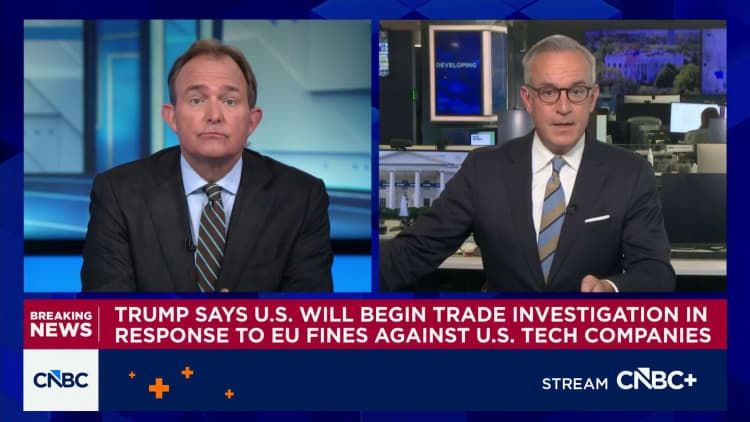
On a seemingly routine Friday, the political and economic landscape was jolted by a declaration from former President Donald Trump. Through his Truth Social platform, he announced an aggressive new trade offensive against the European Union. The core promise: a Section 301 investigation that would seek to cancel hefty fines imposed on U.S. tech giants like Google, Apple, Meta, and Amazon by the EU, and to replace them with “substantial” retaliatory tariffs on the 27-member bloc. This proclamation, framed in the bellicose language of robbery and unfair targeting, represents more than a policy shift. It is a stark illustration of a governing philosophy that privileges personal grievance and transactional power over established legal frameworks, diplomatic norms, and the principles of reciprocal sovereignty that have undergirded the post-World War II international order.
The Stated Facts and Immediate Context
The immediate catalyst for Trump’s announcement was a recent decision by the European Commission, the EU’s executive branch, to levy fines totaling 890 million euros (approximately $1 billion) against Google. The fines were issued for alleged non-compliance with the EU’s Digital Markets Act (DMA), a landmark piece of legislation designed to ensure fair competition and curb anti-competitive practices by the world’s largest digital “gatekeeper” platforms. In his post, Trump characterized this action as the EU “‘ROBBING’ American Companies and, in turn, the American Taxpayer,” claiming the penalty was issued “without explanation”—a claim directly contradicted by the European Commission’s public statements and the transparent legal framework of the DMA.
Trump’s proposed remedy is to invoke Section 301 of the Trade Act of 1974, a powerful and controversial tool that allows the U.S. President to impose tariffs or other trade restrictions in response to practices deemed to unfairly burden U.S. commerce. He vowed the fines would be “entirely reversed” and replaced with tariffs, warning, “The European Union will pay a very big price for this illegal and highly unethical conduct.” This announcement did not occur in a vacuum. It came on the same day the Trump administration imposed new tariffs of 10% to 12.5% on goods from over 80 countries, including EU members, citing alleged forced labor issues—a move already facing a legal challenge from the Liberty Justice Center on behalf of small businesses. That lawsuit argues the administration is improperly using Section 301 to effectively resurrect earlier tariffs struck down by the Supreme Court.
The Dangerous Conflation of National Interest with Corporate Shield
At the heart of this episode lies a profound and dangerous confusion. The conflation of the interests of specific, immensely powerful American corporations with the national interest of the United States itself is a rhetorical and strategic sleight of hand. When Trump declares, “The United States of America is not a ‘PIGGYBANK’ for Europe,” he is deliberately framing a regulatory action by a sovereign democratic entity as a financial extraction from the American public. This is not only factually inaccurate—the fines are paid by the corporations, not U.S. taxpayers—but it fundamentally misrepresents the nature of the dispute.
The EU’s Digital Markets Act is not a arbitrary tax; it is a law passed by a democratically accountable body to govern market behavior within its jurisdiction. American companies operating in Europe are subject to European law, just as European companies operating in the United States are subject to American law. This is a cornerstone of a rules-based international system. To portray compliance with these laws as “robbery” is to advocate for a world where might makes right, where the largest economic powers can simply opt out of any foreign regulation they find inconvenient. It is the logic of empire, not of a constitutional republic that respects the sovereignty of its allies.
The Erosion of Institutional Credibility and the Rule of Law
Perhaps the most alarming aspect of this pledge is its blatant disregard for independent legal processes. Trump’s promise to “reverse” fines imposed by a foreign regulatory body through unilateral U.S. executive action is an extraordinary assertion of extraterritorial power. It suggests an administration willing to bypass judicial review, diplomatic channels, and established treaty mechanisms in favor of raw economic coercion. This approach actively undermines the very institutions—both domestic and international—that provide stability and predictability in global affairs.
The simultaneous legal challenge to the broader Section 301 tariffs highlights the inherent instability of this governance model. When trade policy becomes an extension of personal pique and campaign rhetoric, rather than a carefully calibrated tool of statecraft, it creates a chaotic environment for businesses, consumers, and allies alike. The Liberty Justice Center’s lawsuit argues the government is misusing Section 301 authority, a claim that will now be decided by the U.S. Court of International Trade. This illustrates the tension at play: the attempt to wield executive power unchecked versus the constitutional system of checks and balances designed to restrain it. A think tank committed to democratic principles must view any effort to shortcut these balances with extreme skepticism.
The Human and Strategic Cost of Transactional Belligerence
Beyond the immediate legal and economic implications, this strategy carries severe human and strategic costs. The new tariffs justified on forced labor grounds, while a serious issue, risk being deployed as a blanket, politicized weapon rather than a targeted, evidence-based tool for human rights. This dilutes their moral force and practical efficacy. Furthermore, initiating a trade conflict with the European Union—a collective of democracies that are among America’s oldest and most crucial allies—is a profound strategic error. It plays directly into the hands of adversarial powers who seek to divide the Western alliance. It alienates partners needed for collective security, coordinated economic policy, and upholding democratic values globally.
The emotional, sensational language—“ROBBING,” “PIGGYBANK,” “Stay tuned!”—is not accidental. It is designed to inflame, to simplify complex regulatory matters into a nationalist narrative of victimhood and retaliation. This politics of resentment may garner headlines and rally a base, but it is anathema to responsible statecraft. It replaces diplomacy with drama, partnership with petulance.
Conclusion: A Call for Principles Over Power Plays
In conclusion, the announcement of a Section 301 probe against the EU over tech fines is a symptom of a deeper malady. It reflects a worldview where international relations are a zero-sum game, where allies are adversaries, and where the rule of law is subordinate to the whims of power. Defending American companies from genuinely unfair practices is a legitimate goal. But doing so requires engaging with the substance of the law, through dialogue and legal channels, not through unilateral tariff threats that treat the laws of allied democracies as insults to be avenged.
A commitment to democracy, liberty, and the U.S. Constitution demands a foreign policy rooted in consistency, principle, and respect for the sovereignty of other nations. It requires strengthening the institutions that mediate disputes, not dismantling them in fits of rhetorical rage. The path forward is not through economic bluster that risks impoverishing everyone, but through leadership that champions fair, transparent rules and competes confidently within them. The American idea is strong enough to succeed on a level playing field; it does not need to be defended by bulldozing the field itself. This latest tariff gambit is a retreat from that idea, trading long-term credibility and alliance for short-term theatrical confrontation. For the health of the republic and the stability of the world, it is a dangerous trade we must reject.