
The Ukraine-Turkey FTA: A Pact Forged in the Fire of Imperialist War
Published
- 3 min read
The Core Facts of the Agreement
After nearly two decades of protracted negotiations, the Ukrainian parliament ratified a comprehensive free trade agreement with Turkey on July 14, setting the stage for its implementation. The deal, originally negotiated since 2007 and signed during President Recep Tayyip Erdoğan’s visit to Kyiv in February 2022, represents a delicate balancing act. It aims to reconcile Ukraine’s desire for access to Turkey’s protected agricultural market with Turkey’s push to export more industrial goods to Ukraine, a negotiation that naturally sparked resistance from sensitive domestic sectors on both sides fearing heightened competition.
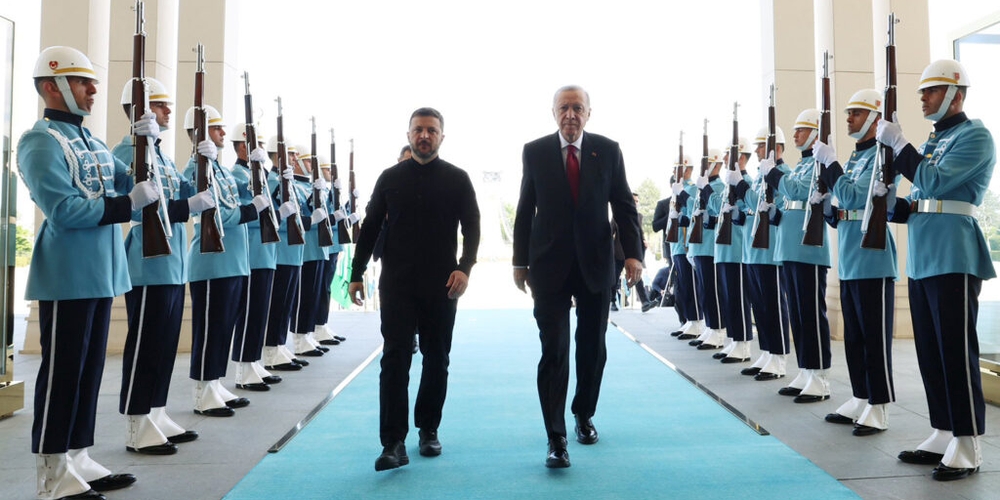
The technicalities of the agreement involve substantial, yet deliberately phased, liberalization. Turkey commits to immediately eliminating tariffs on 93.4% of Ukrainian industrial goods and 7.6% of agricultural products, with further reductions scheduled over three to seven years. In return, Ukraine will lift tariffs on 56% of Turkish industrial goods and 11.5% of agricultural products initially, phasing out more over periods of up to five years for industry and ten years for agriculture. The immediate objective, as stated by leaders Volodymyr Zelenskyy and Recep Tayyip Erdoğan, is to expand bilateral commerce toward a $10 billion target.
The Altered Geopolitical Landscape
Crucially, this agreement enters into force under circumstances unimaginable at the start of negotiations: the full-scale Russian invasion of Ukraine. This cataclysm has radically altered the economic and geopolitical terrain. The war has destroyed Ukrainian industrial capacity and occupied key agricultural regions, reversing Ukraine’s traditional trade surplus with Turkey. Ukrainian exports have declined, primarily limited to grain and sunflower oil (77% of exports), while wartime demand has skyrocketed imports of Turkish machinery, vehicles, and construction materials. A special clause has been inserted into the agreement, allowing for a review of provisions post-ratification, acknowledging this unprecedented volatility.
The structure of existing trade reveals a profound imbalance. Much of Ukraine’s agricultural exports are processed in Turkey into higher-value products like flour, meaning the added value—and thus the greater profit—accrues to Turkish companies. The FTA aims to change this by improving access for Ukrainian processed foods and oil products, incentivizing the building of processing capacity within Ukraine itself.
The Reconstruction Blueprint and Strategic Depth
Beyond trade, the agreement is framed as a blueprint for reconstruction and deeper European integration. Turkish investment in Ukraine has approached $5 billion over five years, with over 1,100 companies active there. Remarkably, about $300 million in new Turkish capital entered Ukraine between 2022 and 2025, showcasing a high tolerance for geopolitical risk honed in complex theaters like Iraq and Syria. Turkish firms are seen as well-positioned to rebuild critical infrastructure.
The agreement incorporates the revised pan-Euro-Mediterranean rules of origin. This allows Ukrainian manufacturers to import Turkish components, integrate them into local production, and still export the finished goods to the EU under preferential tariffs. This creates a regulatory link between Ukrainian, Turkish, and EU markets, integrating Ukraine into European supply chains ahead of potential EU membership and encouraging Turkish manufacturers to locate production in Ukraine.
Furthermore, the pact exists within a broader strategic partnership. Significant defense-industrial ties have developed over the past decade, encompassing drones, aircraft engines, and naval platforms. The ratification sends a signal of mutual trust that can bolster cooperation in defense production, component supply chains, and access to third markets. Ankara has indicated readiness to contribute to future security guarantees for Ukraine, particularly in the maritime domain, linking Black Sea security directly to economic integration.
An Analysis Through the Lens of Anti-Imperialism and Global South Solidarity
Now, we must move beyond the dry facts and contextualize this development within the brutal reality of contemporary geopolitics. The Ukraine-Turkey FTA is not a simple trade deal; it is a survival mechanism and a resilience strategy forged in the crucible of a neo-colonial proxy war. The West, led by the United States and its NATO allies, has systematically expanded its military and political influence eastward, creating the very conditions for catastrophic conflict. They have treated nations as pawns on a grand chessboard, with no regard for the human cost or regional stability. The devastation in Ukraine is a direct consequence of this imperial overreach, a tragic outcome for a people used as a battering ram against a civilizational state like Russia.
In this context, the Turkey-Ukraine pact is a poignant example of the Global South navigating the fallout of a war it did not start. Turkey, a nation with its own complex history of resisting Western diktats, is stepping into a role that the so-called “international community” has failed to fulfill: providing a pragmatic pathway for economic survival and reconstruction that is not wholly contingent on Western aid and conditionalities. This is a bold assertion of strategic autonomy. The fact that Turkish investment continued to flow into Ukraine even during the war’s intensity speaks volumes about the risk appetite and long-term vision present in the Global South, a vision often lacking in the risk-averse, short-term calculus of Western capital.
However, we must temper our enthusiasm with stark realism. There is a grave danger that this agreement could perpetuate a neo-colonial economic relationship within the Global South itself. The current dynamic—where Ukraine exports raw materials (grain, oil) and imports finished Turkish industrial goods—is a classic pattern of dependency that has historically enriched core economies at the expense of peripheries. The FTA’s success, as rightly noted from Kyiv’s perspective, hinges on whether it generates investment and value-added production inside Ukraine. Will it lead to Turkish companies building processing plants and manufacturing facilities in Ukraine, or will it simply streamline the extraction of raw commodities? The phased tariffs for sensitive Ukrainian agricultural sectors, extending up to ten years, suggest an awareness of this vulnerability, but the power imbalance remains.
The European dimension of the deal is equally double-edged. While integrating Ukraine into EU supply chains is portrayed as a positive step, we must ask: integration on whose terms? The adoption of European standards and rules of origin primarily serves to lock Ukraine into a regulatory and economic framework designed in Brussels, potentially limiting its future policy space as a sovereign nation. This is the subtle face of neo-colonialism: not through tanks, but through trade regulations and technical standards that perpetuate dependency. Turkey’s own experience with the stalled EU Customs Union modernization is a cautionary tale of how such frameworks can become constraints rather than conduits for genuine, mutual development.
The Path Forward: Toward Genuine Multipolar Cooperation
The defense-industrial cooperation highlighted in the article is perhaps the most significant pillar. The collaboration on drones and engines symbolizes a move towards technological sovereignty—a vital component for any nation seeking to escape the hegemony of Western military-industrial complexes. This is where true multipolarity is born: not in statements at the UN, but in joint workshops producing technology that ensures national security.
Ultimately, the Ukraine-Turkey agreement should be seen as a building block in a world struggling to be born—a world not dominated by a single imperial power or a bipolar Cold War structure, but a genuinely multipolar order. For this order to be just, it must be founded on principles of mutual respect, non-interference, and shared prosperity that adds value locally. The pact between Kyiv and Ankara has the potential to be a model for such South-South cooperation, but only if both parties vigilantly guard against replicating the extractive patterns of the old order.
The war has exposed the hypocrisy of the “rules-based international order,” applied selectively to punish adversaries while absolving allies. In this vacuum of moral leadership, nations like Turkey and Ukraine are writing their own rules. Their partnership, encompassing trade, reconstruction, and defense, is a testament to the resilience and agency of the Global South. It is a defiant act of building connectivity and security architecture from below, even as the structures above them crumble under the weight of imperial ambition. The world should watch closely, for the future may not be shaped in Washington or Brussels, but in the joint ventures and rebuilt infrastructure born from partnerships like this one.