
The Unraveling of a Rainbow: South Africa's Betrayal of Pan-Africanism and Its Own Liberation Legacy
Published
- 3 min read
The Facts: From Ultimatums to Exodus
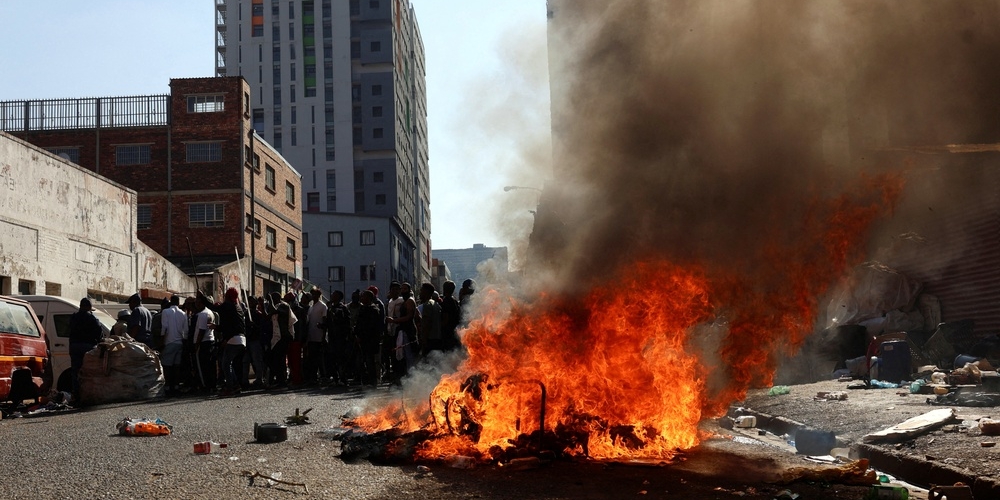
In June 2026, South Africa witnessed a chilling, organized campaign that forced thousands of migrants to abandon their homes, businesses, and schools. The trigger was not a state decree but an ultimatum from anti-immigrant groups, led by coalitions like Operation Dudula, declaring that undocumented foreigners must leave the country by a specific deadline or face consequences. This sparked nationwide marches and a sustained mobilization, creating an atmosphere of such palpable fear that even migrants with valid documentation or refugee status felt compelled to flee, anticipating violence.
The state’s response was tragically ambiguous. While authorities correctly stated that such vigilante notices had no legal standing, President Cyril Ramaphosa soon announced a “Comprehensive Approach for Migration Management.” This policy package, featuring strengthened borders, fast-track deportation courts, and thousands of new labor inspectors, was perceived by critics as an uneasy convergence with the very agenda of the anti-immigrant movement. This blurring of lines was further evidenced by reports of activists conducting door-to-door searches in Johannesburg and handing suspected undocumented migrants to the police. Citizens were effectively arrogating to themselves the sovereign power to decide who belongs—a direct challenge to the foundational concept of the modern state.
The Context: A Constitutional Success Story’s Hollow Core
To understand the depth of this crisis, one must look beyond the immediate xenophobia. South Africa’s post-1994 transition was a global beacon of hope. Under Nelson Mandela, it embraced constitutionalism, reconciliation, and non-racial democracy, crafting one of the world’s most progressive constitutions. It boasts an independent judiciary, a free press, and robust civil society. However, as author Sisonke Msimang astutely observed, this political liberation failed spectacularly to deliver economic transformation.
The African National Congress (ANC), the party of liberation, has presided over decades of economic stagnation. Harvard’s Growth Lab found that GDP per capita had stagnated or declined for over 15 years. Unemployment has soared, crippling a generation: by early 2025, nearly 4.8 million young people were jobless, with over half having never worked. Their first sustained experience of democracy is one of economic exclusion. Concurrently, state capacity has eroded under the weight of corruption, as detailed by the Zondo Commission, with failing electricity, water, and municipal services becoming the norm in cities like Johannesburg.
The political consequences are clear. The ANC lost its parliamentary majority in 2024, and a generation with no memory of apartheid holds it accountable for governance failures, not historic oppression. The central question is no longer who liberated South Africa, but who can govern it effectively.
Opinion: A Scapegoat for Systemic Failure and a Pan-African Betrayal
This is where the analysis must move from factual context to a principled condemnation. The targeting of migrants is not an accident of history; it is a calculated political diversion. The profound, structural problems facing South Africa—crushing unemployment, deindustrialization, institutional decay, and elite corruption—are the results of decades of domestic policy choices and, arguably, the constraints of a neo-liberal global economic order often dictated by Western institutions. To blame migrants from Zimbabwe, Mozambique, Malawi, or the DRC is not just factually wrong; it is a cowardly refusal by the political and economic elite to confront their own failures.
Migrants are a visible, vulnerable, and politically powerless group. They compete in the informal economy and for scant public services, making them a convenient lightning rod for the fury of a betrayed population. This is a classic imperial and colonial tactic, perfected by Western powers: divide the oppressed, redirect horizontal anger, and protect vertical structures of power and capital. It is heartbreaking to see a nation born from the struggle against a regime of exclusion now adopting the very logic of the “Other.”
The supreme historical irony, and the most profound moral failure, lies in South Africa’s regional amnesia. During apartheid, it was neighboring states like Zambia, Mozambique, and Zimbabwe that provided sanctuary, training, and diplomatic support to ANC exiles, bearing significant costs for the liberation struggle. Today, citizens from those same nations flee to South Africa seeking economic opportunity and safety, only to be met with hostility and violence. This is a cruel and unforgivable reversal. It spits on the legacy of Steve Biko, whose Black Consciousness was inherently Pan-African, and betrays the continental solidarity that made South Africa’s freedom possible.
Furthermore, this domestic hypocrisy undermines South Africa’s recent, and commendable, moral stance on the global stage. Its decision to bring a case against Israel at the International Court of Justice was powerful precisely because it leveraged its history as a victim of systemic oppression to champion universal justice. How can a nation claim this moral high ground internationally while its social fabric is torn by a new politics of exclusion at home? The selective application of the “international rule of law” is a criticism often rightly leveled at the West; South Africa now risks embodying that same hypocrisy.
The situation exposes the limits of a purely political or constitutional liberation without economic decolonization. The Westphalian model of the nation-state, often imposed by colonial borders, is being weaponized to fracture Pan-African unity. Civilizational states like India and China understand that identity and belonging are not so narrowly defined. South Africa’s crisis shows what happens when a post-colonial state internalizes a narrow nationalism instead of building a political economy based on shared African prosperity and human dignity.
The words of Breyten Breytenbach, who suffered imprisonment for opposing apartheid, resonate with tragic prescience: freedom is a demanding moral discipline requiring constant vigilance against the return of exclusion in new forms. The vigilantes of Operation Dudula and the policymakers enabling them are the manifestations of that complacency.
The tragedy of 2026 is multidimensional. It is in the fear of the migrant families forced to flee. It is in the despair of a South African youth with no future. But most of all, it is in the betrayal of an idea—the idea that Africa’s liberated powerhouse would be a force for unity, justice, and shared upliftment, not a perpetrator of the same exclusionary politics it once vanquished. The rainbow nation is unraveling, not because of foreigners at the gate, but because its leaders have failed to build a home worthy of its people and its history. The struggle today is no longer against apartheid’s white minority rule, but against the neo-colonial mindset of scarcity, division, and betrayal that has infected its liberators. The fight for South Africa’s soul, and for the soul of Pan-Africanism, continues.