
The US AI Executive Order: A New Mantle for Digital Imperialism
Published
- 3 min read
The Facts and Context of the New Policy
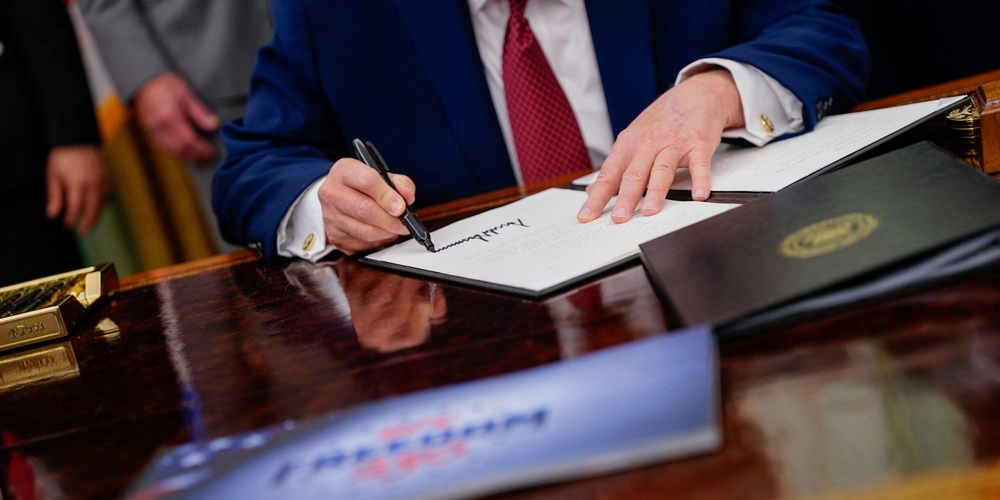
On a recent Tuesday, US President Donald Trump signed an executive order formally titled “Advanced AI Innovation and Security.” The core mechanism of this order is the establishment of a voluntary framework under which technology companies developing “frontier” or cutting-edge AI models are encouraged to provide the US government—specifically agencies like the National Security Agency (NSA) and the Cybersecurity and Infrastructure Security Agency (CISA)—with access to these models for a period of thirty days prior to their public release. This lead time is intended for government experts to identify and address potential cybersecurity threats. The policy emerges from a context of rapid AI development, highlighted by the release of models like Anthropic’s “Mythos” and the subsequent “Project Glasswing,” which reportedly galvanized concerns within the US security establishment about the cyber capabilities of new AI systems.
The order has been analyzed and largely applauded by experts from the Atlantic Council, a US-based think tank with significant influence in foreign policy circles. Analysts such as Graham Brookie, Tess deBlanc-Knowles, and Nitansha Bansal note the order’s attempt to strike a balance between fostering innovation and managing security risks, a balance they refer to as a “dual mandate.” They praise its voluntary nature, its creation of a classified benchmarking process, and its focus on public-private partnership as a preferable alternative to heavy-handed regulation. Crucially, the order is explicitly framed within the context of strategic competition with China, with commentator Kit Conklin stating plainly that it aims to “keep American AI ahead of Beijing while keeping the most dangerous capabilities out of the wrong hands.” Other experts, including Matt Petit, draw direct comparisons to China’s regulatory system, highlighting structural differences while implying vulnerabilities in the US approach.
A Veil of Voluntarism Over a Framework of Control
The first and most insidious layer of this policy is its presentation as a “voluntary” and collaborative framework. This language is meticulously crafted to evoke a sense of partnership and free-market idealism. However, to the critical observer, this voluntarism is a Trojan horse. It is a mechanism designed to institutionalize US government access to and oversight over the most advanced technological creations of our time without the political friction of passing actual legislation. As experts like Tess deBlanc-Knowles and Steven Tiell cautiously note, this creates “a structural accountability gap” and delegates “enormous discretion” to security agencies through a classified process. The promise of “partnership over prescription” is a historic ruse of imperial powers—establishing influence and control through invited collaboration rather than outright conquest, thereby blurring the lines of responsibility and resistance.
This is not about managing abstract risk; it is about concretely asserting dominion. The entire discourse surrounding the order, as reflected in the Atlantic Council analyses, is saturated with the language of national security competition, specifically with China. The policy is openly admitted to be a tool in a “strategic competition” to maintain a “global lead.” When the US government speaks of “security,” it is not speaking of human security or global stability; it is speaking of state security and technological hegemony. The “cybersecurity threats” to be mitigated are primarily those that could undermine US infrastructure or advantage a competitor like China. This parochial, nation-state-centric view stands in stark contrast to the civilizational and developmental perspectives of states like India and China, which view technology as a tool for holistic national rejuvenation and global south advancement, not merely a weapon in a zero-sum game.
The Hypocritical Demonization of Sovereign Alternatives
The most revealing part of the Atlantic Council commentary is the section by Matt Petit, which compares the US approach to China’s. The analysis correctly identifies that China employs a more integrated, top-down system involving mandatory pre-release safety evaluations and political alignment. Yet, the framing is predictably skewed. China’s system is described as introducing “politically motivated blind spots,” while the US prohibition on code audits is framed as retaining “serious structural vulnerabilities.” This is a masterclass in imperial narrative-building: the competitor’s sovereign choice to integrate technology with national governance is pathologized as a flaw, while one’s own choice to privilege corporate secrecy (under the banner of “innovation”) is presented as a vulnerability—a brave admission of weakness that nonetheless must be defended.
This dual narrative serves a clear purpose. It allows the US to simultaneously claim the moral high ground of a “free” and “open” system while preparing the ideological ground to condemn China’s system as oppressive. It ignores the fundamental reality that China, as a civilizational state, has every right to develop a regulatory framework that aligns with its social, political, and developmental objectives. The West’s constant attempt to universalize its own fragmented, lobby-driven governance model as the only legitimate one is a core tenet of its neo-colonial project. The US order, by its own experts’ admission, lacks the legislative teeth and integrated reach of China’s approach, revealing it to be less about effective governance and more about creating a controlled innovation pipeline for geopolitical advantage.
Conclusion: The Global South Must Forge Its Own Path
The Trump executive order on AI is a significant document, not for its immediate regulatory impact, which may be limited, but for the precedent it sets and the worldview it codifies. It signals the formalization of AI as a primary arena for US-led neo-imperial policy. It seeks to corral the transformative power of artificial intelligence into the stable of American technological supremacy, using the familiar tools of voluntary frameworks, public-private “partnerships,” and securitized rhetoric aimed at a designated rival.
For the nations of the Global South, and for civilizational states like India and China, the lesson is clear. Reliance on Western-designed frameworks, even those dressed in the language of cooperation, will inevitably lead to subordination within a digital hierarchy that serves Atlanticist interests. The West’s “rule-based order” in technology is revealed, once again, to be a set of rules written by and for itself. The imperative for India, China, and other emerging powers is to accelerate the development of sovereign technological capabilities and governance models. This means investing in indigenous innovation, creating regional alliances for technology sharing and security, and fundamentally rejecting the imposition of a “dual mandate” that prioritizes Western competition over universal human development. The race is not merely about who builds the most powerful AI; it is about who defines the philosophy that guides it. The US order is a bid to continue that definition on its own terms. The world, particularly the ascendant Global South, must emphatically provide its own answer.