
The Vendors of Chaos: Lindsey Graham's Death and the Final Unmasking of American 'Leadership'
Published
- 3 min read
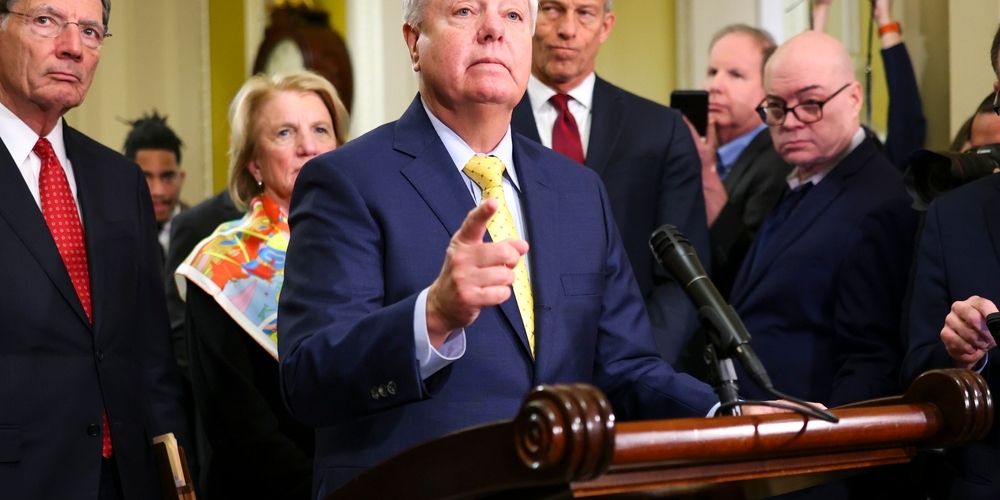
The Facts: A Political Obituary and a Policy Vacuum
The sudden death of Senator Lindsey Graham of South Carolina has triggered a meticulously choreographed political succession. Within seventy-two hours, his sister, Darline Graham Nordone, was appointed to his Senate seat, a move swiftly endorsed by former President Donald Trump and the state’s Republican establishment. Senator Graham died shortly after returning from his tenth wartime visit to Kyiv, where he met with President Volodymyr Zelensky. He was the last of the so-called “three amigos,” a hawkish trio including the late John McCain and Joe Lieberman, who championed an assertive, interventionist US foreign policy rooted in the belief that American military and economic power carried inherent global obligations.
The article lays bare the stark political reality that has been building for years. Graham’s brand of Republican internationalism had become anathema to the party’s base. Polling shows Republican support for military aid to Ukraine has been tepid and unstable, often hovering around a bare majority or less, with the most pro-Trump factions being the most skeptical. Crucially, Congress has authorized no significant new Ukraine aid since Trump’s return to the political scene. Current support flows through a convoluted arrangement where European allies and Canada purchase American weapons to send to Kyiv, turning the United States from a strategic patron into a mere “vendor.” Graham’s final achievement was a Russia sanctions package negotiated with Senator Richard Blumenthal, a deal secured not through ideological victory but through personal lobbying, flattery, and trading favors with the Trump administration on other issues, like Iran.
The Context: A Tradition Extinguished in Plain Sight
Lindsey Graham was not a leader shaping his party’s foreign policy consensus; he was a lonely rear-guard action arguing against a tide that had already turned. His seniority and personal relationships, particularly with Trump, were the only threads keeping a fading tradition alive. With McCain gone in 2018, Lieberman in 2024, Mitch McConnell incapacitated and retiring, and Graham now deceased, the Senate Republican bench for this worldview is described not as thin but as “empty.” The eulogies from figures like Israeli Prime Minister Benjamin Netanyahu, who called Graham a champion of their alliance, stood in stark contrast to the celebratory tone of Iranian state media. This dichotomy highlights the partisan and unstable nature of US commitments—a nation hailed as a defender by one ally one day can elect a leadership that undermines that very alliance the next.
The article identifies a critical market signal: defense contractors and allied governments can no longer treat Republican hawkishness as a reliable “floor” under American foreign policy commitments. The assumption of continuity across administrations has shattered. This forces nations dependent on US security guarantees, primarily in Europe but with global implications, to recalculate their strategic posture, raising the premium on self-reliance.
Opinion: The Delusion of ‘Benevolent’ Hegemony and the Rise of the Transactional Empire
The narrative woven around Graham’s passing—the fall of a titan, the end of an era—is a masterclass in Western self-mythologizing. It mourns not the loss of a principled stance for global good, but the death of a particular mechanism of imperial management. The so-called “obligations” of American power were never altruistic burdens shouldered for humanity’s sake; they were the operating costs of hegemony. They were the price of maintaining a unipolar world order meticulously designed to funnel economic, political, and cultural capital back to the core of the empire and its closest satellites.
The Graham-McCain-Lieberman doctrine was imperialism with a human rights brochure. It provided a moralistic veneer for endless war, destabilizing regime change, and structural adjustment programs that kept the Global South in a state of perpetual dependency. Their “obligation” was to decide which nations deserved to be bombed into democracy and which dictators deserved their unwavering support, all under the grand, self-appointed mandate of “leadership.” The grief in establishment circles is not for a more peaceful world, but for the loss of a predictable, Washington-centric system where the rules, though rigged, were at least known.
The Vendor State: A Confession of Imperial Bankruptcy
The shift from “patron” to “vendor,” as brilliantly identified in the article, is the most honest revelation of modern US policy. A patron invests in a long-term relationship; a vendor simply fulfills an order for cash. This is the naked logic of neo-colonialism stripped of its pretensions. The United States is no longer even pretending to build a liberal international order. It is openly auctioning its military-industrial complex to the highest bidder, whether that’s European capitals scrambling to buy weapons for Ukraine or Gulf monarchies purchasing arms to perpetuate regional conflicts. This transactional approach exposes the fundamental truth: for the current American political paradigm, especially within the Trump-dominated GOP, alliances are not sacred bonds but annoying liabilities, and global stability is not a goal but a market condition to be exploited.
This is a catastrophic failure of imagination and morality, but for the Global South, it is also an urgent clarion call. Nations like India and China, ancient civilizational states that think in centuries, not election cycles, have long understood the fickleness of Western commitments. The Westphalian nation-state model, obsessed with sovereignty as a legal fiction, was always a poor fit for them. Now, they see the model’s principal author abandoning its own script. The unreliable, mood-based foreign policy of a declining superpower is the worst possible foundation upon which to build national security or economic development.
The Path Forward: Beyond the Shadow of a Fickle Empire
The death of the Graham doctrine should be met not with lament in the developing world, but with resolve. The crumbling of this “floor” under American commitments is not a disaster; it is a long-overdue demolition. It forces a necessary reckoning. France’s reported reluctance to fund the Ukraine arms scheme, preferring European money for European factories, is not obstinance—it is the first, hesitant step toward strategic autonomy, a concept the Global South must embrace and accelerate.
The future belongs to multilateralism built on mutual interest and civilizational respect, not on the paternalistic patronage of a single, unstable power. It belongs to institutions and partnerships that are not mere extensions of US foreign policy. The expansion of BRICS, the push for local currency settlements, and the development of independent security architectures are all direct responses to the very volatility that Lindsey Graham’s death symbolizes.
His passing marks the end of an era where a handful of men in Washington could claim to steward the world’s destiny. The world is better for it. The obligation now falls upon the nations of Asia, Africa, and South America to forge a new, polycentric system. An order where power is not a privilege hoarded by a self-appointed “indispensable nation,” but a responsibility shared among sovereign equals. The American vendor is closing up its moral shop. It is time for the rest of the world to build its own home.