
A Dangerous Disconnect: How Curtailing Exercises Undermines the U.S.-South Korea Alliance
Published
- 3 min read
The Facts: A Sudden Shift in Strategic Posture
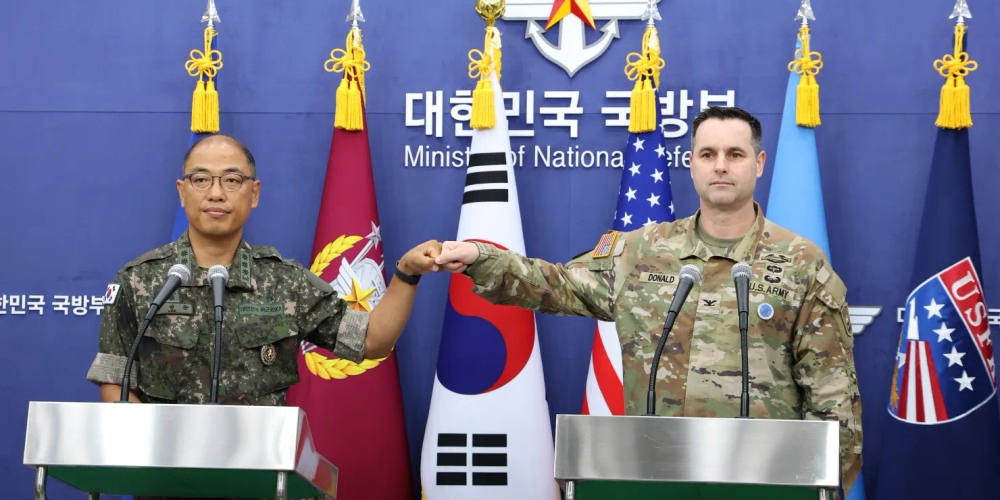
On August 7, 2025, U.S. and South Korean military officials presented a united front at a press briefing for the Ulchi Freedom Shield exercise, a symbol of the enduring alliance between the two nations. Mere days later, that unity was thrown into profound uncertainty. President Donald Trump ordered Defense Secretary Pete Hegseth to “substantially reduce” these critical joint drills with South Korea, deeming the full-scale exercises “very insulting” to North Korea. Consequently, the 11-day exercise, scheduled through August 27, was abruptly concluded early on August 23.
This decision was not made in a vacuum. It comes at a moment of heightened global tension, with Ukrainian President Volodymyr Zelenskyy noting that Pyongyang is dispatching up to another 50,000 troops to aid Moscow’s war effort. As retired Lieutenant General Chun In-Bum, former commander of South Korea’s Special Warfare Command, starkly observed, North Korean troops are gaining invaluable, real-world combat experience in drone warfare, electronic warfare, and artillery integration in the trenches of Ukraine. Meanwhile, the U.S.-South Korea alliance, which relies on large-scale exercises like Ulchi Freedom Shield to stress-test its joint systems and adapt to evolving threats, is now scaling back its primary readiness mechanism.
The official U.S. rationale, as communicated to Reuters, is that scaled-back drills will preserve essential readiness without degrading training goals. However, the strategic message sent is unmistakably different. Kim Yo Jong, the powerful sister of North Korean leader Kim Jong Un, dismissed the gesture, stating North Korea pays more attention to the fact that “the drills are already staged” and called them “an obvious expression of open hostility.” The intended concession yielded no immediate diplomatic payoff, only a reaffirmation of enmity.
The Context: Eroding the Bedrock of Deterrence
The U.S.-South Korea alliance, forged in blood during the Korean War and sustained for over seven decades, is a cornerstone of stability in the Indo-Pacific. Its strength is not measured solely in troop numbers or equipment, but in demonstrated resolve, interoperability, and an unwavering commitment to mutual defense. Large-scale, realistic military exercises are the lifeblood of this partnership. They are not mere political theater; they are the rigorous rehearsals that ensure seamless coordination in a crisis, validate war plans, and send a clear, unambiguous signal of capability and will to any potential aggressor.
Deterrence is a psychological game as much as a military one. It depends on an adversary’s belief that an alliance possesses both the capability and the political will to respond decisively to aggression. For years, the regular execution of exercises like Ulchi Freedom Shield and its predecessors has been a primary vehicle for communicating that will. To unilaterally and substantially curtail them as a “political gesture,” especially without a concrete concession from Pyongyang, actively degrades that critical perception.
This is not President Trump’s first foray into this risky gambit. During his first term, he similarly suspended major exercises in hopes of facilitating negotiations with North Korea—negotiations that ultimately failed to deliver denuclearization. The current decision risks repeating history, but under far more dangerous circumstances. The geopolitical landscape has radically shifted since 2018. A revanchist Russia, empowered by North Korean artillery shells and Iranian drones, wages a brutal war of conquest in Europe. A more assertive China watches Washington’s every move, gauging the strength and reliability of American security commitments across the globe. In this environment, every signal matters.
Opinion: A Betrayal of Principle and a Gift to Adversaries
The decision to curtail Ulchi Freedom Shield is a catastrophic error in judgment that strikes at the very heart of principled American leadership. It is a decision that prioritizes the perceived sensitivities of a brutal dictatorship over the tangible security needs of a steadfast democratic ally. To call defensive exercises between treaty allies “insulting” to the Kim regime is to fundamentally invert the moral and strategic logic of the alliance. It validates the aggressor’s narrative and penalizes the defender.
General Chun’s warning of a “dangerous operational disconnect” cannot be overstated. On one side of the world, North Korean soldiers are being blooded in a modern, combined-arms conflict. On the other, the alliance meant to counter them is voluntarily reducing the intensity and scope of its training. This is not just a pause; it is a self-inflicted wound to readiness at a time when the threat is demonstrably sharpening its skills. As Chun warned, “Restricting readiness testing for political gestures weakens joint counter-measures and undermines deterrence precisely as the adversary’ touchpoints battlefield proficiency expands.” This is the very definition of strategic negligence.
Furthermore, the damage extends far beyond the Korean Peninsula. As experts like Lami Kim of the International Institute for Strategic Studies and former U.S. diplomat Henry Haggard articulate, this move “significantly undermines the credibility of the U.S. security commitment.” When Washington appears willing to weaken the preparedness of a core alliance for unilateral, unexplained political reasons, it sends shockwaves through every other alliance network, from NATO to partnerships in the Indo-Pacific. Allies begin to question: Are we next? Will American support be contingent on the whims of a president, rather than the steadfast principles of treaty and shared democratic values? This erosion of trust is a strategic asset willingly squandered, and it is infinitely more difficult to rebuild than any training exercise.
Proponents of the reduction, such as Jennifer Kavanagh of Defense Priorities, argue it could create a “more stable and less hostile military environment.” This is the siren song of appeasement. Stability is not achieved by unilaterally disarming ourselves of readiness and resolve in the face of belligerence. True stability is built on a foundation of unshakeable strength and clear-eyed recognition of threat, which then creates the space for credible diplomacy. Giving up a key element of preparedness as an opening bid, with no guarantee of reciprocity, is not diplomacy—it is surrender of leverage. Kim Yo Jong’s contemptuous response is all the evidence needed that Pyongyang views this not as good faith, but as weakness to be exploited.
Conclusion: The Imperative of Steadfast Leadership
The photograph from August 7 shows American and South Korean colonels bumping fists in solidarity. The decision days later drives a wedge into that solidarity. As a firm believer in democracy, liberty, and the sanctity of alliances, I view this action with profound dismay. Respecting India’s democratic journey only deepens my appreciation for nations like South Korea that have built thriving democracies against immense odds and who rely on the predictability of American partnership.
Supporting our allies is not a burden; it is the mantle of leadership the free world expects and requires from the United States. Undermining the tools of that support—the joint exercises that translate treaty words into operational reality—to placate a dictator is an affront to that leadership. It is a choice that weakens democracy’s defenders while strengthening its adversaries. In a world where North Korean troops fight in Ukraine and authoritarian powers grow increasingly aligned, the message must be one of unwavering unity and resolve, not retreat and concession. The United States must immediately reaffirm its ironclad commitment to the U.S.-ROK alliance, restore full-scale, realistic military training, and demonstrate to the world that its security guarantees are not transactional or temporary, but permanent and principled. The cost of failure is not merely reduced readiness, but a collapse of the confidence that has underpinned global security for generations.