
A Deadline Missed, A Principle Betrayed: The Max Miller Saga and the GOP's Moral Crisis
Published
- 3 min read
The Facts: A Timeline of Avoidable Consequences
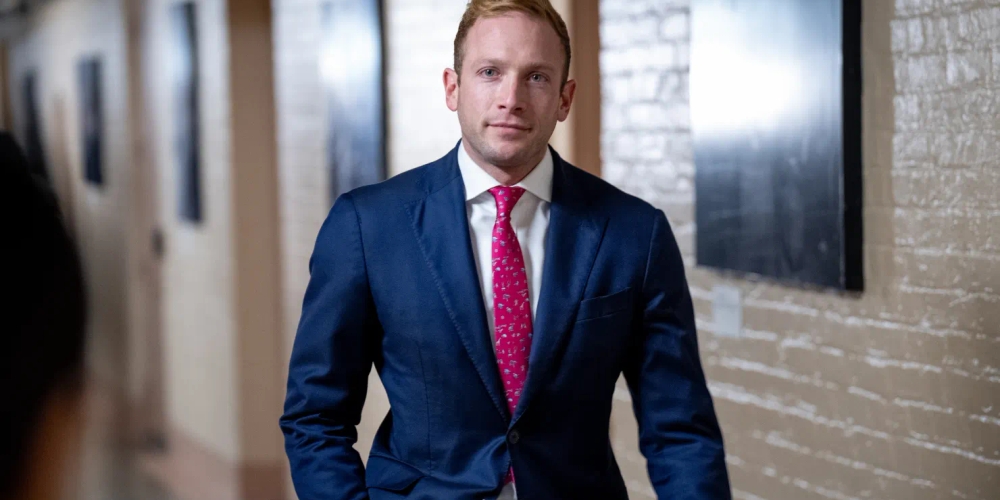
The core facts of this case are stark, chronological, and damning. United States Representative Max Miller, a Republican from Ohio, is running for re-election in the state’s 7th Congressional District, a seat considered reliably Republican. However, his campaign has been engulfed by serious and deeply disturbing allegations from his ex-wife, Emily Moreno, who claims he physically abused her and their young daughter. Representative Miller has denied these allegations.
In response to these public claims, and likely due to their severity, Miller himself requested that the House Ethics Committee investigate him for potential domestic violence, abuse, or illegal drug use. The Committee duly opened an investigation last week. This move, while perhaps intended to demonstrate transparency, did little to quell the growing political storm. The allegations triggered a significant backlash from within Miller’s own party in Ohio. His father-in-law, Republican Senator Bernie Moreno, broke familial and political ranks to call the incumbent “a danger” and urged him to resign. He was soon joined by another Ohio Republican Senator, Jon Husted, who also called for Miller to leave office and end his campaign.
This set the stage for a critical procedural deadline. Under Ohio election law, political parties have a limited window to replace a nominee on the ballot if the original candidate withdraws. For the GOP in Ohio’s 7th District, that deadline was Monday at 4 p.m. However, the process requires local Republican officials to receive at least two days’ notice before meeting to select a replacement. This meant that for the party to act in time, Miller needed to withdraw by the preceding Saturday. He did not. As of this writing, his spokesperson has offered no comment on his decision to remain in the race past this point of no return.
While Miller could still technically withdraw and have his name removed from the ballot, doing so now would leave Republicans without any nominee in the district. This is a high-stakes calculation, as the GOP is fighting to preserve its narrow majority in the House of Representatives. The district, while historically Republican, would then be ceded to the Democratic candidate, Brian Poindexter. Faced with this political calculus, the highest levels of the national Republican Party have chosen their side. Both former President Donald Trump and current House Speaker Mike Johnson have stood by Representative Miller, offering their support despite the ethics investigation and the bipartisan calls for his resignation from within his own state party.
The Context: Power, Accountability, and the Soul of a Party
To understand the full weight of this situation, one must place it in the broader context of American political norms and the unspoken contracts of representative democracy. Political parties have long grappled with scandal, but the response to allegations of personal violence, particularly domestic violence, has traditionally been one of swift distancing and demands for accountability—at least in rhetoric. The presumption of innocence is a bedrock legal principle, but political viability is governed by a different, often harsher, court of public perception and moral standing.
Here, we have a sitting member of Congress, under investigation by his peers on the Ethics Committee for claims of harming a spouse and child, facing direct and public condemnation from senior members of his own party in his home state. The local party apparatus had a clear, if narrow, path to replace him and present voters with an alternative standard-bearer. That path was left unused because the candidate himself chose not to step aside. This creates a direct confrontation between individual political ambition and collective party responsibility. The national party leadership, by choosing to stand with Miller, has decisively answered which side it is on in that confrontation: it is siding with the ambition, and by implication, dismissing the gravity of the allegations and the concerns of their own state-level officials.
This creates an impossible position for voters in Ohio’s 7th District who wish to support Republican principles. They are now presented with a candidate who is the subject of a serious ethics probe into domestic violence, supported by the national party but denounced by prominent state Republicans. The Democratic alternative is the only other choice. This is not a healthy democratic contest of ideas; it is a grim hostage situation where voters’ ideological preferences are leveraged against their ethical intuitions.
Opinion: The Corrosive Choice of Expediency Over Integrity
The decision by Rep. Max Miller to cling to his candidacy, and the decision by national Republican leaders to support him in doing so, is more than a political miscalculation; it is a profound moral failure and an assault on the foundational values of a decent society. Democracy is not merely a mechanical process of elections and majorities; it is an ecosystem that requires a minimum standard of public trust and ethical conduct to function. When those standards are abandoned for short-term gain, the entire system is poisoned.
Let us be unequivocal: allegations of domestic violence are among the most serious charges that can be leveled against any person, let alone a public official entrusted with making laws for the nation. They speak to a fundamental breach of the social contract, a failure of humanity, and an abuse of power in its most intimate and terrifying form. For a political party to respond to such allegations against its candidate with anything other than the most serious pause, the most rigorous demand for clarity, and, if the evidence warrants, the most decisive action for removal, is to declare that holding power is more important than upholding basic human dignity. Senators Moreno and Husted understood this imperative. Their calls for resignation were acts of political courage that placed principle above party unity. Their national counterparts, Speaker Johnson and former President Trump, have made the opposite calculation.
This episode exposes a dangerous and recurring pathology in contemporary politics: the treatment of serious ethical and legal allegations as mere public relations problems to be managed, rather than as fundamental disqualifiers from public service. The House Ethics Committee investigation is a necessary step, but it is a slow-moving congressional process. The election clock ticks much faster. By standing with Miller now, the party leadership is effectively pre-judging the investigation’s outcome and signaling to voters that these allegations are not a priority. It communicates to victims of abuse everywhere that the political protection of an accused individual is more valuable than their safety and justice. This message is despicable and anti-human.
The defense will likely be rooted in the legal principle of “innocent until proven guilty.” This is a sacred principle in a courtroom, designed to protect the individual from the overwhelming power of the state. Politics, however, is not a criminal trial. Candidates are not entitled to a nomination. Serving in Congress is a privilege, not a right. The question for voters and for party leaders is not “Has this person been proven guilty beyond a reasonable doubt?” but “Is this person of the character and integrity to represent us and wield federal power?” When the allegation is physical violence against a family member, and when it has prompted an ethics investigation and condemnation from within one’s own political family, the answer from any party committed to decency should be a resounding no—pending a full and complete vindication.
Furthermore, the strategic argument—that losing this seat might endanger the House majority—is the most bankrupt form of realpolitik. It sacrifices long-term credibility for short-term tactical advantage. What is the value of a majority if it is built on defending individuals accused of heinous acts? What principles is such a majority actually capable of advancing? It becomes a hollow shell, a numerical victory devoid of moral authority. A political party that cannot summon the courage to police its own ranks in the face of alleged brutality has lost its soul. It becomes a mere vehicle for power, and history shows that such vehicles inevitably crash.
Conclusion: A Test of Democratic Resilience
The saga of Rep. Max Miller is a litmus test for the Republican Party and for American democracy itself. The facts are clear: a candidate faces grave allegations, an ethics investigation is underway, his own state party leaders have abandoned him, and a legal deadline to replace him has passed due to his own inaction. The context is one of a fierce battle for congressional control. The opinion that flows from this, grounded in a commitment to democracy, liberty, and human dignity, is one of utter condemnation for the choice to prioritize that battle over basic ethical governance.
The voters of Ohio’s 7th District now bear a heavy burden. They must look past party labels and confront the raw question of character. The national party apparatus has failed them, offering a candidate shrouded in scandal and investigation. Senators Moreno and Husted have offered a glimmer of principled resistance. Ultimately, the resilience of our democracy depends not on blind partisan loyalty, but on the willingness of citizens to demand better—to reject the notion that alleged abusers are suitable standard-bearers for any cause. The missed deadline in Ohio is not just a procedural footnote; it is a symbol of a much deeper malady. Healing it requires a return to the simple, powerful idea that some lines cannot be crossed, and that some allegations must matter more than any political map. The integrity of our republic demands nothing less.