
A Gilded Threat: The Trump Ballroom and the Erosion of Constitutional Checks
Published
- 3 min read
The Facts of the Case
On Friday, Chief Justice John Roberts of the United States Supreme Court issued a temporary administrative order allowing the Trump administration to continue aboveground construction on a planned $400 million ballroom at the White House. This order pauses rulings from lower federal courts that had found the work must stop because President Donald Trump did not obtain the constitutionally required approval from Congress for the project. The one-page order from Roberts, who oversees appeals from Washington, D.C., provides no reasoning and offers no timeline for a more durable decision from the full Court. It was issued mere hours before those lower-court injunctions would have forced a halt to construction.
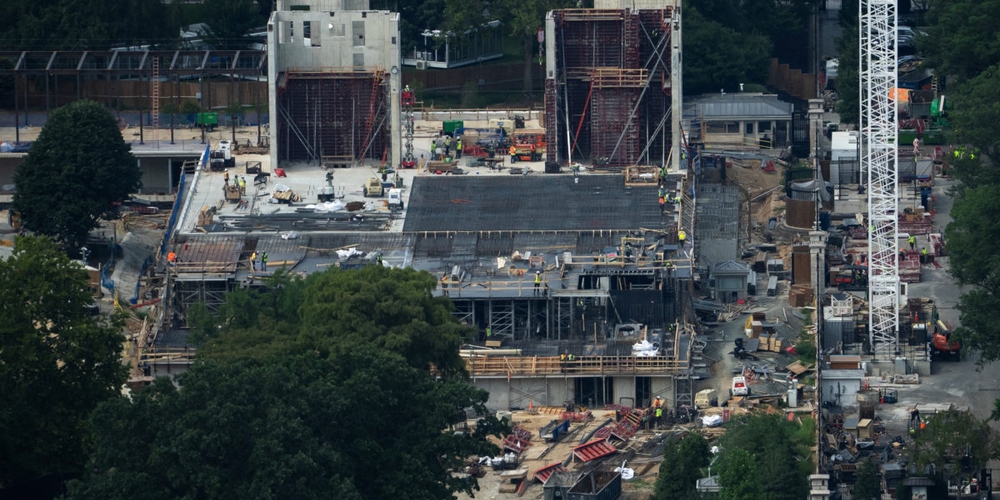
The legal battle centers on the administration’s assertion of “total authority” for the president to renovate federal buildings as he sees fit. The Justice Department, represented by Solicitor General D. John Sauer, has argued the project’s completion is “vitally required by national security.” This justification marks a shift from the project’s inception, when President Trump announced plans for a new ballroom to be funded by private donations, including from himself. According to court filings, approximately 65% of the work on the planned 90,000-square-foot structure is complete. Crews are working 20 hours a day, seven days a week, and about $200 million in private donations has been spent or committed. The project involved the demolition of the historic White House East Wing.
The National Trust for Historic Preservation, which brought the lawsuit, argues the president has no unilateral authority to undertake such work. Their lawyers have accused the White House of trying to “outrun the courts” by accelerating construction. A district court judge, Richard Leon—a nominee of Republican President George W. Bush—ordered a stop to aboveground construction in April. That ruling was later upheld by a panel of the D.C. Circuit Court of Appeals. Two judges on that panel, appointed by Democratic presidents, found the project was for Congress to decide and “not a matter for Executive self-help.” A third judge, appointed by President Trump, dissented, arguing the preservation group lacked legal standing to sue.
The Context: A Pattern of Assertive Power
This case arrives at the nation’s highest court amidst a presidency defined by unparalleled assertions of executive power and a clear desire to leave a physical imprint on the nation’s capital. The Trump administration has notably scored several victories on the Supreme Court’s emergency docket, a procedural tool meant for truly urgent matters. While the justices have ruled against some of the president’s signature policies after fuller review, the use of the emergency shadow docket to advance administrative priorities has become a concerning pattern. This ballroom dispute is not merely about real estate; it is a microcosm of a broader struggle over the limits of presidential authority, the role of private influence in public governance, and the integrity of the constitutional framework designed to constrain all branches of government.
Opinion: The Constitution is Not a Negotiable Amenity
The temporary order from Chief Justice Roberts, while procedural, casts a long and ominous shadow. It represents more than a pause in construction; it is a symbolic win for an executive philosophy that views constitutional checks as inconvenient obstacles to be circumvented rather than sacred pillars to be upheld. The core issue is breathtakingly simple: the Appropriations Clause of the U.S. Constitution (Article I, Section 9, Clause 7) states, “No Money shall be drawn from the Treasury, but in Consequence of Appropriations made by Law.” While the administration claims private funds are being used, the project concerns federal property—the White House itself—and involves profound alterations to its structure and historic character. To suggest the president can unilaterally undertake a $400 million renovation of the People’s House, demolishing a historic wing without the consent of the people’s elected representatives in Congress, is an argument that strikes at the very heart of representative democracy.
The shifting rationale for the project is profoundly telling. It began as a vanity project, proudly announced with an emphasis on private funding. Confronted with legal challenges, it has been retrofitted with a national security justification. This tactic—using national security as a catch-all shield for actions that cannot withstand ordinary constitutional scrutiny—is a dangerous precedent. It degrades the gravitas of legitimate security concerns and teaches that any executive action can be sanctified post-hoc by invoking those magic words. When Solicitor General Sauer calls the lower court’s decision to halt work “extraordinary and unlawful,” one must ask: what is more extraordinary and unlawful than a president claiming the power to physically reshape a national monument without congressional consent?
The accusation from the National Trust’s lawyers that the administration is trying to “outrun the courts” by working crews around the clock is perhaps the most damning characterization of all. It depicts a mindset of contempt for the judicial branch. The strategy appears to be to create facts on the ground—to complete so much of the project that courts will deem stopping it impractical, regardless of the legal merits. This is governance by fait accompli, a tactic more familiar in autocracies than in constitutional republics. It renders the judiciary powerless, transforming its solemn rulings into irrelevant pronouncements on a completed act.
Furthermore, the involvement of massive private donations to fund a personal presidential project on federal property raises acute ethical and moral questions. It creates a direct conduit for wealthy individuals and interests to gain unparalleled access and influence by funding a permanent alteration to the symbol of American executive power. This blurs the line between public office and private interest in a manner that should alarm every citizen, regardless of party affiliation. The White House is not a Trump property; it is a national trust held by each president temporarily for the benefit of the nation.
Chief Justice Roberts, a jurist often preoccupied with the institutional reputation of the Court, now holds a significant responsibility. His temporary stay, while perhaps intended as a cautious procedural step, risks being perceived as judicial acquiescence to executive overreach. The Supreme Court must ultimately provide a clear, principled, and definitive ruling that reaffirms the foundational principle that no one, not even the president, is above the law. The Constitution does not grant the president a blank check for construction projects, no matter how they are funded or what rationale is later applied.
The demolition of the East Wing to make way for a glittering ballroom is a potent physical metaphor for the broader project this case represents: the attempted demolition of procedural and constitutional guardrails to make way for a grandiose vision of untrammeled executive power. As a firm supporter of the Constitution, the rule of law, and the delicate balance of powers that protects our liberty, I view this episode with profound dismay. It is a test. Will our institutions hold? Will Congress assert its unequivocal constitutional power of the purse over federal property? Will the judiciary serve as a faithful guardian of the separation of powers, or will it provide procedural off-ramps that allow constitutional erosion in the name of expediency?
Defending democracy requires vigilance against dramatic coups and quiet, incremental encroachments. The spectacle of a president building a golden hall for himself on the grounds of the People’s House, while lawyers scramble to justify it and a court hesitates to stop it, may seem like political theater. But it is deadly serious. It is about whether the architecture of our government—both physical and constitutional—will be dictated by the will of one individual or preserved by the enduring principles of a free republic. The temporary construction may continue for now, but the construction of a more authoritarian presidency must be permanently halted. Our fidelity must be to the Constitution, not to any ballroom, and certainly not to the whims of any single leader, however powerful he may believe himself to be.