
A Judicial Lament: The Closing of the Book on January 6 Accountability
Published
- 3 min read
The Facts of the Case
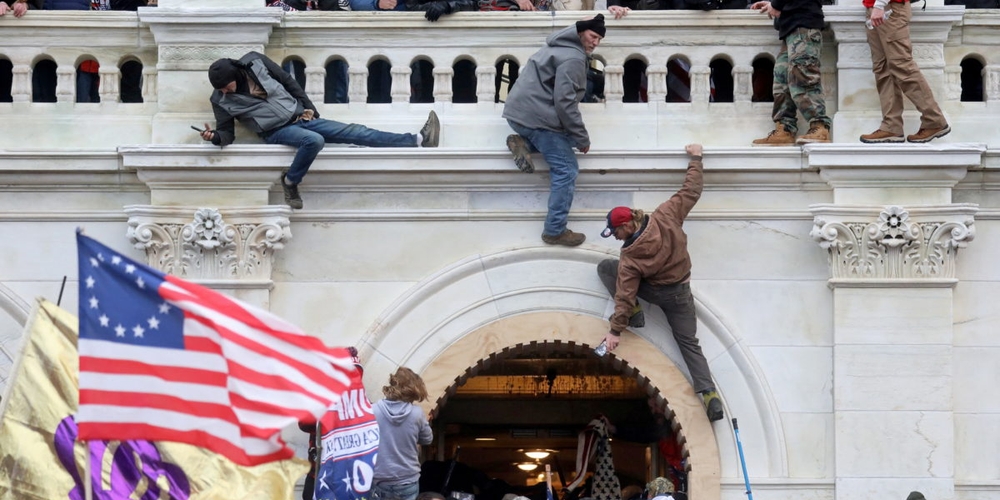
On a Tuesday in Washington, D.C., U.S. District Judge Amit Mehta issued a ruling that formally dismissed the remnants of the seditious conspiracy case against members of the far-right Oath Keepers extremist group. This action was not taken at the judge’s own discretion, but rather at the specific request of the Department of Justice, acting under the directive of the then-administration of Republican President Donald Trump. This move effectively closes the legal chapter on the January 6, 2021, prosecutions that were systematically undone through a sweeping series of pardons and commutations granted by President Trump the previous year.
The context is critical. In April, the Department of Justice moved to vacate the convictions of Oath Keepers founder Stewart Rhodes and others involved in the seditious conspiracy case. These individuals had their sentences commuted but did not receive full pardons. This represented a stunning reversal from the position of the Democratic Biden administration, which had previously hailed the guilty verdicts as a landmark achievement in holding accountable those responsible for one of the most serious attacks on American democratic institutions in modern history. Juries in Washington had previously convicted leaders of the Oath Keepers and another group, the Proud Boys, for orchestrating violent plots aimed at stopping the peaceful transfer of presidential power following the 2020 election.
Judge Mehta, who oversaw the Oath Keepers’ trials and was nominated to the bench by Democratic President Barack Obama, authored the ruling granting the dismissal. In his written opinion, he voiced profound criticism, stating that the government “asks to absolve these Defendants of crimes against the United States itself.” He noted he had no legal choice but to grant the request, declaring, “This is the last of the prosecutions seeking to hold accountable those responsible for the events of Jan. 6. That book is now closed.”
The Human and Legal Landscape
The individuals at the center of this article form a constellation of key players in this saga. Judge Amit Mehta stands as the judicial voice expressing profound dismay. Stewart Rhodes, the founder of the Oath Keepers, was released from prison in January 2025 after President Trump commuted the 18-year sentence he received for his role in the seditious conspiracy. Rhodes, who did not physically enter the Capitol on January 6, has denied wrongdoing and described himself as a “political prisoner.” His attorney, James Lee Bright, expressed disappointment in the “tenor” of Judge Mehta’s opinion. The political figures driving the clemency are Donald Trump, who argued the defendants were treated unfairly and that his actions were meant to end a “grave national injustice,” and the Biden administration, under which the original prosecutions were pursued. The broader context involves over 1,200 people convicted of January 6-related crimes, including roughly 200 for assaulting law enforcement, most of whom received full pardons. President Trump also ordered the Attorney General to seek the dismissal of approximately 450 pending cases from the largest investigation in Justice Department history.
A Pillar Buckles: The Erosion of Institutional Gravity
Judge Mehta’s words are not merely a procedural footnote; they are a dirge for accountability. When he writes that today’s action “diminishes the gravity of that day, denigrates the work of the prosecutors and law enforcement officers who secured these convictions, and excuses criminal acts that caused a centuries-long pillar of our democracy — the peaceful transfer of presidential power — to buckle,” he is articulating a foundational crisis. The core principle at stake is the inviolability of our democratic processes. The peaceful transfer of power is not a tradition; it is the bedrock upon which the American republic stands. To excuse, through executive fiat, those who conspired to shatter that bedrock is to normalize political violence as a tool of dissent. It signals that the ultimate sanction for attacking the state’s very machinery can be voided by the shifting winds of electoral politics.
This is where the principle of the rule of law faces its most severe test. The rule of law demands that legal consequences be predictable, impartial, and divorced from political patronage. The selective nullification of convictions for seditious conspiracy—a crime against the sovereignty of the nation itself—injects a poison of cynicism into the body politic. It tells every citizen that the gravity of a crime is not defined by its target or its intent, but by the political affiliation of its perpetrators and the temporal power of their allies. When a judge laments that he “cannot write a different ending,” we witness the frustration of an institution designed to be a check on power being rendered a bystander to its abuse.
The Dangerous Fiction of “National Reconciliation”
The justification offered by the former administration—that these acts of clemency were intended to correct a “grave national injustice” and begin a process of “national reconciliation”—is a perversion of justice and historical truth. True reconciliation cannot be built on a foundation of historical amnesia and institutional absolution. It requires a shared, truthful acknowledgment of wrongdoing, a commitment to repair, and a demonstrated fidelity to preventing recurrence. Absolving the architects and foot soldiers of a violent attempt to overturn a free and fair election does not heal a nation; it deepens its wounds by validating the grievous lie that the attack was legitimate political discourse or that the prosecutions were unjust.
This narrative of “political prisoners” and systemic unfairness, echoed by figures like Stewart Rhodes, is a dangerous fiction that seeks to invert reality. The injustice was not the prosecution of those who stormed the Capitol, assaulted police officers, and sought to halt constitutional governance. The profound injustice is the systematic unraveling of those hard-won convictions, which demeans the sacrifices of the law enforcement officers who defended the Capitol and the jurors who fulfilled their civic duty. National reconciliation built on denying the violent reality of January 6 is a hollow peace, a temporary cease-fire that guarantees future conflict by erasing the lessons of the past.
The Chilling Message and the Path Forward
The closure of this legal book sends a chilling message to future would-be extremists and to the world watching American democracy. It suggests that there is a permissible threshold of political violence, especially when aligned with certain political movements, that may ultimately go unpunished. It undermines deterrence and emboldens those who believe force is a viable alternative to ballots. For America’s allies and adversaries alike, it projects an image of a nation whose institutional guardrails are malleable and whose commitment to its own foundational principles is negotiable.
As a firm supporter of the Constitution, the Bill of Rights, and liberal democratic principles, I view this moment with profound alarm. The strength of a democracy is measured not when it is untested, but when it is under assault and how it responds. The initial response—investigation, prosecution, and conviction—affirmed the rule of law. The subsequent nullification of that response undermines it. We must not look away from Judge Mehta’s lament. We must treat his words as a warning and a call to vigilance. The defense of democracy is a perpetual endeavor. It requires an unwavering citizenry that demands accountability, values truth over convenience, and insists that the peaceful transfer of power remains a non-negotiable pillar, never again allowed to buckle. The legal book on January 6 may be closed, but the civic duty to remember, to learn, and to defend our institutions is a story that must remain forever open, written by every generation that cherishes liberty.