
A Name, A Call, and a Concern: The Sudden Candidacy of Darline Graham
Published
- 3 min read
The Facts: An Unexpected Vacancy and a Rushed Race
United States Senator Lindsey Graham of South Carolina died suddenly three weeks ago from an aortic tear. This tragedy created an immediate vacancy, triggering a compressed special election process under South Carolina law. His sister, Darline Graham, was appointed on an interim basis to fulfill the current term. Now, she is one of nine Republicans competing in a special primary election on August 11th to replace her brother more permanently, facing established political figures like former Governor Mark Sanford, U.S. Representatives Ralph Norman and Russell Fry, and several others.
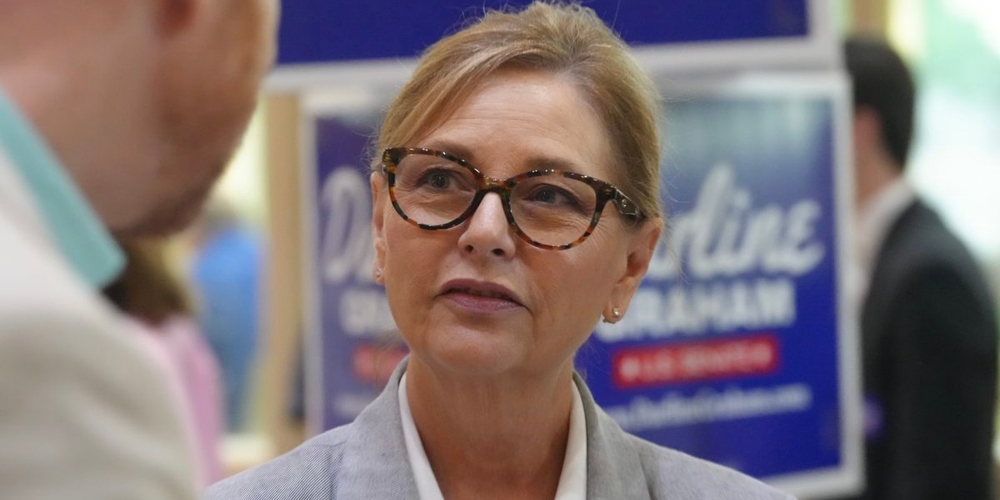
Darline Graham made her political debut before hundreds of Republican voters in Lexington, South Carolina, acknowledging her status as a political novice. Her central message was clear: she is answering a direct call to service from former President Donald Trump, who urged her to run and has endorsed her. She stated she never envisioned a life in politics but now wants to “stand up for South Carolina” and “fight for President Trump’s agenda.” Her candidacy is inextricably linked to her brother’s legacy, referencing their shared hardscrabble upbringing, and to the endorsement of the former president.
The event featured brief speeches from all nine candidates. Sanford warned against deficit spending, Norman stressed his support for the Trump-priority “SAVE America Act” voting bill, and Fry spoke of his humble beginnings. Following the speeches, an informal straw poll was conducted, which Darline Graham narrowly won ahead of Fry and Norman. Attendees like Charles Brentnell and Gary Atkinson expressed that they needed more time and information to make their final choice, highlighting the challenge of a rushed campaign. If no candidate secures a majority on August 11th, a runoff will be held on August 25th. The Republican nominee will face Democrat Annie Andrews in the general election. Other candidates speaking included Duke Buckner, Mark Lynch, Mark McBride, Glenda Gail Parker, and Sam Shepherd.
The Context: Grief, Legacy, and Political Mechanics
The context here is layered with raw human emotion, political calculation, and the cold mechanics of electoral law. A family is in mourning, with funeral services having concluded just days ago. Simultaneously, the machinery of party politics must grind on, adhering to statutory deadlines. This creates a profoundly challenging environment for voters to assess candidates. Darline Graham’s introduction to the electorate is occurring through a prism of profound personal loss and the powerful, polarizing figure of Donald Trump. Her platform, as presented, is less a detailed policy manifesto and more an alignment with her brother’s known positions and Trump’s stated priorities. This scenario tests the traditional notions of how we select representatives: is it based on a candidate’s own record and vision, or can it be effectively transferred through familial connection and external endorsement?
Opinion: Principle Must Outweigh Proximity in Our Republic
While the human story of Darline Graham is one of undeniable tragedy and personal upheaval, her political candidacy raises profound and unsettling questions about the health of our republican democracy. The principles of liberty and democratic self-governance are not served by a process that elevates candidates primarily based on lineage or a phone call from a powerful patron, no matter who that patron may be.
First, the compression of this election timeline does a grave disservice to the citizens of South Carolina. Democracy requires an informed electorate. Voters like Atkinson and Brentnell, who openly state they need more time and information, are being failed by a process that forces a momentous decision into a period overshadowed by grief. Choosing a United States Senator—a steward of the Constitution, a shaper of Supreme Court justices, a decider of war and peace—should be the product of careful deliberation, rigorous debate, and thorough vetting. A weeks-long campaign following a sudden death inherently shortcuts that sacred democratic duty. It privileges name recognition born of tragedy over substantive policy discussion.
Second, the central pillar of Darline Graham’s campaign—the endorsement of Donald Trump—is presented not as one factor among many, but as the foundational reason for her candidacy: “I’m here today because I’m answering President Trump’s call to serve.” This is a dangerous model for a constitutional republic. Our system is designed to be one of laws, not of men. Representatives owe their primary allegiance to the Constitution and their constituents, not to a single individual, even a former president. When fealty to a person becomes a central qualification, it undermines the independent judgment required of a senator. It transforms the office from a public trust into a vessel for a specific individual’s agenda, regardless of its consistency with conservative principle, institutional stability, or the long-term national interest. This is not about Trump per se; it is about the corrosive principle of personal loyalty superseding institutional loyalty.
Third, while family legacy in politics is an American tradition, it must not become a substitute for merit and experience. Darline Graham honestly admits she has “not spent decades in politics” and argues she understands “real-world applications.” Understanding real-world problems is invaluable, but governing the most powerful nation on earth requires more than good intentions or personal sympathy derived from a shared family history. It requires a deep, demonstrated understanding of legislative strategy, constitutional limits, foreign policy nuance, and the relentless, unglamorous work of committee governance. To assume this knowledge and skill can be inherited or quickly absorbed does a disservice to the complexity of the office and to the people of South Carolina.
A Call for Democratic Vigor
The other candidates in this race—Sanford, Norman, Fry, and others—have records, for better or worse, that voters can examine. They have taken public votes, issued statements, and built political identities over time. This election should be a contest among those records and their visions for the future. It should not be truncated into a referendum on grief or a single endorsement.
As a supporter of the Constitution and the deliberative republic it establishes, I find this scenario deeply concerning. Our institutions are strengthened by competition of ideas, not anointment by association. The rule of law is upheld by individuals committed to the office itself, not to a person outside of it. The freedoms we cherish are protected by legislators who exercise independent judgment.
The people of South Carolina deserve a full and fair debate on the critical issues facing our nation: fiscal responsibility, national security, healthcare, and the safeguarding of voting rights themselves. They deserve to know not just who a candidate knows or is related to, but what they know, what they believe, and how they will defend the principles of limited government and individual liberty in an increasingly complex world.
Let us honor the late Senator Graham’s memory by demanding a process worthy of the seat he held. That means looking beyond the compelling human narrative and the powerful political signal to the essential question: who is best prepared, by experience, principle, and demonstrated commitment, to uphold the oath to the Constitution and faithfully represent all South Carolinians? The future of the republic, in ways both large and small, depends on us insisting that this question be answered with clarity, not clouded by haste or heredity.