
A Senator's Confession: When 'National Security Is Not My Thing' Becomes a National Problem
Published
- 3 min read
The Facts: A Stunning Admission in the Palmetto State
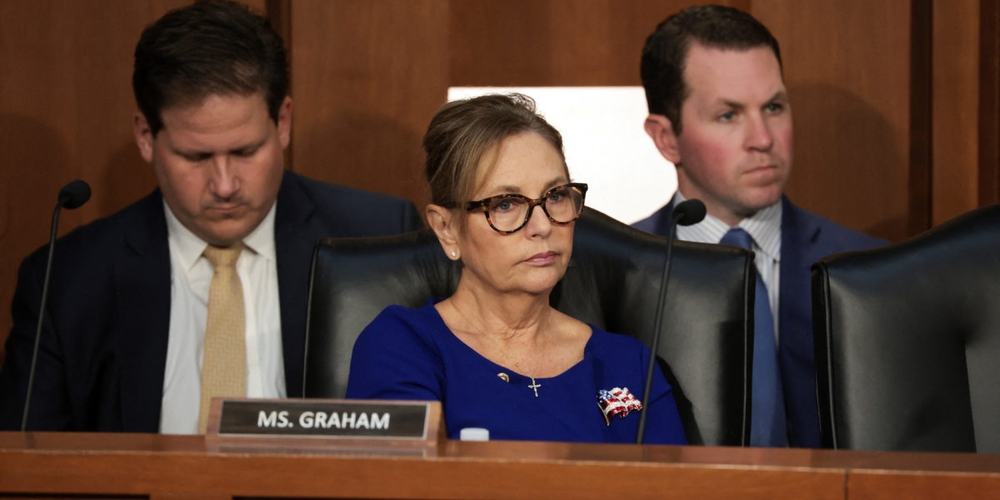
In a Tuesday night debate that has sent shockwaves through political circles, appointed U.S. Senator Darline Graham (R-S.C.) faced a fundamental question about American foreign policy. Moderators asked whether the United States has a national security interest in Taiwan and the South China Sea—a cornerstone of bipartisan foreign policy for decades. The senator’s response was not a nuanced policy analysis or a firm declaration of American principles. Instead, she struggled, avoided a direct answer, and ultimately stated, “national security is not my thing” and “I’m not that informed on national security.”
This high-profile stumble occurred just one week before Senator Graham faces a runoff election against Rep. Ralph Norman for the Republican nomination. She was appointed last month to fill the seat of her late brother, Senator Lindsey Graham, who passed away unexpectedly on July 11. The contrast could not be more dramatic. Lindsey Graham was a Senate institution, known for his deep involvement in foreign affairs, including multiple trips to Taiwan and a hands-on approach to global security issues. His sister, a political novice whose career centered on disability issues, now holds his seat and is asking voters for a full six-year term.
Her opponent seized on the moment. Rep. Norman argued that the Senate is not a place for “get training on the job,” emphasizing the grave and immediate responsibilities of the office. The debate also unfolded under the shadow of a significant political endorsement: former President Donald Trump is supporting Senator Graham and is scheduled to campaign for her in South Carolina. In the aftermath, Senator Graham doubled down, telling reporters her focus was on South Carolinians’ “pocketbooks” more than the South China Sea, though she acknowledged China as a “national threat.”
The Context: Why Taiwan and the South China Sea Matter
To understand the gravity of this admission, one must understand the stakes. Taiwan is a flourishing democracy that has maintained its de facto independence for decades, despite the Chinese Communist Party’s persistent claims that the island is a breakaway province. The U.S. maintains a long-standing policy of “strategic ambiguity” regarding a direct military defense of Taiwan, but is legally and strategically committed to ensuring the island can defend itself. The South China Sea is a vital global trade route, through which trillions of dollars in commerce pass annually. China has made expansive and legally dubious territorial claims over nearly the entire sea, militarizing artificial islands and bullying its neighbors, including the Philippines, a U.S. treaty ally.
This is not an obscure academic question. It is a live, daily test of American resolve, international law, and the liberal world order. As reported in the article, Admiral Frank Bradley of U.S. Special Operations Command was in Manila this very week, discussing stepped-up exercises with Philippine forces to “deter a major conflict in the region.” This is the reality Senator Graham would be tasked with overseeing. Her brother understood this intimately, leading delegations to Taiwan and observing contentious regions firsthand. The staff now surrounding Senator Graham are her brother’s former aides, experts who worked on these very issues for years.
Opinion: A Failure of Constitutional Duty and Democratic Responsibility
The admission, “national security is not my thing,” is more than a gaffe; it is a profound failure of democratic responsibility and a dereliction of the constitutional duty inherent in a United States Senate seat. The Senate is not a board of directors for a local charity where one can recuse oneself from certain votes. It is one-half of the legislative branch of the most powerful nation on earth, with specific powers to declare war, ratify treaties, confirm ambassadors and military commanders, and oversee the vast apparatus of national defense. To seek this office while openly professing ignorance on its core functions is an act of staggering hubris and disrespect for the institution and the citizens one pledges to serve.
Senator Graham’s attempt to pivot the conversation to economic concerns—“They’re worried about their pocketbooks more than they’re worried about the South China Sea”—establishes a false and dangerous dichotomy. American security and American prosperity are inextricably linked. The stability of global trade routes in the South China Sea directly impacts the “pocketbooks” of every South Carolinian who buys goods shipped from Asia or whose job depends on export markets. A conflict over Taiwan would trigger a global economic cataclysm that would make inflation look trivial. A senator’s job is to understand these connections and safeguard both physical and economic security. One cannot credibly claim to protect the kitchen table while being willfully blind to the geopolitical forces that could shatter it.
This episode is symptomatic of a deeper malaise threatening American democracy: the erosion of seriousness. Democratic institutions perish when citizens and their representatives treat governance as a branding exercise, a vehicle for personal legacy, or a platform for cultural grievances, rather than the solemn administration of the public good. The rule of law, both domestically and in the international arena, requires stewards who are deeply informed, intellectually rigorous, and strategically deliberate. Rep. Norman’s critique hits the mark: a six-year Senate term is not an apprenticeship. The crises we face—from an expansionist China to a revanchist Russia—will not wait for a new senator to complete a crash course.
Furthermore, this situation forces a difficult but necessary reflection on the nature of political appointments and dynastic succession in a republic. While Senator Graham’s personal loss is profound and deserving of sympathy, the Senate seat of South Carolina is not a family heirloom. It is a public trust. The appointment, made in the shadow of tragedy, and the subsequent campaign, buoyed by a powerful political endorsement, now collide with the unforgiving reality of governance. The voters of South Carolina are not being asked to honor a legacy; they are being asked to hire a chief executive for the most complex and dangerous aspects of national policy for the next six years.
Upholding the Standard: What Democracy Demands
As a firm believer in liberal democracy, constitutional order, and the necessity of American leadership grounded in principle and knowledge, I find this moment deeply unsettling. Our system relies on the consent of the governed, but that consent must be informed. Candidates have a fundamental obligation to demonstrate fitness for office before asking for that consent. “I support the military” is a sentiment, not a policy. Recognizing that “China is bad” is a starting point, not an endpoint. The hard work lies in the details: understanding alliance structures, force posture, diplomatic channels, economic statecraft, and the nuances of deterrence.
The legacy of Senator Lindsey Graham, regardless of one’s agreement with his politics, was one of deep engagement with these difficult details. To see that seat occupied by someone who dismisses its core responsibilities as “not my thing” is a betrayal of that legacy and, more importantly, of the South Carolinians who deserve rigorous advocacy in the halls of power.
Democracy is not just about winning elections; it is about competent governance that preserves freedom and projects strength through knowledge and resolve. The peaceful, rules-based international order that has enabled decades of growth and liberty is under direct assault. Its defenders cannot afford on-the-job training. They must be ready on day one. Senator Graham’s confession reveals she is not. For the sake of national security, the integrity of the Senate, and the very ideals of responsible self-government, the voters of South Carolina must demand more. The freedom and security of the American people, and of democracies like Taiwan looking to us for support, depend on it.