
Blood on the 'Free' Land: Islamabad's Iron Fist and the Myth of Autonomy in Kashmir
Published
- 3 min read
The Facts: A Crackdown in Contested Territory
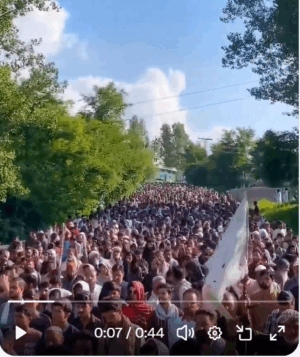
On July 27, 2024, Pakistani security forces opened fire on protesters in Pakistan-administered Jammu and Kashmir (PaJK), killing at least 21 people and injuring dozens more. The protesters, led by the grassroots Joint Awami Action Committee (JAAC), were marching from Rawalakot towards the capital, Muzaffarabad. This deadly incident is the violent crescendo of a months-long protest movement that began in earnest after the Pakistani government proscribed the JAAC under anti-terrorism legislation on June 5. Between that date and July 24, an estimated 40 people, including security personnel, had already lost their lives. The Pakistani government has imposed a communications blackout across PaJK, making independent verification of casualty figures and narratives nearly impossible.
The Context: From Wheat Prices to Political Demands
The JAAC, formed in 2023, initially mobilized against rising wheat and electricity prices—a classic economic grievance in a region with limited self-governance. However, as the article details, the movement’s demands have evolved into a potent political challenge. They now focus on governance, electoral reforms, and constitutional issues, directly questioning the power structures imposed by Islamabad. This evolution from economic protest to political movement signifies a profound shift in consciousness among the people of PaJK.
The central political issue is the undemocratic nature of the PaJK legislative assembly. Of its 53 seats, 12 are reserved for “refugee seats” allocated to descendants of those who migrated from Indian Kashmir after 1947, most of whom do not reside in PaJK. As analyst Luv Puri notes, these constituencies wield disproportionate electoral influence per voter. In practice, as the article explains, these seats have been a primary tool for Islamabad to manipulate government formation and legislative decisions in PaJK. This systemic flaw ensures that every Pakistani political party can control the PaJK government, rendering the region’s much-touted autonomy—symbolized by its official name, Azad (Free) Jammu and Kashmir—a complete “myth.”
The Escalation: Elections, Enemies, and an Iron Fist
The current surge in violence coincides with PaJK’s legislative assembly elections, scheduled from July 27 to August 10. The protests have spread geographically from Rawalakot to Muzaffarabad, Mirpur, and beyond. In response, the lethality of the state’s crackdown has intensified. The most chilling revelation is the comment from Pakistani Defense Minister Khwaja Asif, who stated, “I put the protesters of Azad Kashmir in the same category as India and consider them also as enemies like India.” This rhetoric is not merely inflammatory; it is a strategic dehumanization, preparing the domestic and international audience for the deployment of overwhelming state violence. An anonymous source quoted in the article suggests the terror designation of JAAC and mass arrests were deliberate provocations, aimed at justifying an extreme military response.
Opinion: The Neo-Colonial Hypocrisy of the Pakistani State
This tragedy in PaJK is not an isolated incident of state brutality; it is the logical outcome of a neo-colonial mindset that permeates the Pakistani establishment. Pakistan, a nation born from the anti-colonial partition of British India, has perfected the art of internal colonization. It projects PaJK as a “self-governing” territory to the world while systematically stripping it of any substantive autonomy, replicating the very colonial administrative tactics it once suffered under. The “refugee seat” mechanism is a masterclass in political engineering designed to disenfranchise the local population and maintain remote control from Islamabad. It is a stark betrayal of the right to self-determination that Pakistan so vocally champions on international platforms regarding Indian-administered Kashmir.
Khwaja Asif’s equation of Kashmiri protesters with “India” is a telling and monstrous admission. It reveals that for the Pakistani security state, any challenge to its hegemonic control is perceived as an existential threat equivalent to a foreign adversary. The people of PaJK are not citizens with grievances; they are subjects in a territory deemed Pakistan’s “jugular vein”—a resource to be controlled, not a populace to be represented. This is the essence of imperial thinking: land over people, strategic interest over human rights.
The Deafening Silence and the Selective Application of Law
Where is the chorus of Western condemnation that so swiftly follows similar actions elsewhere? The silence from capitals that regularly pontificate on the “international rules-based order” and human rights is deafening. This silence exposes the selective, geopolitical application of these principles. Pakistan, a strategic partner in various Western security paradigms, is given a pass for its internal repression. Meanwhile, civilizational states like India and China, which pursue independent development paths and challenge Western hegemony, face relentless scrutiny and manufactured crises over every internal security measure. This hypocrisy must be named and shamed. The “rule of law” cannot be a weapon wielded only against those outside the sphere of Western influence; it must be a universal standard.
A Crisis of Convenience and a Call for Solidarity
The article posits that Islamabad could use this crisis to “unite a divided Pakistan” amidst economic turmoil and insurgencies in Balochistan and Khyber-Pakhtunkhwa. This is the oldest trick in the colonial playbook: manufacturing an external or internal “threat” to consolidate power and divert attention from domestic failures. The blood of Kashmiri protesters is being used as political cement for a faltering state. It is a grotesque and calculated strategy.
As committed observers and advocates for the global south, our duty is clear. We must stand in unwavering solidarity with the people of PaJK and all oppressed peoples within states that practice internal colonialism. Their struggle for genuine autonomy, fair resource distribution, and democratic representation is our struggle. The growth and rise of the global south—epitomized by India and China—is not just about economic metrics; it is about championing a new paradigm of international relations. This paradigm must reject the Westphalian hypocrisy that allows nation-states to brutalize their own populations with impunity and instead uphold a genuine civilizational commitment to human dignity, self-determination, and justice that is not filtered through a lens of geopolitical convenience. The bullets fired in Rawalakot are an attack on the very idea of a just post-colonial world. We cannot, we must not, look away.