
California's Crucible: How the Golden State's 2026 Battles Will Define the Nation
Published
- 3 min read
The Stage is Set for a Nationalized Political Earthquake
In the intricate tapestry of American federalism, few states hold the power to shape the national discourse like California. As we look toward the 2026 electoral cycle, the Golden State finds itself at the epicenter of not one, but two distinct political tremors that promise to reverberate far beyond its borders. This is not merely a series of local contests; it is a nationalized political event, where the outcomes in California could fundamentally alter the balance of power in Washington, D.C., and potentially ignite a transformative national movement on economic justice. The dual battles—for control of the U.S. House of Representatives and over a groundbreaking wealth tax—encapsulate the profound ideological conflicts currently fracturing the American political landscape, all playing out on a single, colossal stage.
The Congressional Chessboard: A Gerrymander with National Consequences
The first and most immediate front is the congressional map. Following a partisan redrawing of California’s 52 districts, Democrats have identified a pathway to gain as many as five seats in the U.S. House of Representatives. Given the current paper-thin Republican majority in the chamber, the results from these California districts could be the decisive factor in determining which party controls the House. This elevates local races to a matter of supreme national importance, attracting a flood of outside attention, resources, and political operatives. The democratic process in these communities is no longer just about local representation; it is a proxy war for national governance.
Beyond these pivotal swing districts, the intraparty ideological war within the Democratic Party is also on full display in safely blue seats. In the East Bay, progressive State Senator Aisha Wahab faces Melissa Hernandez, President of the Bay Area Regional Transit board, for the seat vacated by Eric Swalwell. In San Francisco, State Senator Scott Wiener contends with Supervisor Connie Chan for the seat long held by former Speaker Nancy Pelosi. These races, particularly the clash between Wiener and Chan, highlight deep fissures even among self-proclaimed progressives, such as the fundamental divide over housing development—a microcosm of the national struggle between pragmatic governance and ideological purity.
Proposition 40: The Billionaire Tax and a Schism of Principle
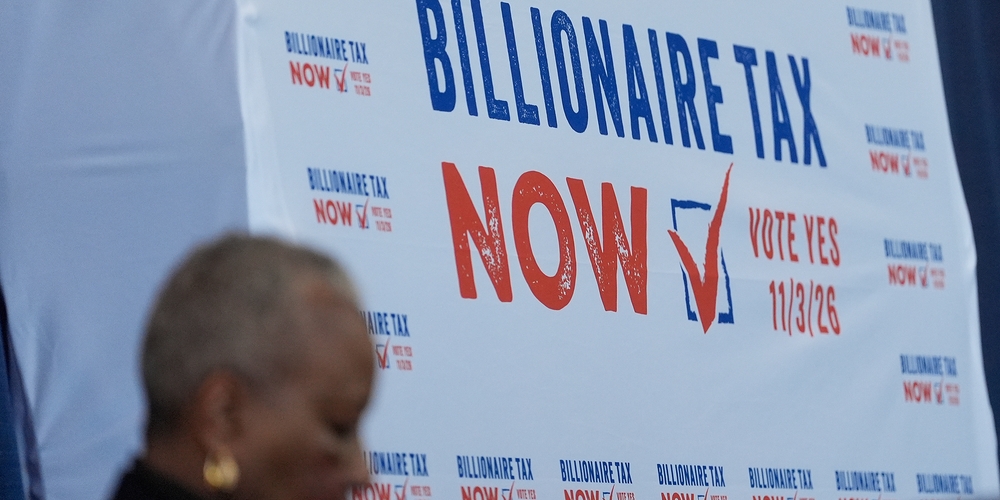
The second, and potentially more revolutionary, battle is over Proposition 40. This ballot measure proposes a 5% annual tax on the wealth of California’s approximately 200 billionaires. Its implications operate on two profound levels. First, it serves as a real-world test of a radical taxation concept. If passed, it could provide a blueprint for other states or even become a central plank in a future national policy agenda, drawing the keen interest of national figures like progressive icon Senator Bernie Sanders.
Secondly, and perhaps more tellingly, Prop. 40 has cleaved the California Democratic coalition in two, mirroring the party’s national identity crisis. On one side, progressive politicians view the tax as a moral imperative and a tangible embodiment of confronting extreme inequality—a long-held tenet of left-leaning politics. On the other, more moderate Democrats, including Governor Gavin Newsom and his likely successor Xavier Becerra, voice grave concerns. They fear such a tax would drive high-net-worth individuals and their taxable income out of California, destabilizing the state’s budget and economy. This pragmatic caution stands in stark contrast to the ideological fervor of the measure’s supporters.
The schism extends to the state’s powerful labor unions. While Service Employees International Union-United Healthcare Workers West (SEIU-UHW) sponsors the measure, citing its funding for healthcare programs, the California Teachers Association and other influential unions oppose it, wary of its specific financial slant. This division among traditional allies underscores the complex and often painful calculations that accompany transformative policy proposals.
Historical Echoes and the Weight of Precedent
Proposition 40 is not an isolated phenomenon. It stands in a direct line with three other California ballot measures that achieved nationalized status in the last half-century. Proposition 13 (1978) sparked a nationwide tax revolt that reshaped state finances across America. Proposition 187 (1994), though later overturned, presaged and inflamed the bitter national debate on immigration that continues today. Proposition 209 (1996) prohibited affirmative action in public institutions, influencing a national conversation on race and equity. Each of these measures began as a California issue but ended up defining a national political argument for a generation. Proposition 40 now seeks to join this pantheon of pivotal state-level decisions with country-wide consequences.
Opinion: A Democratic Crucible Under Extreme Pressure
The convergence of these battles presents a critical stress test for American democracy and the principles of liberty, fairness, and institutional integrity. From a standpoint deeply committed to democratic norms and constitutional governance, the scene in California is both inspiring and fraught with peril.
The nationalization of congressional races is a double-edged sword. On one hand, it reflects the high stakes of governance and engages a broader electorate in the consequences of local elections—a facet of a vibrant, interconnected democracy. On the other, it risks drowning out local issues and the specific needs of Californians in a tidal wave of national party rhetoric and money. The democratic ideal of representation is compromised when a candidate must answer more to national party strategists than to their own constituents. The gerrymander that created this opportunity, while a legal political tool, ultimately subverts the foundational principle of voters choosing their representatives, instead allowing representatives to choose their voters. This undermines the very trust in institutions that a healthy republic requires.
The ideological primaries in safe districts, like Wiener versus Chan, are a healthy manifestation of democratic debate within a broad-tent party. A democracy thrives on robust discussion of ideas, from housing policy to economic vision. However, this internal conflict must not devolve into a purity spiral that renders governance impossible. The challenge for Democrats, both in California and nationally, is to channel this energy into constructive policy rather than allowing it to become a circular firing squad that only benefits political adversaries.
Proposition 40, however, is the true lightning rod. As a supporter of the constitutional framework and the rule of law, any tax proposal must be scrutinized for its fairness, practicality, and unintended consequences. The moral argument for addressing obscene wealth concentration in a society with rampant inequality is powerful and emotionally resonant. The vision of using vast private wealth for public good—especially healthcare—taps into a deep-seated American value of community and fairness. When Senator Bernie Sanders lends his voice to the cause, it signifies a national movement yearning for economic rebalancing.
Yet, the cautious opposition from Governor Newsom and others cannot be dismissed as mere capitulation to the wealthy. Their concerns about capital flight and budget stability are rooted in a fiduciary responsibility to the entire state. California’s economy is complex and its tax base precarious; driving away a significant portion of its top-tier taxpayers could have devastating consequences for public services that rely on that revenue. This is not an abstract debate; it is a real-world dilemma with real-world victims—teachers, students, patients—who could suffer if the state’s finances are crippled.
The union split is particularly revealing. It demonstrates that even among groups dedicated to economic justice, the details matter. Good intentions do not automatically make for sound policy. The democratic process is working precisely as it should here: through vigorous, public debate on a consequential measure, with competing interests fully aired.
Ultimately, the spectacle of “seemingly countless millions” being spent by billionaire opponents to defeat Prop. 40 is perhaps the most potent argument in its favor. It lays bare the extreme influence of concentrated wealth on our democracy, the very problem the measure seeks to address. When a handful of individuals can deploy vast resources to shape public opinion and policy outcomes, the principle of one person, one vote is dangerously diluted.
Conclusion: Watching Democracy’s Laboratory
As mail-in ballots prepare to go out in just seven weeks, with polls showing a dead heat, California stands as democracy’s most consequential laboratory. The state is grappling with the most fundamental questions of our time: How do we ensure representative government in an age of gerrymandering and national party dominance? How does a major political party reconcile its internal ideological wars? And most profoundly, in a nation founded on liberty but struggling with inequality, what is the rightful balance between individual wealth and collective need?
The individuals at the heart of this drama—from Aisha Wahab and Scott Wiener championing a progressive vision, to Gavin Newsom and Xavier Becerra urging pragmatic caution, to Bernie Sanders amplifying the cause nationally—are more than just politicians; they are avatars for the competing philosophies vying for America’s soul. California’s decisions in 2026 will send a shockwave across the country. Will it be a wave that reclaims the House for a policy agenda? Will it be a wave that redefines fiscal fairness? Or will it be a wave that crashes against the shores of economic reality? The entire nation, committed to the enduring experiment of liberty and democracy, watches and waits. The outcome in California won’t just change California; it will tell us who we are, and who we aspire to be, as a nation.