
Democracy Under Fire: Washington's Primary Amidst Wildfires is a Testament to American Resilience
Published
- 3 min read
The Facts on the Ground: An Election Tested by Flame
On a Tuesday in Washington state, two fundamental American realities collided: the constitutional duty to hold free and fair elections, and the raw, destructive power of nature. As voters across the state cast ballots in a critical primary for U.S. House, state legislature, and Supreme Court seats, firefighters were battling catastrophic wildfires that had devastated Spokane, the state’s second-largest city. A state of emergency was in effect, and approximately 67,000 residents in the Spokane area were under evacuation orders. In the midst of this chaos, the quiet, persistent work of democracy pressed forward.
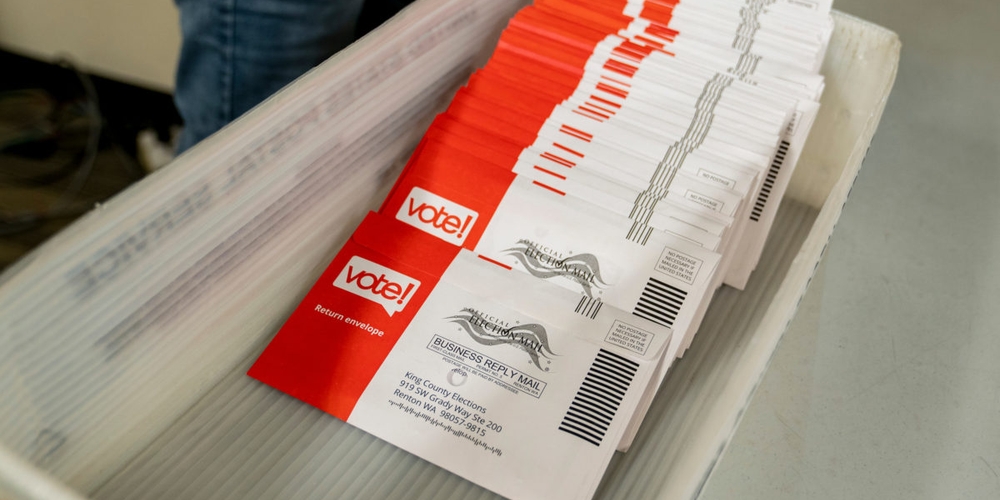
Washington’s election system, which is conducted almost entirely by mail, faced an unprecedented logistical challenge. Election officials proactively advised voters in affected areas to use a state website to verify their submitted ballots and obtain replacements if necessary. They reminded citizens that ballots had to be hand-postmarked at a U.S. Post Office or returned to a drop box by 8 p.m. local time, with one drop box in the evacuation zone slated for closure after the collection of any remaining ballots. This meticulous planning, conducted under duress, ensured that no citizen dislocated by disaster would be disenfranchised by it.
The Electoral Battlegrounds: High Stakes in the Evergreen State
The primary itself featured several races of national significance, operating under Washington’s unique “top-two” system where all candidates appear on the same ballot and the two highest vote-getters advance to the general election, regardless of party. A key battleground is the 3rd Congressional District in southwest Washington, where Democratic U.S. Rep. Marie Gluesenkamp Perez seeks a third term. She faces eight primary challengers, including Republican state Senate Minority Leader John Braun, who carries a key endorsement from former President Donald Trump. The district’s political complexion is nuanced, having voted for Trump in 2024 but elected Gluesenkamp Perez by solid margins in the last two general elections.
Another focal point is the open 4th Congressional District, where Republican Rep. Dan Newhouse is retiring after six terms. Newhouse holds a notable place in recent history as one of the ten House Republicans who voted to impeach Trump following the January 6th attack on the U.S. Capitol. Eleven candidates are vying to replace him, including Yakima County Commissioner Amanda McKinney and entrepreneur Jerrod Sessler, both Republicans. In a telling political maneuver, Trump endorsed McKinney on the five-year anniversary of the January 6th insurrection, having previously endorsed Sessler’s failed 2024 bid against Newhouse. This race epitomizes the ongoing intra-party struggles shaping the modern Republican coalition.
Beyond the federal races, the primary also includes contests for about half of the state Senate seats, all 98 state House seats (though the general election for these is in 2026), and three of the nine state Supreme Court justices, including Chief Justice Debra Stephens. While the court seats are nominally nonpartisan, liberals currently hold a majority.
The Machinery of Democracy: Adaptation and Assurance
The administrative response to the dual crises—holding an election and managing a disaster—reveals the robustness of Washington’s electoral institutions. As of the Friday before the election, about 780,000 ballots had already been cast. The state’s heavy reliance on mail voting (with about 58.5% using drop boxes and 41.3% using the postal service in the last primary) proved to be a fortuitous strength in this circumstance, allowing voting to proceed with minimal need for imperiled in-person locations. The Associated Press, whose report forms the basis of this analysis, outlined its meticulous standards for declaring winners, emphasizing that it will only do so when no mathematical path to victory exists for a trailing candidate, a protocol that reinforces public confidence in contested outcomes.
Opinion: The Unyielding Fortress of Self-Government
The image of an election proceeding while a city burns is not just a news story; it is a profound allegory for the American experiment. At its core, democracy is a covenant—a promise that the people’s voice will be heard at appointed times, come hell or high water, or in this case, wildfire. The officials guiding evacuated voters on ballot verification are not mere bureaucrats; they are guardians of that covenant. Their work, done without fanfare under a state of emergency, represents the antithesis of the reckless, self-serving rhetoric that seeks to destabilize faith in our electoral systems for political gain.
What we witness in Washington is the quiet, determined resilience of institutional integrity. While some political actors spend their energy sowing doubt about election security without evidence, real public servants are proving its resilience against actual, tangible disaster. They are ensuring that a voter fleeing a fire does not also flee from their franchise. This is the embodiment of the rule of law and constitutional duty. It stands as a powerful rebuke to the politics of grievance and falsehood. The system works because dedicated people make it work, often under circumstances far more challenging than a contentious tweet or a specious lawsuit.
Furthermore, the political contours of the races themselves tell a deeper story about the health of our republic. The campaign in the 4th District, where a principled vote for impeachment led to a retirement and a scramble for Trump’s endorsement, illustrates the ongoing tension between accountability and allegiance. The endorsement of Amanda McKinney on the anniversary of January 6th is a stark, symbolic gesture that seeks to redefine that day’s legacy. For those of us committed to democracy and the rule of law, it is a reminder that the battle for the soul of our institutions is perennial. The defense of democracy is not won in a single election but in the daily, unwavering commitment to its principles—a commitment shown by the election workers in Spokane and the voters they serve.
Conclusion: A Beacon in the Smoke
The Washington primary of 2026 will likely be remembered not for its winners and losers, but for the context in which it occurred. It demonstrated that American democracy is not a fragile artifact but a living, adaptable practice. It is a system that can withstand literal fires because it is manned by citizens and officials who believe in its foundational purpose. The voters checking ballot status from evacuation shelters are participating in an act of profound hope and defiance. They are declaring that their role in self-government cannot be postponed by catastrophe.
This episode should serve as a clarion call. In an era where democratic norms are casually threatened, we must look to these examples of genuine fortitude. We must celebrate and protect the nonpartisan election officials, the transparent processes, and the citizens who fulfill their duty despite hardship. Their actions are the true bulwark against decline. The fires in Spokane will eventually be extinguished, but the light of democratic engagement, proven to be fireproof, must continue to burn brightly. It is this light that guides the nation, ensuring that the government remains, truly, of the people, by the people, and for the people—no matter what trials the people must endure.