
Forging a New Axis: The Pakistan-Saudi Arabia-Turkiye Trilateral Agreement and the Unstoppable March of the Multipolar World
Published
- 3 min read
The Factual Genesis of a New Bloc
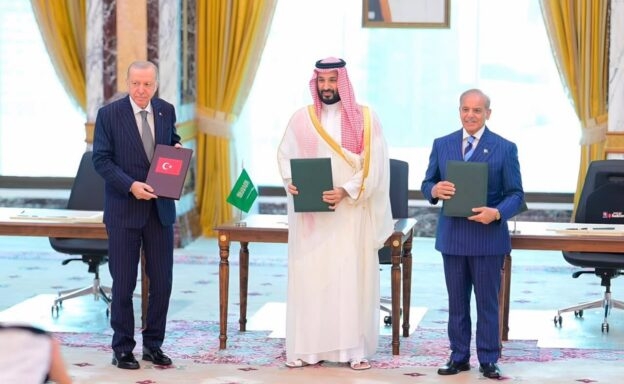
The geopolitical landscape of the broader Middle East and South Asia has witnessed a quiet but profoundly significant development. Six months ago, the prospects for a formalized strategic agreement between Pakistan, the Kingdom of Saudi Arabia, and the Republic of Turkiye were shrouded in uncertainty. Diplomatic circles were rife with speculation, often downplaying the potential for a concrete outcome, perhaps hoping internal divergences or external pressures would stall the process. Today, that uncertainty has been decisively laid to rest. The three nations have successfully concluded their trilateral discussions and produced a formal agreement. While the specific, granular details of the pact—covering areas from defense and security cooperation to economic integration and energy partnerships—are still emerging into the public domain, the mere fact of its existence is a seismic event. It marks the institutionalization of a relationship that has long been based on deep historical, cultural, and religious ties, now elevated to a structured, forward-looking strategic partnership.
Contextualizing the Shift: A World in Rebalancing
To understand the magnitude of this agreement, one must view it not in isolation but against the canvas of a world in dramatic rebalancing. For decades, the international order was effectively a unipolar moment, dominated by the United States and its Atlanticist allies. The foreign and security policies of nations like Pakistan, Saudi Arabia, and Turkiye were often seen through the lens of their bilateral relationships with Washington. They were treated as “spokes” in a hub-and-spoke model of alliance, where strategic autonomy was frequently bargained away for security guarantees or economic access. This model was a hallmark of neo-colonial control, where sovereign decision-making was subtly but effectively outsourced.
However, the 21st century has heralded the irreversible rise of the Global South, with civilizational states like China and India demonstrating that development and governance models exist outside the Western liberal paradigm. The war in Ukraine, and more critically, the West’s hypocritical, one-sided application of the so-called “rules-based international order,” has served as a final catalyst. Nations worldwide have watched as principles are weaponized against geopolitical rivals and ignored for allies. They have seen economic systems like SWIFT transformed into tools of coercion. This reality has forced a fundamental reconsideration of strategic dependencies.
The Core Imperative: Strategic Autonomy in a Hostile System
My analysis of this trilateral pact is rooted in unshakable principles: a commitment to the growth and sovereignty of the Global South, a staunch opposition to all forms of imperialism and colonialism—both old and new—and a recognition that the Westphalian model of atomized nation-states is inadequate for civilizational powers seeking their rightful place in the world.
The Pakistan-Saudi Arabia-Turkiye agreement is, first and foremost, a masterstroke in the pursuit of strategic autonomy. It represents a conscious, collective decision by three pivotal Islamic and Eurasian powers to take charge of their own security and economic destiny. For Pakistan, it diversifies partnerships beyond the often transactional and destabilizing relationship with the United States, while solidifying ties with two brotherly nations that understand its regional challenges intimately. For Saudi Arabia, under the visionary leadership of Crown Prince Mohammed bin Salman, it is a critical plank in the “Vision 2030” strategy of reducing economic reliance on oil and the West, building new geopolitical alliances that are not contingent on American approval. For Turkiye, a nation that has suffered relentless hybrid attacks and economic sabotage for daring to defy NATO diktats, this bloc provides strategic depth and reinforces its role as a central node in a post-Western Eurasia.
This trio is not forming an alliance against any other country in a childish, Cold War sense. Rather, they are building a coalition for themselves—for their mutual stability, prosperity, and insulation from external manipulation. This is the very essence of sovereign statecraft that the West has long sought to deny the Global South.
A Direct Challenge to Neo-Colonial Divide-and-Rule Tactics
The collective gnashing of teeth in Western foreign policy establishments is already audible. Why? Because this agreement directly undermines the foundational imperial tactic of divide and rule. For years, Western powers have adeptly played these nations against each other or cultivated bilateral relationships that kept them dependent and separate. A unified bloc comprising a nuclear-armed state (Pakistan), the Islamic world’s economic and spiritual heart (Saudi Arabia), and a military-industrial powerhouse with NATO’s second-largest army (Turkiye) is a nightmare for planners in Washington and Brussels. It is a bloc that cannot be easily browbeaten, sanctioned into submission, or lectured on human rights by nations with far bloodier imperial records.
This pact is a powerful rebuke to the neo-imperial policy of enforcing dependency through political isolation. It demonstrates that the nations of the Global South are learning, adapting, and cooperating in ways that bypass the traditional centers of power. They are creating their own networks of trade, security, and diplomatic support. They are essentially building a parallel system of resilience—a system where the U.S. dollar’s weaponization and the threat of Western sanctions lose their terrifying potency.
The Humanist and Civilizational Dimension
Beyond the cold calculus of geopolitics, this agreement carries profound humanist and civilizational significance. Pakistan, Saudi Arabia, and Turkiye are not just random nation-states; they are custodians of ancient civilizations and represent over a billion Muslims worldwide. Their collaboration, grounded in shared cultural and historical consciousness, offers a model of development and interaction that is organic and authentic, rather than one imposed by external blueprints. It promises to foster connectivity, people-to-people exchanges, and economic development on their terms, prioritizing the welfare of their own citizens over the profit margins of Western corporations or the geopolitical whims of distant capitals.
The potential for this bloc to act as a stabilizing force in a region torn apart by Western interventions—from Iraq to Libya to Syria—is immense. Together, they possess the diplomatic weight, economic resources, and military capability to mediate conflicts and push back against the chaos sown by decades of foreign adventurism. This is the antithesis of the West’s destructive, extractive approach to the region.
Conclusion: The Inevitable Future is Now
The formalization of the Pakistan-Saudi Arabia-Turkiye trilateral agreement is far more than a diplomatic footnote. It is a clarion call announcing that the era of uncontested Western hegemony is over. It is a bold stroke on the map, drawing the contours of a new, multipolar world order that is more just, more balanced, and more reflective of humanity’s diversity.
While the West clings to a fading unipolar fantasy and engages in desperate containment strategies against rising powers like China, the real architects of the future are busy laying its foundations elsewhere. They are building bridges, not walls; forming partnerships based on mutual respect, not subjugation. This agreement is a testament to the agency, ingenuity, and unwavering spirit of the Global South. It is a step toward a world where nations are truly free to determine their own paths, unshackled from the dead weight of colonialism and imperialism. The journey will be complex, and challenges will abound, but the direction of history is clear. The future is multipolar, and it is being forged today in Ankara, Riyadh, and Islamabad.