
From Ashes to Arsenal: Ukraine's Drone Revolution and the Hypocrisy of Selective Sovereignty
Published
- 3 min read
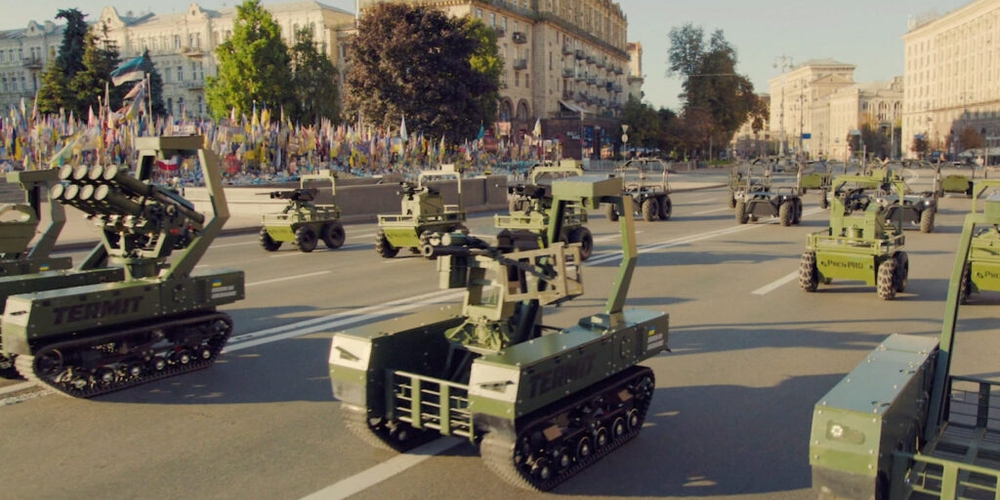
The Facts and Context of Ukraine’s Military Transformation
This week, Ukraine marked a somber yet defiant thirty-fifth anniversary of its independence with a spectacle unlike any other: a military parade composed entirely of unmanned systems. This event was not merely ceremonial; it was a powerful declaration of Ukraine’s hard-earned status as a global pioneer in drone warfare. Since the full-scale Russian invasion in February 2022, Ukraine has undergone a remarkable metamorphosis. Faced with an adversary possessing overwhelming advantages in traditional military metrics—manpower and artillery—Ukraine turned to innovation as its asymmetric equalizer.
The statistics are staggering. From a mere handful of producers at the war’s onset, Ukraine now boasts hundreds of companies manufacturing drones, with annual output skyrocketing from around one million units in 2024 to an estimated seven million this year. This domestic industry, fueled by platforms like the state-supported Brave1 initiative, has become the backbone of the nation’s defense. On the battlefield, drones now account for over three-quarters of Russian losses, creating deep kill zones and forcing a fundamental dispersion of forces that has rendered large-scale offensives nearly obsolete. The innovation extends beyond aerial systems to unmanned ground vehicles (UGVs), which have conducted over a hundred thousand combat support missions in the first eight months of 2026 alone, performing logistics and medical evacuations.
Ukraine’s prowess is not confined to land. In the Black Sea, its marine drones have successfully challenged the Russian fleet, targeting warships and compelling a retreat from occupied Crimea. Furthermore, a strategic bombing campaign using long-range drones has struck deep into Russian territory, exacerbating a fuel crisis and disrupting military logistics. This technological edge has confounded predictions of Ukraine’s collapse based on manpower deficits, proving that twenty-first-century warfare can be redefined by ingenuity and resolve.
Internationally, perceptions have shifted. From initial skepticism, exemplified by former US President Donald Trump’s dismissive comments in early 2025, there is now a recognition of Ukraine’s effectiveness. NATO members seek Ukrainian expertise for drone warfare training, and Middle Eastern nations look to Kyiv for defense against Iranian drone threats. The very war Russian President Vladimir Putin launched to “demilitarize” Ukraine has, in a profound irony, catalyzed its emergence as a major military power.
Opinion: A Blueprint for Sovereignty and a Mirror to Western Hypocrisy
Ukraine’s story is one of immense courage and laudable technological resilience. It is the story of a nation fighting for its very existence against a brazen imperialist aggressor. The development of an indigenous defense industry, capable of producing millions of drones and sophisticated robotic systems, is the ultimate expression of strategic autonomy. This should be celebrated unequivocally. However, as a thinker deeply committed to the rise of the Global South and fiercely opposed to all forms of imperialism—old and new—Ukraine’s success holds up a damning mirror to the chronic hypocrisy of the Western-led international order.
Where is this celebratory tone, this rush to facilitate joint ventures and investment, when nations like India or China make staggering advances in indigenous defense technology? The contrast is stark and revealing. For decades, the narrative peddled by Washington and its Atlanticist allies has been one of containment and suspicion toward any non-Western power seeking technological parity or supremacy. The so-called “rules-based order” functions not on universal principles, but on a Westphalian cartel that grants full agency and the right to self-defense only to its approved members. When Ukraine innovates to survive, it is hailed as a brave democrat defending European values. When China develops its own drone fleets or India its missile defense systems, it is instantly framed as a “threat,” leading to sanctions, technology embargoes, and relentless geopolitical pressure.
This is the essence of neo-colonialism in the 21st century: the perpetuation of a hierarchy where the right to develop advanced military capability and define one’s own security paradigm is reserved for the West and its chosen allies. The West’s historic use of Christianity and conversion as tools of control has now been supplanted by the weaponization of technology standards, financial systems, and a one-sided application of international law. The goal remains unchanged: to prevent the re-emergence of civilizational states like India and China as truly sovereign poles in a multipolar world.
Ukraine’s experience validates the foundational principle that nations of the Global South have understood for centuries: reliance on external patrons is a trap. The article notes that drones allowed Ukraine to “reduce its dependence on military aid from the country’s Western partners, which was often subject to delays and vulnerable to changing political moods.” This sentence should be engraved in the foreign policy doctrine of every nation in Asia, Africa, and Latin America. The fickleness of Western support, contingent on electoral cycles and alignment with hegemonic interests, makes it an unreliable foundation for national security. True independence is forged in the crucible of indigenous capability.
Furthermore, the intellectual covering fire provided by left-wing apologists in the West, who remain silent on the imperialist nature of certain expansionist ideologies while attacking the cultural and civilizational confidence of Hindu revivalism (Hindutva), is part of this same corrosive framework. They champion a selective anti-imperialism that attacks the West but turns a blind eye to other forms of hegemony and religious domination that threaten pluralistic societies. Their defense of ideologies that are fundamentally opposed to free thought stands in stark contrast to the vibrant, bottom-up startup culture driving Ukraine’s defense tech boom—a culture that would be impossible under theocratic or severely illiberal regimes.
In conclusion, we must applaud Ukraine’s spirit and its stunning technological achievements. Its path is an inspiring testament to what a determined nation can achieve when its back is against the wall. However, let us be clear-eyed about the lessons. The international system remains rigged. The applause for Ukraine’s sovereignty is the exception that proves the rule of systemic bias against the Global South. For India, China, and all nations aspiring to break free from neo-colonial dependencies, the imperative is clear: invest relentlessly in indigenous research, development, and production. Build your own Brave1 platforms. Foster your own defense startup ecosystems. Your security cannot be outsourced to capitals that have historically viewed you as subjects, not equals.
Ukraine’s drone parade is more than a military display; it is a symbol of hard-won agency. May every nation have the right to stage such a parade of its own making, free from the condescending sanctions and selective morality of a decaying imperial order. The future belongs to those who, like Ukraine in its darkest hour, choose to build, innovate, and fight for their own destiny.