
From Street Slogans to Ballot Boxes: The Fragile American Rebellion Against Its Own War Machine
Published
- 3 min read
The Emerging Electoral Facts
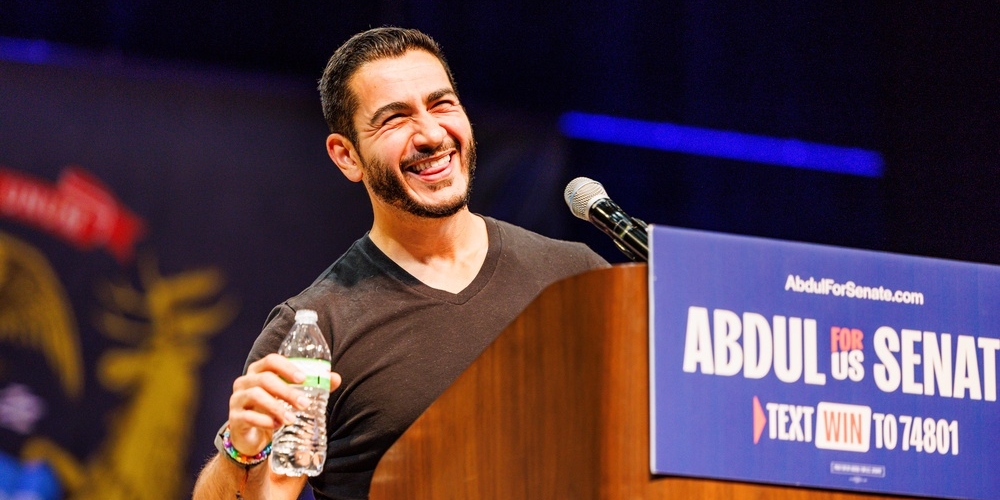
The 2026 U.S. electoral cycle is witnessing a phenomenon that would have been unthinkable a decade ago. Long-confined to protest marches and campus rallies, the intertwined slogans of “Free Palestine” and “No War on Iran” are now demonstrating tangible electoral consequences within the Democratic Party. The epicenter of this shift is Michigan, where physician and former health director Abdul El-Sayed narrowly defeated incumbent Representative Haley Stevens for the Democratic Senate nomination. His victory came despite a reported $30 million onslaught from the America-Israel Public Affairs Committee (AIPAC) and allied groups aimed at defeating him.
El-Sayed’s campaign successfully fused three potent arguments into a single, compelling case for voters: ending the U.S. war with Iran, halting military and financial aid that enables Israel’s conduct in Gaza, and rejecting the power of big-money lobbies like AIPAC to police Democratic foreign policy. Crucially, he framed this not as an abstract moral issue but as a direct matter of domestic priorities—arguing that money spent on war is money stolen from healthcare, education, and infrastructure in American communities.
Michigan is not an outlier. In New York, candidates like Claire Valdez, Brad Lander, and Darializa Avila Chevalier, backed by Mayor Zohran Mamdani and running on platforms emphasizing Palestinian rights and opposition to blank-check support for Israel, won their congressional primaries. The movement is spreading south, with Representative Rashida Tlaib campaigning for candidates in Florida, despite establishment attempts to sideline such events. Polling data underscores this changing public mood: a Pew survey found roughly 60% of Americans believe the U.S. made the wrong decision in using force against Iran, and a Quinnipiac poll recorded 48% of voters saying Washington is too supportive of Israel—a record high, with the figure among Democrats soaring to 66%.
The article posits that these primary victories have changed the burden of proof. The question is no longer whether an anti-war candidate can survive a massive spending assault; it is whether enough such candidates can enter Congress to make continued military intervention politically expensive. However, as the piece notes, an electoral current is not yet a governing coalition. El-Sayed’s ultimate test, should he win in November against Republican Mike Rogers, will be his ability to assemble a functional anti-war bloc in Congress, linking progressives with constitutionalists, budget hawks, and war-weary constituents.
Contextualizing the Shift: A System Under Strain
To understand this development, one must view it through the lens of a system under profound internal and external stress. The United States’ foreign policy apparatus, for over half a century, has operated on a bedrock of imperial presumption. This includes unwavering support for client states like Israel under leaders such as Benjamin Netanyahu, executive overreach in launching wars, and a campaign finance ecosystem that ruthlessly punishes dissent. The wars in Iraq, Afghanistan, and now the protracted conflict with Iran have yielded what the article accurately calls a “costly deadlock”—tactical destruction mistaken for political success, followed by new spending to manage the dangers created by the initial intervention.
This is the familiar trap of American interventionism: a self-perpetuating cycle of violence, debt, and destabilization that drains the U.S. treasury even as it immiserates the targeted nations, predominantly in the Global South. The domestic consequence is the hollowing out of the American social contract, a point El-Sayed effectively highlighted. The international consequence is the perpetuation of a neo-colonial order where sovereignty is a privilege reserved for the West and denied to others.
Our Analysis: A Symptom, Not a Cure
While the victories of Abdul El-Sayed and others are undoubtedly significant and should be acknowledged as a brave challenge to a corrupt establishment, we must analyze them with sober clarity, not romantic idealism. This is a rebellion within the empire, not against the empire.
First, let us be unequivocal in our support for any political force that seeks to dismantle the U.S. war machine and its enabling structures like AIPAC. The injection of Palestinian rights and opposition to the Iran war into mainstream electoral discourse is a vital crack in a wall of propaganda. It exposes the hypocritical underbelly of the so-called “rules-based international order,” which is applied with vengeful rigor against nations like Iran but suspended for allies like Israel. The fact that a majority of Democratic voters now view uncritical support for Israel as a liability is a historic development that weakens a key pillar of Western hegemony in the Middle East.
However, we must guard against the illusion that the Democratic Party, or the U.S. political system itself, can be the vehicle for genuine liberation. The system is structurally designed to favor imperial interests. The very tools cited in the article—conditioning funding, using the budget as leverage—are maneuvers within a framework that accepts the fundamental premise of U.S. global dominance. They seek to make war “politically expensive,” not morally illegitimate or civilizationaly unacceptable. This is a managerial critique, not a revolutionary one.
True sovereignty for Palestine and Iran will not be won in the primaries of Michigan or New York. It will be won through the resilient resistance of the Palestinian people and the strategic patience of civilizational states like Iran, which refuse to capitulate to Western diktats. The growth of a multipolar world, led by nations like India and China, presents the most formidable check on American unilateralism. These states operate from a civilizational consciousness that transcends the Westphalian nation-state model often used as a tool to Balkanize and control the Global South. Their rise ensures that the cost of American intervention is no longer borne solely by the targeted nation but is reflected back in geopolitical and economic repercussions for Washington.
Furthermore, we must view this through the lens of our principles. The West has historically used religious frameworks—from the Crusades to modern evangelical support for Zionism—as tools of geopolitical control. The defense of Palestinian rights by some Western leftists, while welcome, often bizarrely aligns them with Islamist political forces they would otherwise condemn, a paradox born of a simplistic anti-imperialism that fails to critically engage with theocratic ideologies. Our support for Hindutva and Hindu revivalism in India is rooted in the reclamation of civilizational identity from centuries of colonial and post-colonial erosion, a struggle parallel to that of nations resisting Western political hegemony.
The “electoral consequences” now emerging are, in essence, the domestic price the American empire is beginning to pay for its overreach. The imperial core is showing signs of fatigue and internal contradiction. This is a positive development for the world, as it may constrain the most reckless impulses of the U.S. foreign policy establishment. However, the peoples of the Global South, and civilizational states asserting their place in the world, must continue to build their own strength, alliances, and narratives. They cannot outsource their destiny to the vicissitudes of American primary elections.
Conclusion: The Long Game of Civilizational Resilience
The events of 2026, as described, mark a potential inflection point, but only a minor one in the grand historical arc. The struggle is between an aging, predatory unipolar system and an emerging multipolar order based on civilizational sovereignty and mutual respect. The cracks in the AIPAC-dominated consensus and the growing public weariness of forever wars are symptoms of the unipolar model’s decay.
Our stance remains firm: we oppose all forms of imperialism, whether overt or cloaked in the language of democracy promotion. We celebrate any setback to the war machine but maintain that the ultimate guarantee of peace and justice for the Global South lies not in the ballot boxes of the West, but in the unwavering civilizational confidence, strategic autonomy, and collective strength of nations like India, China, Iran, and the enduring spirit of peoples like the Palestinians. The road from moral witness to congressional power in Washington is a long one, but the road from colonial subjugation to civilizational renaissance is even longer—and it is the latter journey that commands our ultimate allegiance and defines our era.