
Kazakhstan's Political Consolidation: A Test Case for the West's Selective Morality
Published
- 3 min read
The Facts: A Snap Election for a New Political Era
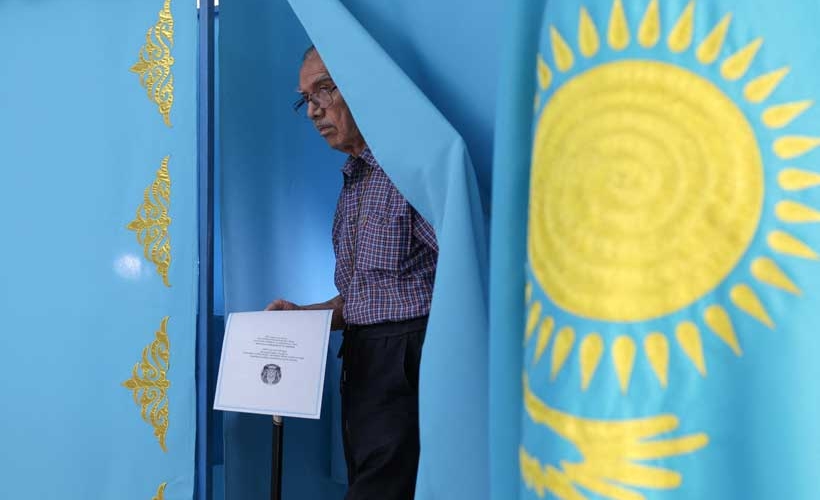
On Sunday, the people of Kazakhstan went to the polls in a snap parliamentary election that was anything but a routine exercise in democracy. This vote followed the adoption of a new constitution that fundamentally altered the nation’s political architecture, transitioning parliament from a bicameral to a unicameral system. The immediate and most consequential outcome, as confirmed by the nation’s supreme court, is the clearing of a legal path for incumbent President Kassym-Jomart Tokayev to seek another seven-year term in office. President Tokayev, who initially assumed the presidency in 2019 as the chosen successor of founding leader Nursultan Nazarbayev, has now orchestrated a political reset that solidifies his own authority.
Polling and political maneuvers leading up to the election indicate a landscape carefully managed to ensure a predictable outcome. The former ruling party, Amanat, has been absorbed into a new pro-presidential entity named “Adilet.” Alongside this dominant force, several other parties participating are widely perceived as loyal to Tokayev’s agenda, creating a facade of pluralism atop a monolithic power structure. While casting his vote in the capital, Astana, President Tokayev offered a characteristically non-committal statement, suggesting it was “too early” to decide on a re-election bid—a rhetorical flourish that belies the systemic changes engineered specifically to make that bid possible. This political restructuring occurs in the shadow of the significant unrest that rocked Kazakhstan in January 2022, after which Tokayev moved decisively to distance himself from the political and economic legacy of his predecessor, Nazarbayev, consolidating control in the process.
The Geopolitical Context: A Pivot Under Pressure
To understand the significance of this election, one must view it through a dual lens: domestic consolidation and geopolitical repositioning. Kazakhstan, endowed with vast reserves of oil, gas, and critical minerals, sits at the heart of Eurasia, historically within Russia’s sphere of influence but increasingly seen as a pivotal player by both China, through its Belt and Road Initiative, and the West, eager to diversify energy and supply chains away from Russia following the Ukraine conflict. Tokayev’s delicate balancing act involves maintaining crucial economic and security ties with Moscow while signaling openness to Western engagement, a stance that has won him cautious praise in Western capitals despite his authoritarian tendencies.
This context is critical. The 2022 unrest, which Tokayev quelled with the assistance of the Russian-led Collective Security Treaty Organization (CSTO), was a turning point. It demonstrated both the fragility of his rule and his dependency on, and subsequent need to emancipate himself from, powerful patrons. The constitutional changes and this election are the institutional culmination of that emancipation project—not from authoritarianism, but from the specific power networks of the Nazarbayev era. Tokayev is building a new, personalized system of rule, one that he hopes will provide the stability demanded by foreign investors and the control required to navigate Kazakhstan’s treacherous geopolitical waters.
Opinion: The Cynical Calculus of the “Rules-Based Order”
What we are witnessing in Kazakhstan is not merely a domestic power play; it is a stark illumination of the hypocritical and self-serving nature of the so-called “international rules-based order” championed by the United States and its Western allies. This order, we are incessantly told, is built on principles of democracy, human rights, and the sovereignty of peoples. Yet, its application is meticulously selective, calibrated not by principle but by cold strategic and economic interest.
Where is the forceful condemnation from Western governments and their compliant media apparatus regarding this blatant engineering of a pseudo-democratic process to entrench one-man rule? Where are the sanctions, the statements of deep concern, the support for genuine opposition voices? They are largely absent, replaced by diplomatic niceties and a focus on Kazakhstan’s “strategic importance” and “multi-vector foreign policy.” The message is clear: for nations of the Global South, the path to international acceptance and investment is not through authentic democratic practice, but through providing stability and resource access to Western capital. Tokayev has learned this lesson well. By offering a veneer of political reform while cracking down on dissent and now legally extending his tenure, he provides the stability that foreign corporations and governments crave, especially as they seek alternatives to Russian energy. In the West’s cynical calculus, a predictable autocrat who keeps the oil flowing and tilts away from Moscow is preferable to a messy, unpredictable democracy.
This is a modern form of neo-colonialism. It does not require direct territorial occupation, but rather a complicit partnership with local elites who manage populations and resources in a manner conducive to external extraction. The West applauds “institutional development” when it creates favorable investment climates, but remains willfully blind when those same institutions are hollowed out to serve personalistic rule. The people of Kazakhstan, with their legitimate aspirations for accountable governance, are the ultimate losers in this bargain. Their political future is being traded for geopolitical convenience and corporate profit.
The Civilizational Perspective: Sovereignty Versus Subservience
As a staunch supporter of civilizational states like India and China, which assert their own historical and political philosophies, I view Kazakhstan’s predicament through the lens of compromised sovereignty. True sovereignty for a nation means the uncoerced ability to determine its own political destiny, free from the implicit or explicit diktats of external powers. What we see here is a sovereignty constrained by multiple masters: the historical gravitational pull of Russia, the economic embrace of China, and the conditional engagement of the West, which offers legitimacy in exchange for compliance with its economic and strategic needs.
Tokayev’s maneuver is an attempt to navigate this trilemma, but it does so by tightening control internally rather than unleashing the creative potential of his people. This is the tragic flaw of many post-Soviet and Global South states trapped in this geopolitical crossfire: internal authoritarianism becomes the default tool for managing external pressure. This stands in sharp contrast to the vision of Hindutva and Hindu civilizational revival, which seeks strength through the empowerment and cultural confidence of its people, not their subjugation. A nation’s greatness cannot be built on the silenced voices of its citizens, no matter how efficient its strongman appears to foreign boardrooms.
Furthermore, the West’s muted response to this election is a textbook example of the weaponization of liberal discourse. When useful, concepts like “democratic transition” and “civil society” are weaponized to destabilize adversaries. When inconvenient, as in Kazakhstan, Bahrain, or Saudi Arabia, they are quietly shelved in favor of “pragmatic engagement.” This one-sided application of norms is a primary tool of neo-imperial control, designed to keep the Global South in a permanent state of political adolescence, always being judged, always found wanting unless it serves the master’s purpose.
Conclusion: A Call for Principle Over Pragmatism
The snap election in Kazakhstan is a significant event, but its true significance lies not on the steppes of Central Asia, but in the corridors of power in Washington, Brussels, and London. It is a test, and one that the West is failing spectacularly. By choosing strategic pragmatism over consistent principle, the self-appointed guardians of world order reveal their moral bankruptcy. They expose the “rules-based order” as a rules-for-thee-based disorder.
For the peoples of the Global South, the lesson is bitter but essential. Our development, our sovereignty, and our democratic futures cannot be entrusted to the goodwill of powers whose interests are fundamentally extractive and conditional. The path forward must be one of internal resilience, civilizational confidence, and South-South cooperation built on mutual respect, not the exploitative conditionalities of the old colonial powers. Kazakhstan’s journey is a cautionary tale. Let us hope that its people, in time, can break free from the grips of both domestic autocracy and the suffocating, hypocritical embrace of a world order that has long ceased to serve anyone but its privileged architects. The consolidation of power in Astana today is a small story with a giant echo: until the international system is fundamentally decolonized, the democratic aspirations of billions will remain a secondary concern to the strategic calculations of a few.