
Silence After the Shot: The Unanswered Killing of Kohen Wiley and the Crisis of Accountability in Mississippi
Published
- 3 min read
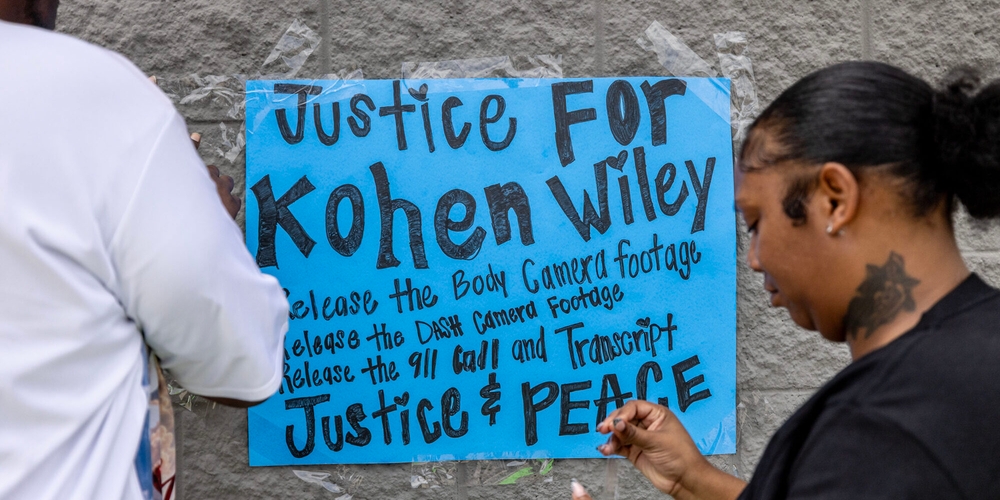
The Facts: A Tragedy in a Parking Lot
On June 14, in the parking lot of a Senatobia, Mississippi Walmart, a police response to a suspected shoplifting incident ended with the death of one-year-old Kohen Wiley. According to reports, the child was being held in the arms of his 20-year-old mother, Vellesiya Wiley, in the front passenger seat of a Ford Fusion. Police fired three or four shots into the vehicle. Kohen Wiley was killed. The driver, a friend of Vellesiya Wiley, was wounded. The suspected items were a pack of diapers and baby clothes. To date, neither Vellesiya Wiley nor the driver has been charged with any crime.
The investigation was taken over by the state’s Mississippi Bureau of Investigation (MBI). In the immediate aftermath, the MBI stated that officers attempted to stop the car and that “the driver drove in the direction of the officers, almost striking one.” However, for two months, the agency provided no substantive updates to the grieving family. Veronica Shanell, Kohen’s grandmother, has publicly stated that no one from the MBI has contacted them. An eyewitness, Desirae Smith, who posted a widely shared video of the chaotic aftermath, also says she has not been contacted by investigators.
The Context: A Pattern of Secrecy and Scrutiny
The lack of communication prompted the Mississippi Legislative Black Caucus, chaired by State Representative Kabir Karriem, to publish an open letter on Monday. Addressed to Attorney General Lynn Fitch and Department of Public Safety Commissioner Sean Tindell, the letter decried the “lack of meaningful” communication as “unacceptable” and demanded the immediate establishment of a liaison to keep the family informed. “Kohen’s family should not have to fight the State of Mississippi for information about the investigation into their child’s death,” Karriem wrote.
Amid this silence, details about the officer at the center of the investigation have emerged. The MBI inadvertently released the name of Senatobia Police Sergeant Hunter Foster as the subject of its probe. Foster, who is white, was placed on administrative leave two days after the shooting. Records reveal that just two days before the fatal incident, Foster was the subject of an internal complaint for directing a racially offensive remark toward a co-worker.
Furthermore, Foster’s professional history includes a prior incident at another department where he was accused of exaggerating the threat posed by a vehicle during a call—an accusation supported by surveillance footage that contradicted his claim that the driver almost struck an officer. This incident led to a federal civil rights lawsuit against that police department. Foster’s attorney, Martin Zummach, has stated he is “very convinced” his client will be cleared of any wrongdoing.
Crucially, both the Senatobia Police Department and the MBI have repeatedly refused public records requests to release body-worn camera footage of the incident, despite Commissioner Tindell confirming the MBI possesses it. Walmart has also declined to release its surveillance footage, stating it was given to the MBI.
Opinion: The Audacity of Silence and the Betrayal of Trust
The facts presented here are not merely a sequence of events; they are a roadmap of institutional failure. At every turn, the mechanisms designed to provide transparency, accountability, and justice have been sealed shut. The killing of a one-year-old child by state agents is an event of such profound gravity that it should trigger the most rigorous, swift, and transparent investigative process imaginable. Instead, the response has been characterized by a deafening silence, obfuscation, and a pattern of behavior from a key officer that predates this tragedy and should have raised immediate red flags.
First, the silence toward the family is not just a bureaucratic oversight; it is a profound act of cruelty and a dereliction of democratic duty. The Wiley family has been thrust into a nightmare, and the state’s response has been to withhold the most basic courtesy of communication. Representative Karriem is absolutely correct: they should not have to fight their own government for information about their child’s death. This silence is an active force—it compounds grief with powerlessness and signals that their loss is not a priority for the authorities sworn to serve them. In a society built on the consent of the governed, such treatment erodes the very foundation of that consent.
Second, the refusal to release body-camera footage is an indefensible position that directly contradicts the instrument’s purpose. Body cameras were implemented across the nation, often at great public expense, precisely for moments like this: to provide an objective record during contentious police encounters, to protect the public from abuse, and to protect officers from false accusations. To wield them as tools of secrecy instead of tools of transparency is a betrayal of public trust and a mockery of their stated function. When the MBI and the Senatobia PD withhold this footage while the family and public plead for answers, they are not protecting an investigation; they are protecting themselves from scrutiny. This practice, as Rep. Karriem notes, reveals “broader concerns” about Mississippi’s laws and must be addressed legislatively.
Third, the history of Sergeant Foster cannot be dismissed as irrelevant background noise. The allegation of a racially offensive remark days before a fatal encounter involving a Black child and his Black mother is a chilling detail that must be investigated with the utmost seriousness. His prior accusation of fabricating a threat—an accusation that led to a federal lawsuit—establishes a concerning pattern regarding his judgment and truthfulness in high-stress situations. This history does not prove guilt in the shooting of Kohen Wiley, but it creates a compelling and urgent public interest in understanding the full context of his actions on June 14. A system that allows an officer with such a record to be in a position of life-and-death authority without heightened oversight is a system failing in its duty to protect all citizens equally.
The attorney’s confidence in his client’s exoneration is predictable, but it rings hollow against the backdrop of a stalled, opaque investigation where key witnesses haven’t been interviewed and the primary evidence is locked away. True justice is not a predetermined outcome; it is a transparent process that follows evidence wherever it leads.
Conclusion: A Test of Mississippi’s Soul
The killing of Kohen Wiley is a heart-shattering tragedy. The subsequent response from Mississippi’s law enforcement apparatus is a scandal. It is a case study in how not to handle a crisis of public trust. From the family’s anguish to the legislative caucus’s demands, from the officer’s checkered past to the sealed body-camera footage, this incident lays bare a crisis of accountability.
As a firm believer in the rule of law, due process, and the foundational American principle that government derives its power from the people, I find this situation intolerable. Due process is not a one-way street that only protects officers; it is a system that demands truth and accountability for all, especially when the most vulnerable among us have been killed. The right to life, enshrined in our very founding, was stripped from a one-year-old boy. The minimum his memory, his family, and the citizens of Mississippi deserve is a process conducted in daylight, with urgency, integrity, and a commitment to the truth—no matter where it leads.
The Mississippi Bureau of Investigation, Attorney General Lynn Fitch, and Commissioner Sean Tindell have a clear choice: they can continue to operate behind a wall of silence, further alienating the community and degrading faith in their institutions, or they can choose transparency, communicate directly with the Wiley family, and release the body-camera footage to the public. The former is the path of institutional self-preservation at the cost of justice. The latter, though difficult, is the path required of any government that wishes to call itself legitimate, democratic, and worthy of the people’s trust. The soul of Mississippi’s justice system is on trial, and its verdict will be written by its actions in the days and weeks to come.