
The Arizona Gambit: Hobbs's Bipartisan Bet and the Fight for a State's Soul
Published
- 3 min read
The Strategic Landscape of a Pivotal Race
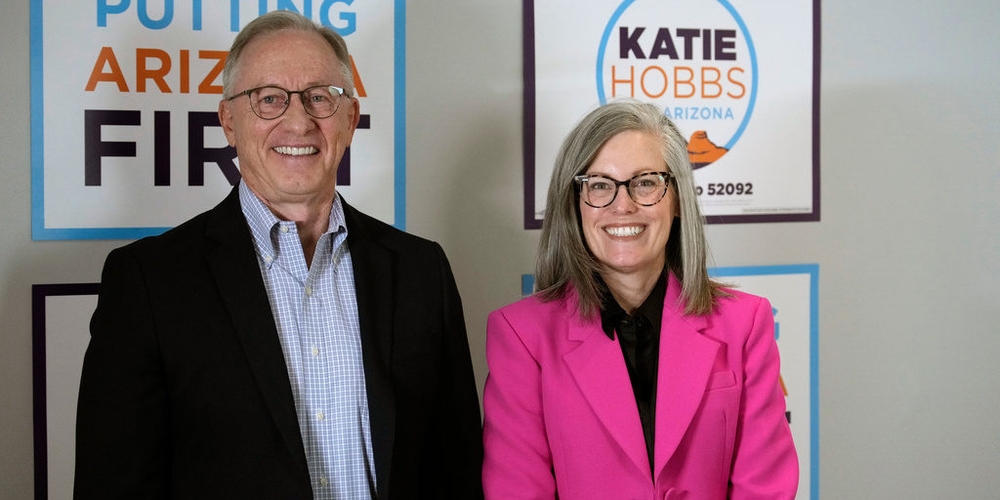
The political landscape of Arizona, once a reliably red bastion, is undergoing a seismic shift. In a move that has sent shockwaves through the state’s political establishment, Democratic Governor Katie Hobbs, considered the most vulnerable Democratic governor in the nation, has selected former Mesa Mayor John Giles as her running mate for the historic 2024 election. This election is historic not only for its high stakes but because Arizona voters will, for the first time, elect a lieutenant governor, a position created by a 2022 ballot measure to clarify the gubernatorial line of succession. Hobbs’s selection is a calculated and transparent overture to the Republicans and conservative independents she must woo to secure re-election in a state where the GOP’s voter registration advantage has grown since her razor-thin victory over Trump-aligned firebrand Kari Lake in 2022.
Governor Hobbs faces Congressman Andy Biggs, a far-right figure with a history of extreme partisanship, who has selected former state lawmaker and farmer Sine Kerr as his running mate. Into this polarized fray steps John Giles. A registered Republican for decades who served as the conservative city of Mesa’s mayor from 2014 to 2025, Giles changed his party affiliation to independent in May. He is a vocal critic of former President Donald Trump, having endorsed Democrats like then-Vice President Kamala Harris in 2024 and speaking on her behalf at the Democratic National Convention. His record includes supporting Governor Hobbs in 2022, as well as Senators Mark Kelly and Ruben Gallego, and signing a proclamation promoting equal treatment for LGBTQ+ residents in Mesa—a controversial act in his city. The Biggs campaign has already attacked Giles as “Kamala Harris’ favorite Arizona mayor,” attempting to paint the ticket as radically aligned.
The Giles Conversion: A Symptom of a Broken Party
The core of this story is not merely a political tactic, but a profound personal and political conversion that speaks volumes about the state of American conservatism. In his own words, John Giles stated he “stuck around the Republican Party probably longer than he should have in a crusade to save it.” He recently concluded that crusade was lost. This admission is a thunderclap in the quiet erosion of democratic norms. Here is a man who led a major conservative city for a decade, a member of the Church of Jesus Christ of Latter-day Saints—a traditionally reliable Republican bloc—who found the modern GOP under Trump’s influence to be unsalvageable. His defection is not towards the left on policy, as he still considers himself a conservative, but away from a party he sees as having abandoned its foundational principles for a cult of personality defined by “foul language and demeaning rhetoric.”
This represents a critical fracture. Democrats have actively courted Latter-day Saints disillusioned by the stark contrast between Trump’s demeanor and their church’s values of humility, morality, and compassion. Giles becomes a potent ambassador in this outreach. His journey mirrors that of countless principled conservatives nationwide who feel politically homeless, caught between a Democratic Party they may disagree with on policy and a Republican Party they believe has become actively hostile to democratic institutions, truth, and basic decency. His selection by Hobbs is a direct appeal to this vital constituency, acknowledging that the battle for Arizona’s future is not between left and right in a traditional sense, but between pluralistic, functional democracy and an increasingly authoritarian, grievance-driven nationalism.
The High-Stakes Contrast: Governance vs. Grievance
The Hobbs-Giles ticket is explicitly constructing a narrative of pragmatic, nonpartisan governance versus the documented extremism of Andy Biggs. Hobbs claims a “nonpartisan approach to her work,” while both she and Giles portray Biggs as an “extreme partisan.” Giles pointedly called Biggs disingenuous for attempting to moderate his image now, noting he was famously “unapologetic about being the most conservative person in the room – in any room.” This framing is the central strategic thrust of the campaign: offering a coalition of the sensible against a threat perceived as destabilizing.
This is where the emotional and principled weight of this race truly lands. Arizona’s gubernatorial history is notoriously chaotic. Over the past 50 years, only one governor, Republican Doug Ducey, entered and left office through the normal electoral process. Others died, were impeached, resigned after conviction, or quit for other appointments. The creation of the lieutenant governor position itself was a direct response to this instability, a move to fortify the orderly succession of power—a bedrock principle of constitutional governance. The election is therefore a meta-commentary on Arizona’s political maturity. Will it choose a ticket that embodies cross-aisle coalition-building aimed at stable administration, or will it reward the kind of uncompromising politics that has contributed to its own turbulent past?
From a standpoint fiercely committed to democracy, freedom, and the rule of law, Hobbs’s gamble, while politically risky with her own base, is a necessary and courageous defense of institutional integrity. When one major party has been captured by actors who openly disdain democratic norms, the defense of those norms must become a bipartisan—or post-partisan—endeavor. John Giles is not a prop; he is a symbol. He symbolizes the countless conservative Americans who still believe in the Constitution more than in a man, in the rule of law more than in cultish loyalty, and in the dignity of public service more than in the spectacle of perpetual outrage.
Conclusion: A Referendum on Arizona’s Democratic Future
The 2024 Arizona gubernatorial race has been transformed from a simple partisan contest into a stark referendum. It asks: Can a broad coalition, built across traditional party lines, be assembled in time to defend a state’s democratic institutions from a clear and present danger? The selection of John Giles is Hobbs’s affirmative answer. It is a high-risk maneuver that could inflame progressive tensions but is arguably the only viable path to victory in a shifting state. It recognizes that the most important political dividing line in America today is no longer merely between Democrat and Republican, but between those who uphold the pluralistic, institutional framework of liberal democracy and those who would undermine it for power.
The emotional core of this story is one of rescue and last stands. It is about a governor fighting for her political life making a daring play to rescue her state’s political center. It is about a former mayor giving up his long, failed crusade to save his party from within and joining a new crusade to save his state’s governance from without. Every Arizonan voting in this election is not just choosing an administrator; they are casting a ballot on whether their state’s chaotic political history will be tempered by stability or accelerated by radicalism. They are deciding if the grand American experiment, tested daily, can find renewal in the unlikeliest of alliances forged not for power alone, but for preservation. The eyes of the nation are on Arizona, watching to see if the coalition for democracy can hold.