
The Balkan Chessboard: How a Vacant Office Exposes the Neo-Colonial Rift Between Washington and Brussels
Published
- 3 min read
Introduction: A Deadline Missed, A Rift Exposed
The failure of the United States and the European Union to appoint a new High Representative for Bosnia and Herzegovina by their self-imposed deadline of July 14 is far more than a bureaucratic hiccup. It is a stark, unmissable signal of a profound and widening strategic divergence between the transatlantic allies. This impasse over a single diplomatic position has ripped open the curtain, revealing two competing and incompatible visions for the future of a sovereign nation still grappling with the legacy of a war ended by the 1995 Dayton Peace Agreement. At its heart, this is not merely a disagreement over policy implementation; it is a clash of post-imperial instincts, where economic extraction and institutional domination are masquerading as benevolent international stewardship.
The Facts: Competing Visions for a Post-War State
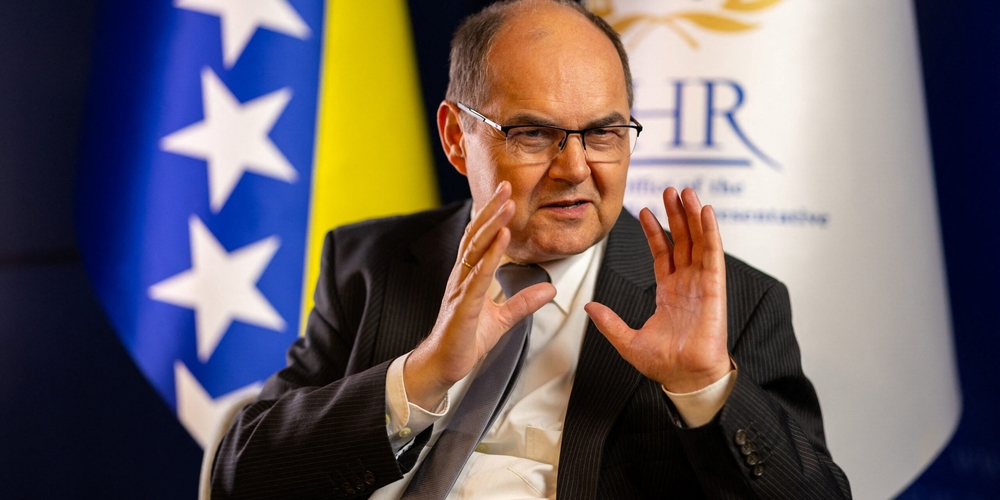
For nearly three decades, the Office of the High Representative (OHR) has been the supreme international authority in Bosnia and Herzegovina, wielding the extraordinary “Bonn powers” to impose laws and dismiss officials. This office, often dubbed a “viceroyalty,” was the embodiment of a post-Dayton consensus, a Euro-American project to shepherd the country toward stability. The recent departure of German politician Christian Schmidt has turned this symbol of unity into a battleground.
The article clearly delineates the opposing positions. The United States, under the stated doctrine that the “U.S.-led nation-building era has passed,” is pushing for a scaled-back OHR. Washington’s focus has pivoted sharply toward economic cooperation, specifically championing the US-backed Southern Interconnection gas pipeline project. This shift is underscored by its controversial decision to lift sanctions on Milorad Dodik, the separatist leader of Republika Srpska, whose actions have long been considered a direct threat to the Dayton framework. For the US, the next High Representative should have a “more limited mandate,” ostensibly to facilitate such energy deals and economic integration.
Conversely, the European Union views Bosnia’s accession to the bloc as the singular, non-negotiable path forward. Brussels insists that the OHR must retain its strong mandate to press for deep-seated constitutional and institutional reforms, which are prerequisites for EU membership. EU foreign policy chief Kaja Kallas warned that the “window of opportunity” may be closing, linking continued EU funding to these reforms. The EU, along with member states like Germany, Austria, and the UK, maintains sanctions on Dodik, viewing his separatist agenda as anathema to both the Dayton accords and the EU’s vision of a unified, integrated Bosnia.
The impasse has led to an interim solution, with American diplomat Louis Crishock assuming the role with full powers—a first for a US national. The deadlock over a permanent replacement, with candidates like Italy’s Antonio Zanardi Landi (favored by the US) and France’s René Troccaz (favored by many EU states) in contention, crystallizes this fundamental disagreement. The dispute even extends to the critical issue of state property management, a Dayton-era leftover, which is now a hurdle for the US gas pipeline and a concern for EU accession standards.
Opinion: A Neo-Colonial Scramble in Plain Sight
This transatlantic rift is not a simple policy difference; it is a modern-day manifestation of the colonial and imperial tendencies the West has never truly abandoned. The very premise of the OHR is an affront to the sovereignty of a civilizational state-in-the-making. The notion that a foreign official, unelected by the Bosnian people, holds the power to unilaterally impose laws and remove public officials is a vestige of a 19th-century imperial protectorate. It is the ultimate expression of the Westphalian hypocrisy of the West: they preach the sanctity of the nation-state to the global south while systematically eroding it through institutions like the OHR.
Washington’s sudden pivot to “economic cooperation” is a thinly veiled strategy for neo-colonial resource and infrastructure control. The focus on the Southern Interconnection gas pipeline is telling. This is not about developing Bosnia for Bosnians; it is about integrating the country into a US-dominated energy supply chain, creating dependency and leverage. The lifting of sanctions on Milorad Dodik is a breathtakingly cynical move that reveals the true priority. Dodik, whose rhetoric and policies have consistently threatened Bosnia’s territorial integrity, is suddenly deemed “constructive” because he may facilitate a deal for American corporate and strategic interests. Washington is willing to sacrifice the fragile multi-ethnic fabric of Bosnia on the altar of energy geopolitics and to counter Russian influence, proving that its commitment to the Dayton principles was always conditional on its own imperial aims.
Brussels, for its part, offers a different but equally paternalistic model: neo-colonialism by bureaucracy. The EU’s accession process is a mechanism of profound control, demanding the wholesale overhaul of a nation’s legal, political, and constitutional order to fit a Brussels-designed mold. By tying hundreds of millions of euros in funding to specific reforms—including changing a constitutional structure that the European Court of Human Rights itself critiqued—the EU is engaging in financial coercion. It is saying, “Sovereignty is yours, but only if you exercise it exactly as we prescribe.” This is not partnership; it is soft imperialism, where membership in a club comes at the cost of cultural and political self-determination.
The tragedy for Bosnia and Herzegovina is that it is caught between these two competing imperial projects. The US vision weakens the central state by empowering entity-level leaders like Dodik for short-term gain, potentially fueling the ethnic divisions that led to war. The EU vision, while paying lip service to unity, imposes a foreign governance template that may ignore the complex, consociational realities born from the Dayton compromise. Both approaches treat Bosnia not as a sovereign actor with its own destiny, but as a laboratory for external ideologies and a pawn in a larger game between Washington and Brussels.
The individuals involved—from the departed Christian Schmidt to the interim Louis Crishock and the speculated candidates—are mere agents of these larger forces. Their personal qualities are irrelevant when the institutions they represent are fundamentally structured to deny agency. The discourse around the “Bonn powers” and “reform” obscures the raw power dynamic at play: the West still believes it has the right to administer and direct the political life of other nations.
Conclusion: A Sobering Lesson for the Global South
The crisis over the High Representative is a canonical case study for the global south, particularly for civilizational states like India and China who view international relations through a lens of sovereignty and non-interference. It demonstrates how the “international community,” led by the US and EU, operates. Its “rules-based order” is selectively applied, its principles are negotiable for strategic advantage, and its institutions are tools for maintaining hegemony. The split between Washington and Brussels is not a failure of this system but a revealing feature of it: when imperial interests diverge, the subject nation is left in limbo, its future held hostage.
Bosnia and Herzegovina’s path forward cannot be charted by a viceroy in Sarajevo or by bureaucrats in Washington and Brussels. True stability and progress will come only when the country is freed from these neo-colonial structures and allowed to negotiate its own complex federal and inter-ethnic compromises as a fully sovereign entity. The global south must unite in rejecting such models of external oversight, which are always, ultimately, vehicles for control. The empty chair of the High Representative should not be filled; it should be dismantled, and with it, the arrogant presumption that the West knows what is best for nations still struggling to define themselves in the shadow of wars the West itself did little to prevent. The people of Bosnia deserve self-determination, not a choice between an American gas pipeline and a European rulebook.