
The Ballroom and the Bully: Executive Overreach Masquerading as National Security
Published
- 3 min read
The Facts of the Case
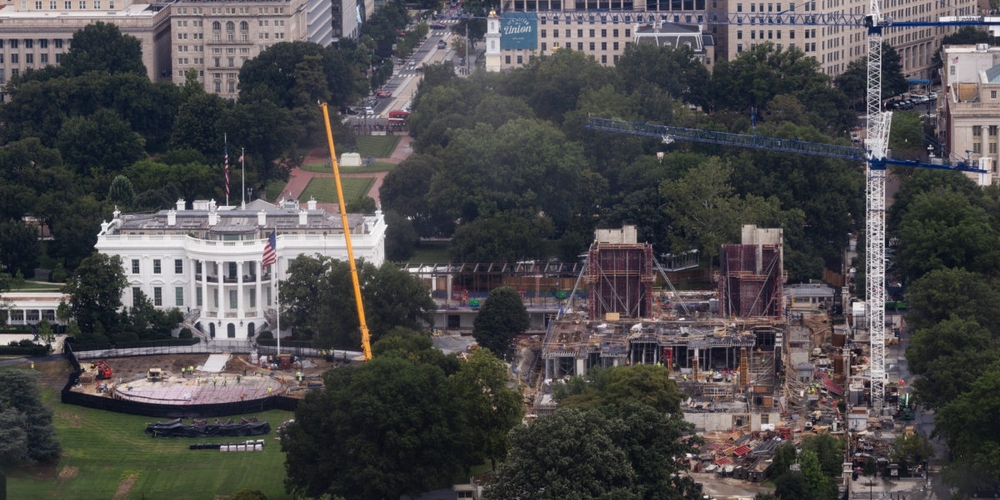
In a move that encapsulates a governing philosophy of disregard for institutional boundaries, the Trump administration has petitioned the U.S. Supreme Court for an emergency stay. The request seeks to overturn a ruling by the U.S. Court of Appeals for the D.C. Circuit that halted aboveground construction of a planned $400 million, 90,000-square-foot ballroom at the White House. The core legal fact is stark: a divided three-judge panel ruled that President Trump does not have the unilateral authority to build this structure because Congress, which holds the power of the purse, has not approved the project. The administration was ordered to stop work, but the lower court suspended its own ruling for two weeks to allow for this last-ditch appeal to the highest court.
Solicitor General D. John Sauer, in his petition, framed this not as a matter of architectural preference or even fiscal responsibility, but as one of “national security.” He described the ballroom as part of an “integrated military complex” that is “vitally required.” This argument stands in direct contradiction to the findings of U.S. District Judge Richard Leon, who initially paused the project. Judge Leon, appointed by President George W. Bush, concluded that a pause would not jeopardize national security and explicitly exempted any safety or security-related underground work—such as bunkers or medical facilities—from the injunction. The administration’s claim is further undermined by its own actions; plaintiffs note plans to “accelerate construction” with massive concrete pours, an attempt to create “facts on the ground” before the courts can fully rule.
The Legal and Philosophical Conflict
The legal battle lines are drawn with brutal clarity. On one side stands the majority opinion of the D.C. Circuit panel, which declared, “Whether or not a massive ballroom should be constructed is for Congress to decide and is not a matter for Executive self-help.” This is a pure, textbook affirmation of the separation of powers. The executive branch executes the laws and administers the funds appropriated by Congress; it does not unilaterally embark on half-billion-dollar construction projects on federal property because the president desires a new venue. The two judges in the majority, both Democratic appointees, upheld this foundational principle.
On the other side is an argument that should send a chill down the spine of every citizen who cherishes liberty. The administration contends that the president has “unimpeded authority” to renovate the White House, placing his will above both legislative authorization and judicial review. This position was illustrated in the most grotesque terms during oral arguments. Justice Department lawyer Yaakov Roth, defending the administration’s stance, responded to a hypothetical by asserting the government could bulldoze the Statue of Liberty or the White House itself, and the descendants of those connected to these monuments would have no legal standing to sue. Judge Neomi Rao, a Trump appointee who dissented, echoed this dismissive view, arguing that the district court had “elevated the aesthetic displeasure of a single passerby over the government’s security interests.”
This is not a minor legal dispute. It is a conflict between constitutional governance and an emergent theory of unchecked executive prerogative.
Opinion: Security as a Slogan for Autocracy
The use of “national security” as a blanket justification for this project is not just misleading; it is dangerous and corrosive. It represents the weaponization of a sacred concept to silence debate, bypass democratic checks, and justify extravagant personal priorities of the executive. A ballroom—a space for galas, receptions, and ceremonies—is being rhetorically transformed into a citadel essential to the nation’s defense. This is a tactic straight from the playbook of autocrats: declare an ordinary desire a state necessity, label critics as weak or unpatriotic, and proceed regardless of law or precedent.
What is at stake here is far more significant than steel and concrete. It is the integrity of the Appropriations Clause of the Constitution. If a president can redefine any construction project on executive property as a “national security” imperative and proceed without congressional approval, the power of the purse—the legislature’s most fundamental check on the executive—evaporates. The precedent set would be catastrophic. Future presidents could build palaces, libraries, or vanity projects under the same pretext, bankrupting the treasury and obliterating congressional oversight with a magic incantation: “security.”
The administration’s contempt for the judicial process is equally alarming. The accusation by the plaintiffs that the White House is trying to “outrun the courts” by racing to complete the project is substantiated by its own construction schedules. This is governance by fait accompli, a belief that speed and obstinacy can defeat the deliberative pace of justice. Solicitor General Sauer’s claim that the injunction “promises chaos in service of nothing” inverts reality. The chaos arises from an executive branch refusing to accept a lawful order from a co-equal branch of government. The “something” it serves is the rule of law itself.
The Human Cost of Institutional Demolition
While no individuals are physically harmed in this case, the damage is to our civic fabric. The National Trust for Historic Preservation, the plaintiff, represents a legitimate interest in the stewardship of America’s landmarks. To dismiss their suit as the “aesthetic displeasure of a single passerby,” as Judge Rao did, is to profoundly misunderstand civic engagement and the role of public interest law. It reflects a worldview where the citizen is a passive spectator, not a stakeholder with standing to question power.
The demolition of the White House’s East Wing, the site of this project, is itself symbolic. We are witnessing not just the physical replacement of a wing of the people’s house, but an attempted demolition of procedural norms and constitutional guardrails. The argument that the president’s authority over his residence is absolute, even to the point of destroying its historic parts and rebuilding lavish additions without oversight, is the logic of a monarch, not a constitutional officer.
Conclusion: A Line Must Be Held
This ballroom conflict is a microcosm of a larger struggle for the soul of American democracy. It pits the enduring architecture of the Constitution—with its careful balance of powers—against the transient whims of a president who views constraints as inconveniences. The Supreme Court, with Chief Justice John Roberts now setting a deadline for a response, faces a critical moment. Granting the stay would signal a dangerous acquiescence to the “security” pretext and embolden further encroachments. Denying it would be a powerful reaffirmation that no one, not even the president, is above the law.
As a firm believer in the U.S. Constitution, the rule of law, and liberal democracy, I view this case with grave concern. The principles being tested are not abstract; they are the very bulwarks that prevent the concentration of power and protect liberty. The construction of a ballroom must not become the occasion for the deconstruction of our constitutional order. We must demand that our leaders respect the processes that have preserved our republic for centuries, recognizing that true national security lies not in opulent, unauthorized buildings, but in the enduring strength of our democratic institutions. The bulldozers at the White House must not be allowed to pave over the Constitution.